Lemon Pound Cake with Lemon Cream Cheese Frosting
Lemon Pound Cake with Lemon Cream Cheese Frosting is the loaf I reach for when I want a bright, comforting dessert that still feels homey.
I remember the first time I paired a dense, buttery cake with a tangy, creamy frosting and how the combination changed my idea of a simple cake forever. I baked this exact loaf for a small spring gathering, and the kitchen filled with the scent of warm butter and zesty lemon zest, while guests chatted around the counter. One friend closed her eyes after the first bite and said it tasted like a sunny afternoon in a cup, which stuck with me. Another time I brought a slice to a neighbor who had just moved in, and it broke the ice like nothing else.
Over the years I refined the balance between the cake and the frosting so the crumb never feels dry and the topping remains lush and not overly sweet. I learned to trust tactile cues, like when the batter looks glossy and just heavy enough to pour slowly into the pan, and when the frosting feels silkier than sticky. You will find those nuances here, since I wrote this recipe after dozens of iterations. Sharing this loaf has become my way of celebrating small moments, from weekend brunches to casual weekday treats. If you love citrus backed by a rich, creamy finish, this cake will feel like a new staple in your baking rotation.
Recipe Snapshot
1 hr 30 mins
30 mins
60 mins
Medium
350 kcal
American
Gluten-Free, Low FODMAP
Desserts
Oven, 9 x 5 inch loaf pan, Stand mixer or electric handheld mixer, Mixing bowls, Rubber spatula, Small saucepan, Cooling rack
Why This Lemon Pound Cake with Lemon Cream Cheese Frosting Is So Good
Bright, Balanced Flavor
I love how Lemon Pound Cake with Lemon Cream Cheese Frosting manages to be both bold and restrained. The combination of lemon zest and lemon juice cuts through the richness of the butter and cream cheese, creating a bright, layered flavor profile that keeps every bite interesting. You get a zesty top note, and a buttery, tender crumb underneath.
Reliable Texture Every Time
When I bake this loaf, I know it will have a dense, tender crumb that slices cleanly. The use of cake flour and careful mixing keeps the texture fine and delicate, while the additional egg yolks add extra richness. This is one of those recipes that rewards patience, and I appreciate how consistent it turns out.
Versatile for Occasions
We’ve served this cake at a casual coffee morning, and I’ve also packed it for a potluck, and it shines in both settings. It travels well when wrapped, and the frosting holds up if the cake is kept chilled. That flexibility makes it a favorite when I need something impressive but not fussy.
Simple Ingredients, Big Impact
Part of why I keep coming back to this loaf is that it relies on familiar pantry items like granulated sugar and eggs, but uses them in ways that elevate the result. Small choices, like using very soft but not melted cream cheese in the frosting, make a huge difference in texture and flavor, and I’ll show you those tweaks in the steps below.
Trustworthy Technique
I’ve included clear cues so you’ll know when each stage is right, from the glossy batter to the golden brown top. I enjoy teaching readers how to read their ingredients and oven cues, because once you learn them, you bake with more confidence. This loaf is forgiving, and with a few pointers, you’ll feel comfortable making it again and again.
Essential Ingredients for Lemon Pound Cake with Lemon Cream Cheese Frosting

These ingredients work together to create a loaf that is rich, tender, and bright. The butter and extra egg yolks build a luscious, tight crumb, while the cake flour keeps the texture fine. The pair of sugars balances sweetness with a hint of caramel depth from the light brown sugar. For the frosting, the contrast of full fat cream cheese and sifted confectioners' sugar yields a silky, tangy finish that complements the citrus notes perfectly.
- 1 cup (8 ounces) unsalted butter: Creamy and unsalted, provides rich fat and structure to the cake batter while promoting tenderness and even browning during baking.
- 1 cup (7 ounces) granulated sugar: Granulated and sweet, creates bulk sweetness, aids in aeration when creamed with butter, and helps achieve a fine crumb texture.
- 1/4 cup (1 and 3/4 ounces) light brown sugar, packed: Moist and slightly caramel-flavored, contributes subtle molasses notes and additional sweetness while keeping the cake tender and flavorful.
- 1 teaspoon pure vanilla extract: Fragrant and sweet, adds depth and rounded vanilla aroma that enhances the overall flavor profile without overpowering the citrus notes.
- 1 teaspoon pure lemon extract: Bright and concentrated, supplies intense lemon aroma that amplifies the citrus character and balances the vanilla for a lively finish.
- 2 tablespoons lemon zest: Zesty and aromatic, imparts fresh citrus oils for bright flavor and tiny flavorful flecks that enhance the cake’s lemon identity.
- 1 tablespoon lemon juice: Freshly squeezed, adds tangy acidity to brighten flavors, balance sweetness, and provide subtle moisture to the batter.
- 4 large eggs plus 2 egg yolks: Rich and binding, eggs and extra yolks contribute structure, moisture, and emulsification for a dense, tender pound cake crumb.
- 1 and 3/4 cups (7 ounces) cake flour: Fine and low-protein, cake flour yields a delicate soft crumb with minimal gluten development for a tender pound cake texture.
- 1/2 teaspoon salt: Salty and balancing, enhances sweetness, amplifies flavors, and helps control dough chemistry for better overall taste.
- 1 teaspoon baking powder: Leavening and lightening, releases gas to give modest rise and lift to the dense pound cake batter for proper crumb height.
- (1) 8 ounce block full-fat cream cheese, VERY soft but not melted: Soft and full-fat, cream cheese gives the frosting tang, creaminess, and stability while adding rich, slightly tart flavor.
- 1/4 cup (2 ounces) unsalted butter, VERY soft but not melted: Soft and creamy, unsalted butter contributes smoothness, spreadability, and enriched mouthfeel to the cream cheese frosting.
- 1/4 teaspoon pure lemon extract: Subtle and citrusy, adds a delicate lemon note to the frosting that complements the cake’s lemon elements without bitterness.
- 2 cups (8 ounces) confectioners' sugar, sifted (more if needed): Fine and sweet, sifted confectioners' sugar provides sweetness and structure to the frosting while ensuring a silky, lump-free texture.
Step by Step Guide for Lemon Pound Cake with Lemon Cream Cheese Frosting

Baking this loaf is about rhythm and sensory cues. I walk you through each stage from warming the butter to the final frosting, focusing on how the batter should look and feel. Follow the cues and you will end up with a golden, fragrant cake and a silky frosting.
- Adjust an oven rack to middle position, then preheat oven to 375 degrees (F). Spray a 9 x 5 inch loaf pan with non-stick baking spray; set aside.: The air in the oven should feel steadily warm as it reaches 375 degrees F , and you will notice a faint mineral scent as the heating elements engage. Preheating ensures the batter hits a consistent environment, so the loaf rises evenly and forms a proper crust. If the oven is not fully preheated before the pan goes in, the cake may bake unevenly, causing a dome that cracks harshly. A good check is to let the oven reach temperature and then insert the pan; you should hear no dramatic temperature shift. Use the middle rack to allow even circulation and browning.
- Melt the butter in a small saucepan over medium heat. Pour melted butter into a large bowl, then whisk in both sugars. Add in vanilla extract, lemon extract, lemon zest, and lemon juice and beat well. Add in the eggs and yolks, one at a time, beating well after each addition.: At this stage you will feel the warmth from the melted butter and smell its nutty aroma as it cools slightly. Whisking in both granulated sugar and light brown sugar dissolves the crystals and creates a glossy base, while the volatile oils from the lemon zest release a fragrant citrus perfume. Adding the eggs one at a time builds a stable emulsion, which traps air and contributes to a tender rise. If you whisk too aggressively, the mixture may look frothy, which is okay, but be careful not to overmix once flour is added. A common mistake is adding all the eggs at once, which can break the emulsion; add them slowly to maintain a cohesive batter.
- In a separate medium-sized bowl combine the cake flour, salt, and baking powder. Add dry ingredients to wet ingredients and gently whisk together until just combined.: When you sift or whisk the cake flour with salt and baking powder , you are lightening the dry mix so it blends evenly. As you fold the dry into the wet, aim for a ribbon like stream that slowly disappears; the batter should be glossy and slightly thick, not overworked. The gentle motion protects the delicate crumb by minimizing gluten development, which keeps the loaf tender. If you keep stirring until every streak is gone, you risk a tougher texture. A telltale sign of overmixing is a batter that becomes elastic and pulls away in strings.
- Pour batter into prepared pan and smooth the top with a rubber spatula. Bake for 20 minutes, then reduce oven temperature to 325 degrees and continue baking for about 40 minutes, or until the top is golden brown and a cake tester inserted in the center comes out clean. Cool cake in the pan for 15 minutes before transferring it to a cooling rack to cool completely (about 1 hour).: As you transfer the batter into the greased 9 x 5 inch pan, the surface should be glossy and slowly settle when smoothed. During the first 20 minutes at 375 degrees F the cake gains initial oven spring; you will hear faint crackling and see the edges pulling slightly from the pan. After lowering to 325 degrees F , the loaf continues to bake through more gently, developing an even golden brown top. The center should no longer jiggle and a cake tester should come out clean, indicating the crumb set. Allowing the cake to rest in the pan for 15 minutes helps it firm up for a clean release, while the full hour on a rack ensures it is completely cooled before frosting. A common trap is frosting a warm cake, which melts the frosting and yields a soggy finish; always wait until the loaf is room temperature.
- In the bowl of a stand-mixer fitted with the paddle attachment, or in a large bowl using an electric handheld mixer, beat the cream cheese, butter, and lemon extract on medium-high speed until completely smooth; about 2 minutes. Reduce the speed to low and gradually add the sifted confectioners' sugar. Once all of the sugar has been added beat on high-speed for 1-2 minutes. If the frosting appears too thin, add a little more confectioners' sugar, 1/4 cup at a time. Once the cake has completely cooled, spread the frosting over the top of cake and decorate with lemon slices, if desired. Slice and serve! Store this cake in the fridge, covered, for up to 3 days.: When you begin, the bowl will emit a cool creamy scent from the softened cream cheese and butter , and after about two minutes the mixture should look pillowy and uniform, with no lumps. Smoothness is critical because lumps in the frosting will affect spreadability and mouthfeel. Keep beaters scraping the sides so everything becomes evenly aerated. A frequent issue is using cold cream cheese which leaves curdled lumps; ensure both ingredients are very soft but not melted.
- Reduce the speed to low and gradually add the sifted confectioners' sugar. Once all of the sugar has been added beat on high-speed for 1-2 minutes: Adding the confectioners' sugar slowly prevents a flour like cloud and ensures a smooth, silky frosting. As the sugar incorporates, the mixture will thicken and become glossier, and the high speed at the end tightens the texture so it spreads cleanly. Taste and adjust sweetness carefully, since too much sugar will mask the lemon notes. If you overbeat for too long, the frosting can become overly aerated and lose structure, so stop once it reaches a silky consistency.
- If the frosting appears too thin, add a little more confectioners' sugar, 1/4 cup at a time: The right frosting should cling to the spatula and slow drip rather than pour. Adding extra confectioners' sugar thickens it without making it gritty, but add sparingly to avoid a cloying finish. If your kitchen is very warm, chilling the frosting briefly can help it firm up. A mistake here is adding liquid to fix thin frosting, which only thins it further.
- Once the cake has completely cooled, spread the frosting over the top of cake and decorate with lemon slices, if desired: The cool loaf should feel room temperature to the touch and the top will be slightly springy. Spreading the frosting slowly with a spatula gives a smooth finish; you may hear a soft dragging sound as the blade glides. Decorate minimally with thin lemon slices if you like a fresh look, but avoid too many wet slices which can weep onto the frosting. Placing thick slices can press into the frosting and make it uneven, so aim for thin, gently arranged slices.
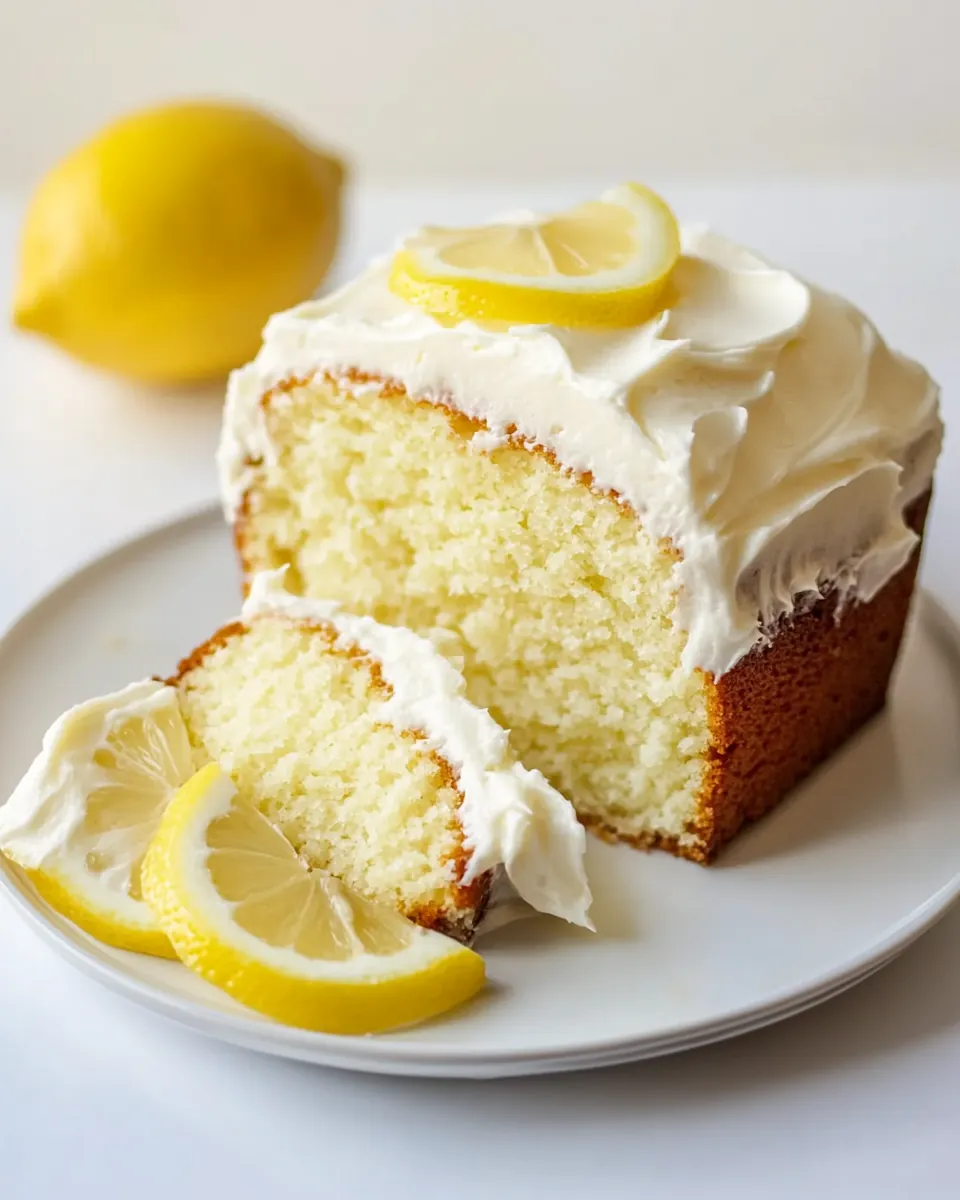
- Slice and serve! Store this cake in the fridge, covered, for up to 3 days: On the plate, the loaf should show a tight, uniform crumb and a silky frosting edge. Chilling helps the frosting set and improves sliceability, and the cake will hold its shape when properly cooled. Keep it covered so it does not absorb fridge odors. A common mistake is leaving the loaf uncovered, which leads to a dried crust over time.
Recipe Variations about Lemon Pound Cake with Lemon Cream Cheese Frosting

This loaf adapts well to small changes while keeping its signature bright flavor. Below are thoughtful variations and serving approaches that keep the texture intact and highlight different aspects of the cake.
- Gently add zest swaps Replace part of the lemon zest with orange zest to create a milder, sweeter citrus profile while keeping the same structural balance in the batter.
- Confectioners’ sugar adjustment If the frosting feels too thin, gradually add more confectioners’ sugar in 1/4 cup increments until you reach a spreadable, satin texture without becoming gritty.
- Chill for cleaner slices After frosting, chill the loaf briefly so the frosting firms slightly, which makes slicing neater and prevents smearing on the knife.
- Use very soft dairy Make sure both the cream cheese and the 1/4 cup butter for the frosting are matched in softness so they combine into a uniform emulsion rather than a curdled mixture.
- Adjust lemon intensity If you prefer a subtler citrus note, reduce the lemon extract by half and lean more on the fresh lemon zest for natural aroma and flavor without the concentrated punch.
Pairing Suggestions for Lemon Pound Cake with Lemon Cream Cheese Frosting
This loaf pairs beautifully with simple accompaniments and suits many occasions. Below are thoughtful serving ideas, storage suggestions, and seasonal pairings to help you present the cake with style.
- Afternoon tea Serve a slice alongside a light black tea or a bright herbal tea, which complements the lemon notes without overpowering the delicate crumb.
- Spring brunch Present the loaf as a centerpiece for a spring brunch, paired with fresh fruit and a simple yogurt dish to highlight the citrus and creamy frosting.
- Casual potluck This loaf travels well when wrapped and kept chilled, making it a reliable choice for community meals or picnics where you want a dessert that stays intact.
- Storage Refrigerate the loaf, covered, for up to three days; bring slices to room temperature before serving to soften the frosting and enhance flavors.
- Seasonal serving In spring, accent the presentation with fresh berries or thin lemon slices to echo the cake's brightness and create an inviting, seasonal platter.
FAQ
Conclusion
This recipe shines because it pairs a dense, buttery loaf with a tangy, silky cream cheese frosting that brightens every bite. Give this Lemon Pound Cake with Lemon Cream Cheese Frosting a try when you want a dessert that feels both comforting and a little celebratory. The balance of textures and flavors makes it ideal for gatherings or quiet afternoons alike, and once you master the cues, you will find yourself returning to this recipe again and again with confidence.
Lemon Pound Cake with Lemon Cream Cheese Frosting
Equipment
- Oven
- 9 x 5-inch loaf pan
- Stand mixer or electric handheld mixer
- Mixing Bowls
- Rubber spatula
- Small Saucepan
- Cooling rack
Ingredients
- 1 cup (8 ounces) unsalted butter Creamy and unsalted, provides rich fat and structure to the cake batter while promoting tenderness and even browning during baking.
- 1 cup (7 ounces) granulated sugar Granulated and sweet, creates bulk sweetness, aids in aeration when creamed with butter, and helps achieve a fine crumb texture.
- 1/4 cup (1 and 3/4 ounces) light brown sugar, packed Moist and slightly caramel-flavored, contributes subtle molasses notes and additional sweetness while keeping the cake tender and flavorful.
- 1 teaspoon pure vanilla extract Fragrant and sweet, adds depth and rounded vanilla aroma that enhances the overall flavor profile without overpowering the citrus notes.
- 1 teaspoon pure lemon extract Bright and concentrated, supplies intense lemon aroma that amplifies the citrus character and balances the vanilla for a lively finish.
- 2 tablespoons lemon zest Zesty and aromatic, imparts fresh citrus oils for bright flavor and tiny flavorful flecks that enhance the cake’s lemon identity.
- 1 tablespoon lemon juice Freshly squeezed, adds tangy acidity to brighten flavors, balance sweetness, and provide subtle moisture to the batter.
- 4 large eggs plus 2 egg yolks Rich and binding, eggs and extra yolks contribute structure, moisture, and emulsification for a dense, tender pound cake crumb.
- 1 and 3/4 cups (7 ounces) cake flour Fine and low-protein, cake flour yields a delicate soft crumb with minimal gluten development for a tender pound cake texture.
- 1/2 teaspoon salt Salty and balancing, enhances sweetness, amplifies flavors, and helps control dough chemistry for better overall taste.
- 1 teaspoon baking powder Leavening and lightening, releases gas to give modest rise and lift to the dense pound cake batter for proper crumb height.
- (1) 8 ounce block full-fat cream cheese, VERY soft but not melted Soft and full-fat, cream cheese gives the frosting tang, creaminess, and stability while adding rich, slightly tart flavor.
- 1/4 cup (2 ounces) unsalted butter, VERY soft but not melted Soft and creamy, unsalted butter contributes smoothness, spreadability, and enriched mouthfeel to the cream cheese frosting.
- 1/4 teaspoon pure lemon extract Subtle and citrusy, adds a delicate lemon note to the frosting that complements the cake’s lemon elements without bitterness.
- 2 cups (8 ounces) confectioners' sugar, sifted (more if needed) Fine and sweet, sifted confectioners' sugar provides sweetness and structure to the frosting while ensuring a silky, lump-free texture.
Instructions
- Adjust an oven rack to middle position, then preheat oven to 375 degrees (F). Spray a 9 x 5 inch loaf pan with non-stick baking spray; set aside.: The air in the oven should feel steadily warm as it reaches 375 degrees F , and you will notice a faint mineral scent as the heating elements engage. Preheating ensures the batter hits a consistent environment, so the loaf rises evenly and forms a proper crust. If the oven is not fully preheated before the pan goes in, the cake may bake unevenly, causing a dome that cracks harshly. A good check is to let the oven reach temperature and then insert the pan; you should hear no dramatic temperature shift. Use the middle rack to allow even circulation and browning.
- Melt the butter in a small saucepan over medium heat. Pour melted butter into a large bowl, then whisk in both sugars. Add in vanilla extract, lemon extract, lemon zest, and lemon juice and beat well. Add in the eggs and yolks, one at a time, beating well after each addition.: At this stage you will feel the warmth from the melted butter and smell its nutty aroma as it cools slightly. Whisking in both granulated sugar and light brown sugar dissolves the crystals and creates a glossy base, while the volatile oils from the lemon zest release a fragrant citrus perfume. Adding the eggs one at a time builds a stable emulsion, which traps air and contributes to a tender rise. If you whisk too aggressively, the mixture may look frothy, which is okay, but be careful not to overmix once flour is added. A common mistake is adding all the eggs at once, which can break the emulsion; add them slowly to maintain a cohesive batter.
- In a separate medium-sized bowl combine the cake flour, salt, and baking powder. Add dry ingredients to wet ingredients and gently whisk together until just combined.: When you sift or whisk the cake flour with salt and baking powder , you are lightening the dry mix so it blends evenly. As you fold the dry into the wet, aim for a ribbon like stream that slowly disappears; the batter should be glossy and slightly thick, not overworked. The gentle motion protects the delicate crumb by minimizing gluten development, which keeps the loaf tender. If you keep stirring until every streak is gone, you risk a tougher texture. A telltale sign of overmixing is a batter that becomes elastic and pulls away in strings.
- Pour batter into prepared pan and smooth the top with a rubber spatula. Bake for 20 minutes, then reduce oven temperature to 325 degrees and continue baking for about 40 minutes, or until the top is golden brown and a cake tester inserted in the center comes out clean. Cool cake in the pan for 15 minutes before transferring it to a cooling rack to cool completely (about 1 hour).: As you transfer the batter into the greased 9 x 5 inch pan, the surface should be glossy and slowly settle when smoothed. During the first 20 minutes at 375 degrees F the cake gains initial oven spring; you will hear faint crackling and see the edges pulling slightly from the pan. After lowering to 325 degrees F , the loaf continues to bake through more gently, developing an even golden brown top. The center should no longer jiggle and a cake tester should come out clean, indicating the crumb set. Allowing the cake to rest in the pan for 15 minutes helps it firm up for a clean release, while the full hour on a rack ensures it is completely cooled before frosting. A common trap is frosting a warm cake, which melts the frosting and yields a soggy finish; always wait until the loaf is room temperature.
- In the bowl of a stand-mixer fitted with the paddle attachment, or in a large bowl using an electric handheld mixer, beat the cream cheese, butter, and lemon extract on medium-high speed until completely smooth; about 2 minutes. Reduce the speed to low and gradually add the sifted confectioners' sugar. Once all of the sugar has been added beat on high-speed for 1-2 minutes. If the frosting appears too thin, add a little more confectioners' sugar, 1/4 cup at a time. Once the cake has completely cooled, spread the frosting over the top of cake and decorate with lemon slices, if desired. Slice and serve! Store this cake in the fridge, covered, for up to 3 days.: When you begin, the bowl will emit a cool creamy scent from the softened cream cheese and butter , and after about two minutes the mixture should look pillowy and uniform, with no lumps. Smoothness is critical because lumps in the frosting will affect spreadability and mouthfeel. Keep beaters scraping the sides so everything becomes evenly aerated. A frequent issue is using cold cream cheese which leaves curdled lumps; ensure both ingredients are very soft but not melted.
- Reduce the speed to low and gradually add the sifted confectioners' sugar. Once all of the sugar has been added beat on high-speed for 1-2 minutes: Adding the confectioners' sugar slowly prevents a flour like cloud and ensures a smooth, silky frosting. As the sugar incorporates, the mixture will thicken and become glossier, and the high speed at the end tightens the texture so it spreads cleanly. Taste and adjust sweetness carefully, since too much sugar will mask the lemon notes. If you overbeat for too long, the frosting can become overly aerated and lose structure, so stop once it reaches a silky consistency.
- If the frosting appears too thin, add a little more confectioners' sugar, 1/4 cup at a time: The right frosting should cling to the spatula and slow drip rather than pour. Adding extra confectioners' sugar thickens it without making it gritty, but add sparingly to avoid a cloying finish. If your kitchen is very warm, chilling the frosting briefly can help it firm up. A mistake here is adding liquid to fix thin frosting, which only thins it further.
- Once the cake has completely cooled, spread the frosting over the top of cake and decorate with lemon slices, if desired: The cool loaf should feel room temperature to the touch and the top will be slightly springy. Spreading the frosting slowly with a spatula gives a smooth finish; you may hear a soft dragging sound as the blade glides. Decorate minimally with thin lemon slices if you like a fresh look, but avoid too many wet slices which can weep onto the frosting. Placing thick slices can press into the frosting and make it uneven, so aim for thin, gently arranged slices.
- Slice and serve! Store this cake in the fridge, covered, for up to 3 days: On the plate, the loaf should show a tight, uniform crumb and a silky frosting edge. Chilling helps the frosting set and improves sliceability, and the cake will hold its shape when properly cooled. Keep it covered so it does not absorb fridge odors. A common mistake is leaving the loaf uncovered, which leads to a dried crust over time.
Notes
- Gently add zest swaps Replace part of the lemon zest with orange zest to create a milder, sweeter citrus profile while keeping the same structural balance in the batter.
- Confectioners' sugar adjustment If the frosting feels too thin, gradually add more confectioners' sugar in 1/4 cup increments until you reach a spreadable, satin texture without becoming gritty.
- Chill for cleaner slices After frosting, chill the loaf briefly so the frosting firms slightly, which makes slicing neater and prevents smearing on the knife.
- Use very soft dairy Make sure both the cream cheese and the 1/4 cup butter for the frosting are matched in softness so they combine into a uniform emulsion rather than a curdled mixture.
- Adjust lemon intensity If you prefer a subtler citrus note, reduce the lemon extract by half and lean more on the fresh lemon zest for natural aroma and flavor without the concentrated punch.