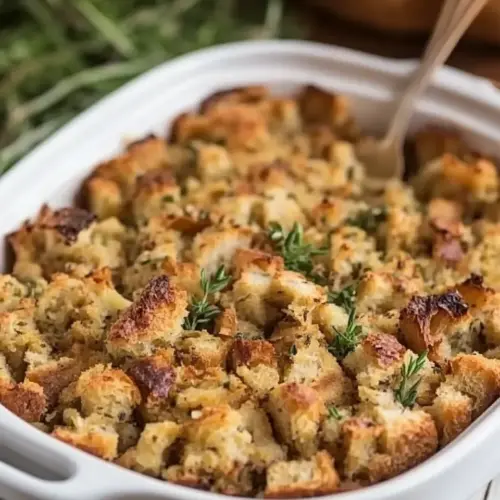
Traditional Bread Stuffing with Herbs
Traditional Bread Stuffing with Herbs is a creamy, herb forward, and easy to make holiday side that blends toasted country bread, savory butter, and fresh herbs for a tender interior and crispy edges. This comforting stuffing works for large gatherings and quiet family meals, making it a perfect easy weeknight dinner addition or Thanksgiving centerpiece to bring warm, nostalgic flavors to the table.
Equipment
- Oven
- Rimmed half sheet pans
- 3 quart gratin or 13x9 baking dish
- Skillet
- Instant read thermometer
Ingredients
- 1 -1/2 pound loaf country white or farmhouse sandwich bread (24 ounce loaf; I use Arnold Country White or Pepperidge Farm Farmhouse White) Torn or cubed into 1-inch pieces and dried slightly to absorb flavors and provide structure, used as the primary base that soaks up butter, stock, and herbs for stuffing; choose a sturdy country or farmhouse white loaf for best texture that holds up after baking. Aim for somewhat stale bread or lightly toasted cubes so the mixture isn't mushy and develops a crisp top and tender interior when cooked.
- 10 tablespoons unsalted butter, divided Softened and divided so part is used to sauté aromatics and the remainder to coat bread for richness; contributes a silky mouthfeel and golden color while transferring fat-soluble herb flavors throughout the stuffing. Use unsalted butter to control overall saltiness and brown remaining butter lightly to deepen savory notes.
- 2 cups small diced yellow onion (about 1/4-inch dice) Sautéed until translucent and slightly caramelized to add sweet, savory depth and a tender bite; small 1/4-inch dice ensures even cooking and integration with celery and herbs. Provides aromatic backbone and balances richness from butter and stock, enhancing overall flavor complexity.
- 1 cup small diced celery (about 1/4-inch dice) Sweated with butter alongside onion to lend a mild, vegetal crunch and a subtle aromatic contrast; diced to match onion size so textures remain consistent in each bite. Celery brings freshness and a light bitterness that offsets richness and complements herbs.
- 2 tablespoons fresh sage leaves, finely chopped Finely chopped and added to the sautéed vegetables to deliver a pronounced earthy, slightly peppery herb flavor; used sparingly because sage is potent and anchors classic stuffing flavor. Fresh leaves provide brighter, more complex aromatics than dried, enhancing stuffing’s traditional profile.
- 1 tablespoon fresh rosemary, chopped Chopped and incorporated to contribute a piney, resinous note that pairs well with poultry; use sparingly for balance and to avoid overwhelming more delicate herbs. Fresh rosemary offers a pleasantly savory aroma that lifts the overall herb blend.
- 2 teaspoons fresh thyme leaves, chopped Chopped and mixed in to add a subtle minty, lemony undertone that ties together richer flavors; small amount lends freshness and complexity without dominating. Fresh thyme leaves distribute evenly and sustain their flavor during gentle cooking.
- 1/2 teaspoon poultry seasoning (I use Bell's) Sprinkled in to provide a blend of warm, savory spices that mimic traditional poultry stuffing flavors; enhances overall seasoning with a balanced mix of sage, thyme, and other aromatics. Use measured amounts to complement fresh herbs without creating a spell-overly spiced profile.
- 1/4 cup chopped flat-leaf parsley leaves, plus additional for garnish (optional) Chopped and folded through the mixture to introduce bright, slightly peppery herbal freshness and a visual pop; extra can be reserved for garnish to enliven the finished dish. Flat-leaf parsley lightens the richness and harmonizes the other herbs.
- 1 -1/2 teaspoons Diamond Crystal kosher salt, plus additional to taste Measured precisely to season and enhance savory flavors while controlling saltiness, especially important when using salted stock or butter; Diamond Crystal kosher salt has a specific flake size so quantity is adjusted accordingly. Add additional salt to taste after combining with broth to avoid over-seasoning.
- 1 teaspoon freshly-ground black pepper, plus additional to taste Freshly ground and added to taste to deliver sharp, aromatic heat that heightens overall flavor harmony; used both in the mixture and optionally as a finishing touch. Adjust quantity to personal preference to balance salt and herbs.
- 2 -1/4 to 3 cups low sodium turkey or chicken broth or stock, plus additional as needed Poured gradually to moisten the bread cubes and bind ingredients while determining final consistency; low-sodium turkey or chicken broth infuses savory depth without making the stuffing overly salty. Add stock incrementally within the listed range to achieve a moist but not soggy texture, supplementing if needed during baking.
- 2 large eggs Beaten and combined to help bind the stuffing, provide structure, and contribute a tender, custardy interior when baked; eggs also enrich flavor and help the mixture hold together. Use large eggs at room temperature for more even incorporation and consistent results.
Instructions
- Preheat oven to 250°F.: As you set the oven, you might notice a faint dry heat that will become important for the gentle toasting of the bread . Keeping a low, steady temperature here ensures the crumbs dry evenly rather than browning too quickly, which preserves neutral toasted aroma. A common mistake is to set the oven too hot, which can brown the crusts without fully drying the interior. If your oven runs hot, check with an oven thermometer and lower heat slightly.
- Cut or tear bread, including the end pieces, into 1/2- to 3/4-inch pieces, leaving soft crusts on. Spread into an even layer on two rimmed half-sheet pans.: The tactile act of tearing or cutting produces irregular surfaces that soak liquid differently, giving a pleasing mixture of textures. You will notice the crumb structure as you handle pieces, and denser bits will hold broth better. Avoid making pieces too small, as they will turn mushy when moistened. If you find a few terribly small crumbs, set them aside to use in another recipe so the stuffing keeps its structure.
- Bake 50-60 minutes, until bread is lightly toasted and dry throughout. Rotate pans halfway through baking time. Let croutons cool completely at room temperature. (You should have about 1 pound of croutons.): When the pieces are in a single layer, warm air circulates and removes moisture uniformly. You want the croutons to dry through, not steam, so leave space between pieces. Overcrowding the pan traps steam and prolongs drying time, so if necessary use additional pans or bake in batches.
- Raise oven temperature to 375°F and place a rack in the middle position. Butter a 3-quart gratin or 13×9 baking dish.: As the bread toasts you will hear small shifts as moisture leaves and the crumb firms up, and the aroma will turn gently nutty. Rotate the pans so both bake evenly. A common issue is stopping too early, leaving pockets of damp crumbs that collapse later; ensure the interior feels dry by breaking a piece open. You should end up with about 1 pound of croutons.
- Melt 8 tablespoons butter in a skillet over medium-high heat until foaming subsides. Add celery and onion and cook, stirring frequently, until the celery is softened and the onions are translucent, about 8-10 minutes.: Increasing to a hotter baking temperature prepares the dish for a final crisp top and reliable internal warming. The butter on the dish gives added flavor and helps prevent sticking while contributing to marginal browning. If you skip buttering, the edges may cling and tear when served, so do not omit it.
- Stir in 1-1/2 teaspoons kosher salt, 1 teaspoon freshly ground black pepper, sage, rosemary, thyme, and poultry seasoning. Cook for an additional 1-2 minutes until the herbs are fragrant.: The sizzling and the change in aroma as the onions sweat release sweet notes that become foundational. Watch the skillet so the aromatics do not brown too quickly; you want them softened and sweet, not caramelized. If the pan browns, lower the heat and stir more frequently to avoid a bitter finish.
- In a large bowl, mix together croutons, onion and celery mixture, and parsley. Moisten with 1-3/4 cups broth or stock and let stand for a few minutes for the bread to soak up the liquid. Season to taste with additional salt and pepper.: As the herbs hit warm fat you will smell an immediate lift, a herbal brightening that signals readiness. This quick cook time allows volatile oils to bloom without becoming dull. Overcooking the herbs can make them muted, so add them toward the end and watch for fragrant steam as your cue.
- In your liquid measuring cup, beat together 1/2 cup broth/stock and the eggs. Fold the mixture into the stuffing to combine and let it stand again for a few minutes to soak in. Squeeze a crouton between your fingertips; it should be moistened through but not mushy and falling apart. If the stuffing seems dry, add some of the additional liquid a little bit at a time, letting it soak in before adding more.: The first pour of broth is critical; the croutons will slurp it up and soften from the inside. Stand time lets the liquid distribute evenly. If you find dry pockets, add more broth in small increments. Avoid drowning the mixture at once, which can lead to a soggy interior instead of a tender, custardy center.
- Transfer the stuffing to the prepared baking dish. Cut the remaining butter into small cubes and dot it over the top of the stuffing.: Folding in the egg enriched broth introduces a binding custard element that sets while baking and gives a silky mouthfeel. After folding, squeeze a crouton between your fingertips, it should be moistened through but not falling apart, which is the textural balance you are aiming for. A common mistake is uneven mixing, so be thorough but gentle to maintain air in the mixture.
- Cover the pan with a piece of foil and bake for 30 minutes. Uncover and continue baking for 15-20 minutes, until edges are crispy and the center reads 165°F on an instant-read thermometer.: As the dish goes into the oven, those butter dots melt and baste the top, encouraging golden color and crisped edges. You will hear a soft settling as it goes in. If the butter melts too quickly and pools, your oven may be hotter than expected; place the dish a bit higher to slow browning.
- Let the stuffing stand for 15 minutes at room temperature after baking. Garnish with additional chopped fresh parsley and serve with roasted turkey, chicken, and your favorite holiday sides (including a drizzle of gravy!).: Covered baking allows the interior to steam and set, while the final uncovered time crisps the edges. Look for bubbling at the edges and a gentle golden crust. If the center still reads low after uncovered time, return it for short increments to avoid overbrowning. A common pitfall is leaving the foil on too long which prevents the top from developing color.
- Let the stuffing stand for 15 minutes at room temperature after baking; garnish with additional chopped fresh parsley and serve: Resting lets the custard finish setting and makes slicing or spooning cleaner. You will notice a settling of aromas and a firmer texture after rest. Serve warm alongside your main dishes. If you skip resting, the stuffing may be too loose and will not present as nicely on the plate.
Notes
- Use day old or toasted bread to achieve the best crumb structure and prevent a gummy interior. If you only have fresh loaf, follow the toasting step fully and confirm the pieces are dry before proceeding.
- Low sodium broth matters because it prevents over salting. Taste the mixture before adding more salt, since reductions or different brands vary widely.
- Chop herbs finely so the herb oils distribute evenly; large leaves can clump or create unpleasant fibrous bites.
- Control texture by resting for 10 to 15 minutes after baking; the custard sets and the flavors meld, making for cleaner servings.
- Toast evenly by rotating pans halfway through the toasting process; inconsistent toasting leads to mixed textures in the final dish.