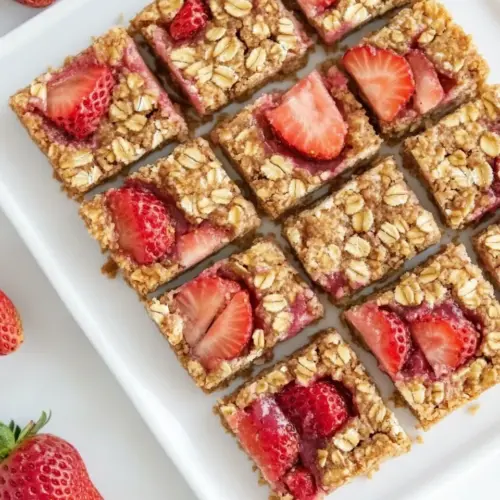
Strawberry Oatmeal Bars
Strawberry Oatmeal Bars are a crispy oat crumb with jammy strawberry center, offering a balance of chewy texture and bright fruit flavor. This easy bake produces bars perfect for snack time, brunch, or casual parties, and they store well for make ahead mornings. Try them for an approachable, crowd pleasing treat that is simple to prepare and irresistible to share.
Equipment
- 8x8-inch Baking Pan
- Parchment Paper
- Rolled Oats
Ingredients
- 1 1/2 cup rolled oats Provide hearty texture and fiber, creating the chewy base and topping for the bars; helps bind with melted butter and flour while offering a nutty flavor when baked.
- 1 cup all-purpose flour Contribute structure and lightness to the bars, forming the dry framework that combines with oats and butter to hold the bars together when sliced.
- 1/2 cup unsalted butter (melted) Add rich flavor and moisture while helping bind the oat and flour mixture; melted form ensures even distribution and a tender, slightly crisp crumb when baked.
- 1 cup sugar Supply sweetness and help with browning, softening the oat flour mixture and balancing the tartness of strawberries; dissolves into the batter to create a uniform sweet profile.
- 1/4 cup milk Provide a bit of liquid to loosen the mixture and aid in cohesion, preventing dryness; helps dissolve sugar and evenly distribute flavor throughout the dough.
- 1 teaspoon vanilla extract Impart fragrant aroma and a warm, sweet vanilla note that enhances the overall flavor; a small amount elevates sweetness perception and balances fruit flavors.
- 1/4 teaspoon salt Enhance flavor by balancing sweetness with a touch of savory contrast; small quantity also strengthens gluten slightly and highlights other ingredients.
- 1/2 cup natural strawberry preserves Contribute concentrated strawberry flavor and jammy sweetness that acts as the filling, adding moisture and a spreadable fruit layer that pairs with fresh diced strawberries.
- 1 cup finely diced strawberries Bring fresh, juicy strawberry bursts and texture contrast to the bars, adding bright fruit flavor and small pockets of moisture that lighten the overall profile.
- 1 tablespoon fresh lemon zest (optional) Provide bright citrus aroma and a zesty lift that accentuates the strawberry flavors; optional addition adds complexity and a fresh finish to each bite.
Instructions
- Preheat the oven to 350 degrees F and line an 8×8-inch baking pan with parchment paper, leaving a few inches overhang on two sides so you can easily lift the bars out when they're cooled.: As the oven warms you will notice a faint heat wave from the open door, and the air in your kitchen begins to feel cozy. This preheating step ensures even baking so the base cooks through while the top browns just right. If you skip this and place the pan in a cold oven you risk uneven texture, with an underbaked center. Keep the pan in the center rack for balanced airflow. When lining the pan, press the parchment into the corners so the dough sits flat. A common slip is cutting the parchment too short, which makes removing the bars difficult.
- To a medium bowl, add the oats, flour, sugar, melted butter, milk, vanilla, and salt. Stir well to combine into a uniform mixture. It will be thick and it should hold together easily when pressed between your fingers.: As you stir, the aroma of butter and vanilla will bloom, and the mixture will transform from dusty dry bits to a cohesive dough. The tactile check by pressing a bit between your fingers lets you judge moisture; it should hold without being sticky. This combination of textures is essential, because it determines how well the base will compress and bake. If the mixture seems too crumbly, your butter may be too cool or you might need a touch more milk. Overmixing can toughen the crumb, so fold gently until uniform.
- Set aside 1 cup of the batter to use as the topping.: Separating the topping gives you the crumble layer that puffs and browns attractively. The reserved dough will be slightly looser from the mixing, and when crumbled on top it creates the classic streusel look. Keep it chilled briefly if your kitchen is warm so it does not become greasy. A common mistake is forgetting to reserve this portion, which leaves you without a distinctive top texture.
- Add the remaining batter mixture to the bottom of the prepared pan, pressing evenly to cover completely.: Pressing the dough into the pan causes it to compact and form a stable base. Use even pressure and check the edges for complete coverage, because thin spots will brown faster. The visual cue to look for is a smooth, packed surface with no loose crumbs. If you press too hard you can compress all the air out and end up with a dense bar; press firmly but with a light, consistent touch across the whole pan.
- Evenly spread the strawberry preserves over the batter. Then, sprinkle on the strawberries and press them down very slightly. Sprinkle with lemon zest, if using to add more bright flavor.: As you spoon the preserves, you will see a glossy red layer forming, and spreading gently ensures the jam does not sink into the base. Add the diced strawberries in an even layer so each bar gets fruit. Pressing them down slightly helps them adhere without bruising. The lemon zest will glint in the jam, offering aromatic lift during baking. Avoid overloading with preserves, since excess jam can make the bars soggy in the middle.
- Crumble the remaining dough mixture over top to cover evenly and press it down slightly.: The topping will scatter into a textured blanket that bakes to a golden, slightly crunchy crust. When crumbling, aim for an even distribution so that large gaps do not expose too much jam. Pressing gently sets the crumbs so they bake as one cohesive layer without flattening them entirely. If you press too hard the topping will lose its crumble and become a compressed crust.
- Bake for 35-40 minutes or until lightly browned. Remove pan from the oven and let cool on a wire rack until room temperature.: During baking you will notice the kitchen filling with a warm, fruity aroma and the top turning a pale golden brown. The sound is quiet, but visually the edges will pull away slightly from the pan, and the center should look set not jiggly. Cooling on a wire rack prevents steam from condensing under the bars, which would make them soggy. A typical error is cutting into the bars while they are still hot, which causes them to fall apart; patience here rewards you with clean slices.
- Use the parchment paper to lift the cooled bars out of the pan. Slice into bars carefully using a serrated knife.: When fully cooled the bars will have a firm yet tender crumb, and the jam layer will be set. Lifting with the parchment gives a clean release. A serrated knife saws through the top crumble without crushing it, and wiping the blade between cuts prevents dragging jam across the next slice. Pressing down slowly but steadily as you cut helps maintain neat edges. Rushing this step can compress the bars and smear the jam.
Notes
- Measure accurately: Use the spoon and level method for both all purpose flour and rolled oats to maintain texture. Too much flour dries the bars, while too little makes them fragile. A small kitchen scale takes the guesswork out of measuring and is worth the cost if you bake often.
- Pick the right jam: Choose a strawberry preserves you enjoy because it is a dominant flavor. If your jam is very runny, strain some liquid or choose a thicker preserve to avoid sogginess in the center. Homemade or jarred, the taste of the jam defines the bars.
- Chill if warm: If your kitchen or butter is warm, chill the mixed dough briefly before pressing for a better crumble texture. Cold dough holds its shape and develops a nice topping during baking. Avoid letting it get too firm, which makes pressing difficult.
- Use parchment with overhang: Lining the pan with parchment that overhangs makes removal effortless and prevents tearing. This small step yields clean slices and makes cleanup simpler. Be sure the paper sits flat so the bars bake evenly.
- Serrated knife for slicing: Cut with a serrated knife and wipe the blade between cuts to keep the crumble intact. Letting the bars cool completely is crucial for neat slices; warm bars will compress and become messy when cut.
- Store properly: Keep bars in an airtight container at room temperature for a few days or refrigerate for longer storage. Layer with parchment between rows to prevent sticking and preserve texture.