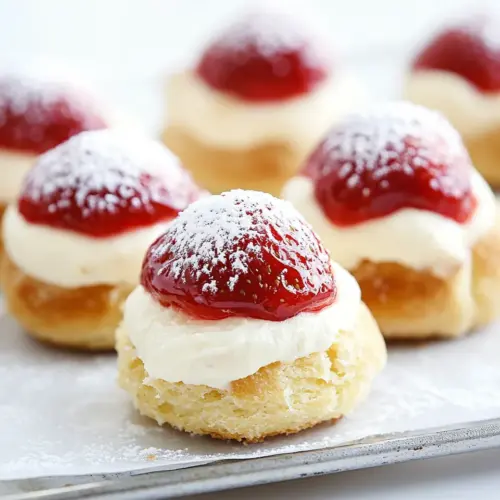
Strawberry Cheesecake Cream Puffs
Strawberry Cheesecake Cream Puffs combine airy pâte à choux shells with a creamy, tangy cheesecake filling and a bright hit of strawberry jam. This recipe yields light, crispy shells and a stable whipped cream and cream cheese filling that feels indulgent yet delicate, perfect for brunch, tea, or special occasions. Make them to impress friends and family with a stunning, bite sized dessert.
Equipment
- Oven
- Saucepan
- Electric Mixer
- Pastry bag
- Baking Sheet
- Parchment Paper
- Wire Rack
Ingredients
- For the Cream Puff Shells Pâte à Choux Used as the structural base for the recipe, indicates the specific component being prepared and organizes ingredients and steps for the pâte à choux shells. Provides context for workflow so the baker knows which portion of the recipe these ingredients apply to. Helps separate shell preparation from filling preparation to avoid confusion.
- 3/4 cup all-purpose flour Provides bulk and structure to the choux dough by forming a gelatinized starch network when mixed with hot liquid. Contributes to the shell's tender crumb and chewiness while also absorbing moisture to allow steam to puff the shells. Ensures proper gluten development when handled appropriately to maintain lightness.
- 6 tablespoons unsalted butter, cut into 6 pieces Adds rich butterfat to the dough, contributing flavor, tenderness, and a glossy crumb to the finished shells. Helps create steam during baking which aids in puffing and forming hollow interiors for filling. Encourages even browning and improves mouthfeel.
- 1 teaspoon sugar Contributes a small amount of sweetness to balance savory notes and enhance browning in the choux pastry. Helps slightly caramelize during baking to deepen the crust's color and flavor. Plays a subtle role in overall taste without overwhelming the pastry.
- 1/4 teaspoon salt Controls overall saltiness and enhances other flavors in the dough, ensuring the pastry is well-balanced and not flat. Strengthens gluten formation slightly and improves dough handling. Helps highlight butter and egg flavors.
- 3 large eggs, at room temperature Provides leavening power, structure, and moisture to the choux dough; eggs create a stable emulsion that traps steam during baking to produce a puffed shell. Contributes richness, color, and binding properties that maintain the shell's shape. Allows for trimming and filling once cooled.
- Egg wash, optional Serves as an optional surface treatment to promote deep golden color and a glossy finish on baked shells. Can be brushed lightly before baking to improve appearance and seal small cracks. Remains optional if a matte finish is preferred.
- 1 egg Acts as the binding component of the egg wash, giving an even coating when brushed onto pastry surfaces prior to baking. Helps create a shiny, browned finish and seals surfaces for uniform color. Used beaten alone for convenience and simplicity.
- 1 teaspoon water Thins the egg wash slightly to make it easier to brush and to produce a smoother, more even glaze on the pastry surface. Encourages better coverage and controlled browning without pooling or streaking. Also reduces the intensity of the egg flavor on the crust.
- For the Strawberry Cheesecake Filling Designates the start of the filling section so readers know the following ingredients and steps relate to the strawberry cheesecake filling. Separates filling components from shell components for clarity during preparation. Guides timing so filling can be chilled while shells bake.
- 1 cup heavy cream Provides the creamy, airy base when whipped for the cheesecake filling, adding richness and lightness to the texture. Balances the denser cream cheese for a smoother, more scoopable filling that holds shape in the puffs. Adds mouthfeel and helps incorporate air for a lighter bite.
- 1 8-ounce package cream cheese, softened Contributes tang, body, and stability to the cheesecake filling while delivering a classic cheesecake flavor and creamy texture. Softening beforehand ensures a lump-free, smooth filling and easier incorporation with other ingredients. Provides structure that helps the filling set without baking.
- 1 cup granulated sugar Supplies sweetness to balance the cream cheese tang and strawberry jam while helping thin and stabilize the filling. Enhances overall flavor profile and can influence consistency depending on amount used. Affects shelf-life and mouthfeel by interacting with dairy components.
- 1 teaspoon table salt Enhances and balances other flavors in the filling by providing a subtle savory counterpoint that deepens overall taste. Helps reduce perceived sweetness and brightens the cream cheese and strawberry notes. Important for achieving a well-rounded flavor profile.
- 1 teaspoon vanilla extract Adds floral and sweet aromatic notes that complement both the cream cheese and strawberries while enriching overall flavor. Provides a familiar dessert scent that elevates the filling's appeal. Works in small amounts to avoid overpowering the other components.
- 1/2 cup strawberry jam Introduces concentrated strawberry flavor and sweetness to the filling, providing fruitiness and color without fresh fruit preparation. Helps distribute strawberry flavor evenly and can be swirled or folded for visual interest. Also contributes to the filling's moisture and spreadability.
- Powdered sugar for dusting Used for a final dusting to enhance presentation and add a touch of refined sweetness without altering texture significantly. Provides contrast to golden pastry and helps mask small imperfections on the surface. Adds a delicate, sugary finish that complements the filling.
Instructions
- For the Cream Puff Shells (Pâte à Choux): When you preheat the oven to 425° , notice the dry heat that will encourage a quick initial puff. A hot oven jumpstarts steam formation inside the dough, creating lift; if the oven is not hot enough the shells can collapse. The baking sheet should be lightly greased or lined with parchment paper so the bottoms crisp rather than stick. A common mistake is opening the oven door during the first crucial minutes which lets steam escape and reduces the rise, so resist peeking early.
- Preheat oven to 425°. Lightly grease baking sheets or line with parchment paper. Measure flour and set aside.: The moment you measure flour and set it aside you are preparing for a fast, exact incorporation. The dough transforms quickly once the flour meets hot liquid, so having everything measured keeps the process smooth. Use a spoon to fill your measuring cup rather than scooping to avoid compacting the flour . A common misstep is adding too much flour, which yields dense shells, so level carefully.
- Bring butter, sugar, salt, and 3/4 cup water to a boil in a 3-qt. saucepan over medium-high heat, stirring occasionally. Immediately remove from heat, and quickly stir in flour mixture all at once. Return to heat and stir with a wooden spoon for 1 to 2 minutes, or until dough is smooth and forms a ball. Transfer dough to the bowl of an electric mixer, and let cool 5 minutes.: As the mixture boils, the butter melts and combines with water, and that hot liquid cooks the starch in the flour when you add it. Stirring until the dough forms a ball tells you the moisture has been absorbed and the surface has been dried a touch, which promotes puffing. Returning briefly to the heat dries the dough further; watch for a sheen that dulls into a smooth paste. A frequent error is not stirring long enough, leaving a wet dough that will not hold structure, so be patient and aim for a cohesive ball.
- Add 3 eggs, 1 at a time, beating until mixture is smooth and glossy. Spoon dough into a pastry bag fitted with a ?-inch plain tip. Pipe dough onto prepared pans into 1 1/2-inch rounds (1 1/2 inches high). Smooth out peaks and round tops with a moistened finger.: Incorporating the eggs one at a time helps you control the dough consistency; the final dough should be glossy and ribbon like, able to hold shape when piped. As you pipe, the dough should be moist but not runny, forming domed rounds. Wetting a finger and smoothing peaks prevents burnt spikes and encourages even browning. A common slip is adding eggs too quickly which can produce a runny batter that spreads instead of puffing.
- Whisk together remaining 1 egg and 1 tsp. water. Brush tops of dough with egg mixture.: Brushing with the egg wash gives the shells an attractive, deep golden color. Use a light hand so the wash does not drip down the sides and weigh the dough. If you brush too heavily, the wash can pool and create dense spots that inhibit even baking, so tap off excess from the brush before applying.
- Bake at 425° for 5 minutes; reduce oven temperature to 375°, and bake 30 minutes or until puffy and golden brown. Turn oven off; let shells stand in closed oven 10 minutes. Remove from baking sheets to wire racks, and cool completely.: That hot burst at 425° creates a powerful steam lift, then lowering to 375° finishes the bake without overbrowning. When the shells are puffy and golden, the interior is mostly cooked, but the extra time in the closed oven dries them, preventing sogginess. You should hear a faint crisp as you tap the bottoms when cooled; if they sound hollow they are done. A common problem is underbaking which leads to chewy centers, so resist the urge to shorten the time.
- For the Strawberry Cheesecake Filling: Place cream in a large bowl. Beat at medium-high speed with an electric mixer until stiff peaks form. Combine cream cheese , sugar , salt and vanilla extract in a separate medium bowl. Beat until smooth. Gently fold in the whipped cream . : Whipping the heavy cream to stiff peaks provides lightness and structure to the filling; you should see peaks that hold their shape and have a satiny sheen. The cream cheese mixture should be totally smooth before folding to avoid lumps in the final filling. Folding gently protects the air you whipped into the cream , preserving the airy texture; overmixing will deflate it. New bakers often overbeat and lose volume, so fold with a spatula using a wide, gentle motion.
- Place cream in a large bowl. Beat at medium-high speed with an electric mixer until stiff peaks form. Combine cream cheese, sugar, salt and vanilla in a separate medium bowl. Beat until smooth. Gently fold in the whipped cream.: Cut the top one-third off of each cream puff. Spoon a scoop of the strawberry jam into the bottom of the cream puff. Spoon or pipe the whipped cream mixture on top of the strawberry jam . Replace the tops. Chill until ready to serve. Dust with powdered sugar before serving. : When assembling, the jam acts as a flavor island, and the filling layered above creates a creamy crown. Cutting the top invites steam to escape and makes room for filling without overstuffing. You should feel a light resistance when slicing off the top; the interior should be hollow and dry to the touch. A typical mistake is filling puffs too early, which softens the shells from moisture, so fill close to serving time for maximum crispness.
- To Assemble the Cream Puffs: This credit is a source note and does not change the technique. It connects the recipe to its origin and honors the creator. Keep such credits intact when sharing recipes openly. A misstep would be omitting attribution when required, so maintain the credit as shown.
Notes
- Measure ingredients accurately using proper dry and liquid measuring tools to ensure the pâte à choux has the right balance of moisture and starch for optimal rise and texture.
- Keep equipment ready before you begin the hot water and flour step, because once the dough is cooked you need to work quickly to add eggs and achieve the correct consistency.
- Dry the shells well by letting them sit in the turned off oven after baking; this extra step prevents a soggy interior when you later add the filling.
- Whip cream cold for faster and more stable peaks; chilling the bowl and beaters can help, especially in warm kitchens.
- Fold gently when combining whipped cream with the cream cheese blend to preserve air and keep the filling light and fluffy.