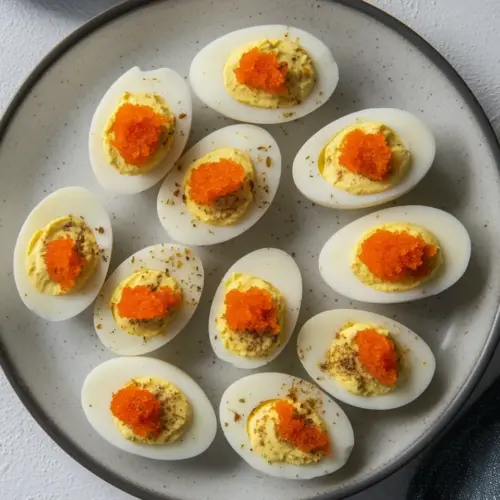
Smoked Salmon Deviled Eggs
Smoked Salmon Deviled Eggs are creamy, smoky, and easy to make, delivering a luxurious appetizer with minimal effort. The silky yolk filling blends cream cheese and mayonnaise while bright dill and briny capers keep it balanced. Perfect for parties or a quick fancy snack, this recipe is a guaranteed crowd pleaser and worth making for its elegant flavor and swift prep.
Equipment
- Small pot
- Spoon
- Bowl
- Serving plate
- Knife
Ingredients
- 6 large eggs Boil and cool to form firm whites and set yolks; halving and scooping creates cavities for the filling. Provide rich texture and protein that balances the creamy filling and smoky salmon.
- 2 tablespoons low-fat cream cheese Soften and blend into the filling to create a tangy, lower-fat creaminess that helps bind the yolk mixture. Add subtle richness without overpowering the delicate smoked salmon flavor.
- 4 tablespoons mayonnaise Whisk into the yolk mixture to add silky body and a slightly tangy richness that smooths the filling. Help achieve a creamy, pipeable consistency and contribute moisture for easy filling.
- 2 tablespoons dill plus more to garnish Chop finely and fold into the filling for a bright, herbaceous lift that complements the fish and creaminess. Use extra as a garnish to add fresh color and a mild anise-like flavor.
- Salt and pepper to taste Season judiciously to enhance overall taste and balance richness; adjust to personal preference for saltiness and heat. Use freshly ground pepper for aromatic bite that brightens each bite.
- 1 teaspoon capers Rinse and chop or leave whole to introduce briny, tangy pops that contrast the rich filling and smoked salmon. Scatter sparingly throughout the yolk mixture to add savory complexity and texture.
- 2 ounces smoked salmon finely chopped Chop finely and stir into the filling to provide smoky, savory flavor and delicate flaky texture that defines the dish. Reserve a few small pieces for garnish to showcase the main protein.
Instructions
- Fill a small pot with enough water to fully submerge the eggs. Bring to a boil. Place your eggs in the water using a spoon and boil for 10-12 minutes. Remove the eggs and place in an ice bath.: You should hear a gentle rolling boil as the water heats, and the surface will shimmer with rising bubbles. This method ensures even cooking of each egg . The why here is consistency, eggs cook uniformly when fully submerged. A common mistake is crowding the pot, which causes uneven cooking and can lead to cracked whites; give the eggs space so water circulates freely.
- Peel the eggs and cut them in half lengthwise. Remove the yolks with a spoon and transfer them to a large bowl. Place the egg whites on a serving plate.: The water will transition from quiet to lively with medium to large bubbles breaking the surface, and you may see steam rising steadily. Rapid boiling helps set the whites quickly when the eggs go in, minimizing movement that might crack shells. Boiling too vigorously can jostle eggs and create cracks, so aim for a steady but controlled boil.
- Add cream cheese, mayonnaise, and dill to the yolks. Mix well with a fork. Season to taste with salt and pepper.: As the eggs cook you will notice a soft rolling sound from the pot and a faint, warm aroma from the water. Ten to twelve minutes produces a fully set yolk without a chalky texture. The rationale is to achieve a firm, yet creamy yolk for mashing. Avoid overcooking beyond twelve minutes, which can yield a dry yolk and a pronounced sulfur scent.
- Spoon the yolk mixture into the egg whites. Garnish with dill, capers, and smoked salmon.: The ice bath should hiss slightly as the hot eggs hit the cold liquid, instantly halting further cooking and making peeling much easier. This shock cools the whites so they contract slightly away from the shell, reducing fragmentation during peeling. A common oversight is skipping the ice bath which leads to continued carryover cooking and tougher whites.
- Peel the eggs and cut them in half lengthwise: When you peel, the shells should come away in pieces rather than shredding into file like bits, and the exposed whites will be smooth and glossy. Cutting lengthwise reveals the yolk center and creates a stable cradle for the filling. Be gentle while peeling to keep the white surfaces intact; rough handling can rip the white and make the presentation uneven.
- Remove the yolks with a spoon and transfer them to a large bowl: The yolks should be firm yet moist, with a pale yellow center. Transferring them to a bowl allows you to mash them to a uniform base for the filling. The reason this matters is texture, if the yolks are crumbled unevenly the filling will be lumpy. Watch for stray shell fragments and remove them promptly to avoid a gritty bite.
- Place the egg whites on a serving plate: Arrange them bed like on the plate so they sit stable and present well. A tidy layout makes spooning or piping the filling simpler and keeps the plate from looking crowded. If you stack the whites they may tip and the filling can spill, so give each half some room.
- Add cream cheese mayonnaise and dill to the yolks: As you mix you will feel the texture soften and become silk like, and the aroma will pick up tang from the dairy and herbaceous notes from the dill . Mixing these elements creates a cohesive emulsion that binds to the yolk. If the cream cheese is too cold you might see small lumps, so soften it beforehand to ensure a smooth texture.
- Mix well with a fork: The sound is quiet scraping, and visually you want a uniform pale filling with no distinct streaks of mayo or cream cheese. Proper mixing ensures the filling is smooth enough to spoon yet firm enough to hold shape. Overworking is rare here, but under mixing leaves textural inconsistencies, so aim for a homogeneous mixture.
- Season to taste with salt and pepper: Sprinkle sparingly and taste a small dab to check balance; the smoked salmon and capers already contribute salt, so adjust cautiously. Proper seasoning will lift all flavors without making the filling overtly salty. A common error is to season before tasting, which can lead to oversalting once the fish is added.
- Spoon the yolk mixture into the egg whites: The filling should glide in with a creamy swoop, holding its shape atop each white. This step transforms simple halves into finished bites. Use a small spoon for control; forcing too much filling can overflow and make the plate messy.
- Garnish with dill capers and smoked salmon: The final touches add visual contrast and bursts of flavor, with the fresh green of dill , the briny glint of capers , and the tender ribbons of smoked salmon . These elements provide aroma and textural variety on top of the smooth filling. A tip is to place garnishes deliberately so each half gets a balanced taste; random scattering can leave some pieces underflavored.
Notes
- Make it extra creamy by increasing the cream cheese by one tablespoon and blending it thoroughly, which will yield a silkier filling especially welcome if you prefer a spread like texture.
- Brighten the flavor by adding an extra half teaspoon of chopped dill or a light grating of lemon zest if you want a fresher lift to counterbalance the smoke.
- Tame the salt by rinsing the capers briefly under cold water before chopping, which reduces their brine while preserving the acidic pop they provide.
- Make ahead by preparing the yolk filling up to one day in advance and storing it covered in the refrigerator, then spooning it into the whites just before serving to maintain texture.
- Elevate presentation by piping the filling through a star tip for a decorative finish and then topping each with a small ribbon of smoked salmon and a single caper.