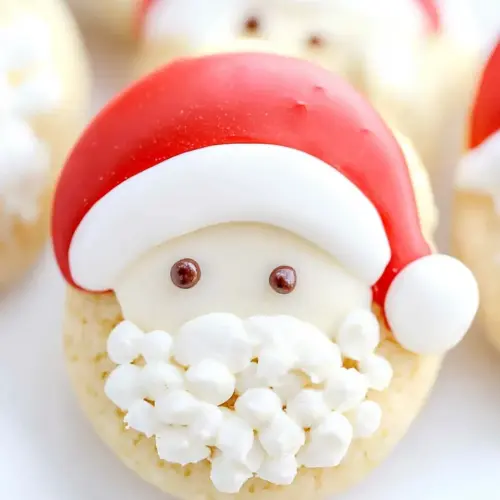
Santa Claus Cookies
Santa Claus Cookies are cute, crispy, and easy to make, combining crunchy Nutter Butter sandwich cookies with creamy melted white baking chocolate, festive red sugar, and tiny candy accents. These no fuss treats are perfect for holiday parties or cookie exchanges, and they come together quickly for a crowd pleasing platter you will want to make again and again.
Equipment
- Microwave-safe Bowl
- Wire racks
- Waxed paper
- Tweezers
Ingredients
- 12 ounces almond bark or white baking chocolate, chopped Melted to create a smooth, sweet coating that binds and covers cookies; provides creamy white color and firm finish when cooled. Use gentle heat to avoid scorching and stir until fully fluid for dipping or drizzling. Adds a sweet, vanilla-like richness that complements chocolate and peanut butter flavors.
- 1 package, (1 pound) Nutter Butter sandwich cookies Used to provide a crunchy, peanut-butter filled base for the festive cookies; pairs well with a white chocolate coating for contrast. Arrange cookies for easy dipping and handle gently to keep sandwich structure intact. Supplies both texture and the classic cookie silhouette essential for the Santa Claus design.
- red colored sugar Sprinkled to add bright red sparkle and an extra crunchy bite on the white coated surface; provides visual contrast and holiday flair. Apply while coating is still tacky so sugar adheres well and stays in place. Available in fine or coarse crystals to vary texture and shimmer.
- 32 vanilla or white chips Melted or sprinkled to create small white decorative accents such as beard highlights or hat trim; offers a creamy vanilla sweetness and smooth texture. Use chips to melt for piping or press whole into coating for defined shapes. Melts uniformly for consistent decorating results.
- 64 miniature semisweet chocolate chips Placed to form eyes or mouth details with concentrated dark chocolate flavor; miniature chips provide precise control for facial features. Press into coating before it sets to secure and create expressive details. Adds both visual definition and a slight bittersweet balance.
- 32 red mini m&ms Pressed to create small red nose details or buttons, giving a bright, candy-coated pop of color; miniature M&Ms supply a crunchy, chocolaty bite. Place each candy into still-wet coating so it adheres firmly as it sets. Provides festive color and a playful finishing touch.
Instructions
- In a microwave safe bowl, melt white chocolate at 70% power for 1 minute; stir. Microwave at additional 10- to 20-second intervals, stirring until smooth.: Warm, gentle heat prevents scorching, and you will notice a glossy sheen when the white baking chocolate has melted correctly. Listen for quiet bubbling rather than loud popping, and stir with a spatula until the texture is silky. The aroma will be sweet and buttery, and the mixture should flow slowly when the spatula is lifted. Why this matters, I find, is that overheated chocolate can seize, turning grainy and losing its smooth finish. A common mistake is using full power and skipping intervals, which risks burning. If the chocolate looks thick or lumpy, add a tiny bit of vegetable oil or shorten intervals, and stir more frequently to distribute heat evenly. Keep the bowl on a towel to stabilize it while stirring.
- Dip one end of each cookie into melted chocolate, allowing excess to drip off. Place on wire racks. For Santa's hat, sprinkle red sugar on top part of chocolate. I found it easier to press the cookie into the sugar after the chocolate had slightly set. Press one vanilla chip off-center on hat for pompom; let stand until set.: You will feel the satisfying weight of the cookie as it meets the warm coating, and see the chocolate curve around the edge before you lift it. Hold the cookie over the bowl for a moment to let extra chocolate fall back, then set it on a wire rack so air circulates and the coating sets evenly. I like how the surface looks glossy immediately after dipping, and then dulls slightly as it cools. The reason to let excess drip is so the chocolate sets in a tidy edge instead of pooling, which keeps the look neat. Avoid dunking too deeply, which could cover the center of the cookie; instead aim for a clean top or bottom edge depending on your orientation. If the coating slides off the cookie, it likely means the chocolate is too thin from overheating, so let it cool a little before the next dip.
- Dip other end of each cookie into melted chocolate for beard, leaving center of cookie uncovered. Place on wire racks. With a dab of melted chocolate, attach semisweet chips for eyes and a the m&m for the nose. Place on waxed paper until set.: When you set cookies on a rack the underside finishes without sticking, and air movement encourages even cooling. You will hear a faint settling sound as the chocolate loses heat, and the surface will begin to firm within minutes. This step matters because cookies left on flat paper can bond to the surface and mar the decoration. A common oversight is stacking cookies too close together; keep them spaced so decorations do not touch. If you do get a drip, a quick swipe with a small offset spatula will tidy it while the chocolate remains soft.
- For Santa's hat, sprinkle red sugar on top part of chocolate: The red sugar sparkles against the white, creating visual contrast and a crunchy texture. For best adhesion, apply the sugar while the chocolate is tacky rather than fully set, so the granules sink slightly and anchor. I find pressing the cookie lightly into a shallow dish of sugar gives even coverage and fewer loose granules. This matters because sugar applied too early will sink, and if applied too late it will not stick. Avoid dumping too much sugar which can make the hat overly grainy; a light, even layer is most attractive.
- I found it easier to press the cookie into the sugar after the chocolate had slightly set: When the coating is semi tacky the sugar adheres without sliding off, producing a defined hat shape. Visually, the sugar will look nestled into the surface rather than scattered across it, and the texture will be stable once fully set. This technique helps maintain the cookie's proportions, because impatient application can smear the chocolate. A typical error is applying sugar to very fluid chocolate, which leads to a messy finish. If that happens, gently lift the cookie and let it sit until the coating firms, then reapply.
- Press one vanilla chip off-center on hat for pompom; let stand until set: The pale chip stands out as a pompom and anchors the hat design. Press it in lightly so it settles into the chocolate but does not sink fully. You will feel a small give as the chip seats, and the overall silhouette of the face begins to emerge. The reason for waiting until partly set is to avoid sliding; if the chip shifts, remove it and reattach with a dab of melted white baking chocolate as glue. Avoid pressing too hard which can break the chip or smear the sugar.
- Dip other end of each cookie into melted chocolate for beard, leaving center of cookie uncovered: The beard is a broad sweep of white that frames the face. As you dip, rotate the cookie to coat the lower portion, and let the excess drip so the beard edge is feathered, not blunt. You will notice the contrast between the exposed center and the bright white beard, and this visual cue helps the face read clearly. This technique ensures the cookie is balanced, and waiting for partial set before additional decoration prevents smudging. A common mistake is overcoating so the beard covers too much of the face; aim for a generous but neat arc.
- Place on wire racks: Again the rack supports proper cooling and keeps the surface clean. You will hear small settling noises and see the shine fade slightly as the chocolate firms. This matters because a stable base makes the subsequent attachments simple and prevents sliding. If crumbs fall onto the wet surface, gently blow them away or remove with a clean finger once set to avoid imperfections.
- With a dab of melted chocolate, attach semisweet chips for eyes and a the m&m for the nose: Use a tiny dot of warm chocolate as adhesive and press each miniature semisweet chocolate chip into place for eyes, then center a red mini m&ms for the nose. The satisfying click as the candy seats is a small reward, and you will see the face become expressive in moments. The reason for using a dab is precision; too much glue creates a smear, while too little fails to hold. A troubleshooting tip: use tweezers to position tiny pieces, which prevents fingerprints and improves accuracy. If an eye tilts, wait until the dot firms and reapply a smaller amount if necessary.
- Place on waxed paper until set: Transfer finished cookies to waxed paper for the final set, which prevents sticking and collects any stray drips. The cookies will firm fully in a short time, depending on room temperature, and the waxed paper makes cleanup straightforward. This matters because transporting partially set cookies risks smudging; allow them to rest undisturbed. A common issue is handling them too soon, which can lift decorations; patience is rewarded here.
Notes
- Temper gently by microwaving at lower power in short bursts, stirring often to maintain a silky texture that sets well and resists bloom.
- Keep tools dry because any moisture in the bowl will cause the white baking chocolate to seize, turning grainy and unusable; always dry spatulas and bowls thoroughly.
- Use a shallow dish for sugar so you can press cookies in lightly and get even coverage without wasting sugar or creating lumps.
- Place decorations while tacky to ensure candies adhere firmly, but not so fluid that they slide; timing this right gives a professional finish.
- Work in small batches to maintain chocolate temperature and avoid rushing, which leads to messy coatings and uneven results.
- Employ tweezers or a toothpick for precision when attaching tiny pieces like the vanilla chips and miniature semisweet chocolate chips, which keeps your fingers clean and decorations straight.