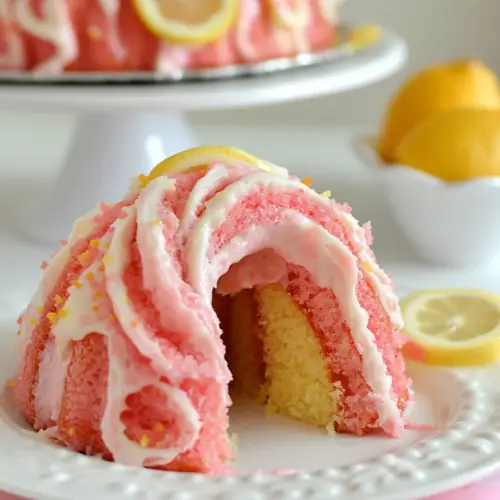
Pink Lemonade Swirl Bundt Cake
Pink Lemonade Swirl Bundt Cake is a bright, playful dessert that pairs a tender lemon cake crumb with a pink lemonade flavored swirl and glossy frosting. This easy, moist cake is perfect for summer parties, potlucks, and kid friendly gatherings, offering a fun visual twist with minimal effort. Make it for a cheerful dessert that looks homemade but comes together quickly.
Equipment
- Bundt Pan
- Measuring Cup
- Mixing Bowl
- Spatula
- Microwave
- Ziploc sandwich bags
Ingredients
- 1 Lemon Cake mix plus the eggs, water, and oil to make the cake Provide structure, moisture, and flavor as the prepared lemon cake mix; follow package directions using the included eggs, water, and oil to create the batter and ensure proper rise and crumb for the bundt cake.
- 2 tablespoons pink lemonade drink mix divided (see note) Add bright citrus flavor and pink color by dividing the powdered pink lemonade mix; stir part into batter or glaze and reserve some for swirling or sprinkling to achieve the signature pink lemonade taste.
- 1 can vanilla frosting Contribute sweetness and a smooth finish as a ready-made vanilla frosting; spread or drizzle over the cooled bundt cake to add creamy vanilla contrast and help showcase the swirled pink coloration.
- food coloring if desired Enhance or adjust visual appeal with optional food coloring; use sparingly to intensify the pink hue or create swirls without affecting flavor, ensuring even distribution for attractive presentation.
Instructions
- Preheat oven to 350 degrees. Butter and flour a bundt pan.: As the oven warms you will notice a gentle hum and the faint scent of heating metal. Getting the oven fully to 350 ensures even rise and predictable baking time, so I always use an oven thermometer if my appliance runs hot or cool. A common mistake is putting the cake in too early, which can lead to uneven texture, so wait until the temperature stabilizes.
- Mix cake mix, eggs, oil, and water according to package directions.: Rubbing softened butter over the curves and dusting with flour creates a satin barrier that helps the cake release cleanly, and you will feel the pan's contours as you work. I pay extra attention to the center tube and the ridges so the loaf unmolds with crisp edges. Skipping this step or doing it unevenly often causes sticking, which ruins the presentation.
- Pour 1 cup of batter into a measuring cup. Stir in 1 tablespoon pink lemonade drink mix. If the color is not bright enough for you, add a few drops of red food coloring.: As you whisk, the batter will go from grainy to smooth, and there should be no streaks of dry cake mix. The batter should be glossy and medium thick; if it looks curdled or overly thin, check your egg size and measure liquids precisely. Over beating can incorporate too much air and result in collapse after baking.
- Place half of remaining lemon cake batter in the bottom of your bundt pan. Carefully pour the pink lemonade batter evenly over the top, and then pour the remaining lemon cake over the pink lemonade batter.: That smaller portion will become the pink swirl, and you will notice it holds a slightly different texture when separated. The reserved batter should be set aside immediately, because the rest needs to be poured into the pan promptly to maintain layering. Leaving the batter exposed too long can make it begin to dry at the surface.
- Bake 38-40 minutes, until a toothpick at the edge comes out clean. Cool completely before removing from pan.: When you blend the pink lemonade drink mix into the reserved cup, you will see the color bloom and the aroma of tart citrus rise. If the hue is muted, add a few drops of food coloring until you are happy with the shade. Avoid adding too much color or mix, which can shift texture and sweetness.
- Once cool, remove cake to a serving plate. I like to take three strips of wax paper and place them under the edges of the cake so that after frosting, once the wax paper is removed, the plate is clean.: Spoon half of the pale batter evenly so it cushions the pan base, and you should hear a faint plop as the batter settles. Smooth it gently with a spatula to create a level bed for the pink layer, because an uneven base will make the swirl asymmetrical. A frequent error is crowding one side of the pan, so work around the center to maintain balance.
- Open the can of frosting. Place 1/4 cup of it in a small microwave safe bowl. Set aside for the moment. Stir the remaining pink lemonade mix into the can of frosting. Remove spoon and foil, and heat in the microwave for 30 seconds. Stir, and place in a ziploc sandwich bag. Seal the bag, all but 1/2” at one end, and cut off the opposite tip.: Pour slowly and let the pink batter spread across the pale lemon cake bed, watching it create veins and ribbons. The thin stream helps control placement, and if it pools too thickly it can sink during baking, so pour with patience. If the pink batter sinks, it often indicates the layers were disturbed or the pan was jolted after assembling.
- Pipe over cake in a firecracker type pattern.: Cover the pink layer with the rest of the pale batter, smoothing the surface lightly so there are no large air pockets. The peachy sound of batter sliding into the pan is subtle, and the top should look even and without gaps. Avoid pressing down on the batter, which can mar the swirl and compress the crumb.
- Heat reserved white frosting for 10-15 seconds in the microwave. Place in its own ziploc sandwich bag and repeat the drizzle process. Chill until set before cutting.: During baking you will notice the top change from glossy to matte and a gentle doming at the center. The aroma will become warmly citrusy as the edges turn pale gold. Test near the outer edge because the center can stay slightly moist; if you overbake the cake becomes dry and crumbly, so err on the cautious side and check at 38 minutes.
- Cool completely before removing from pan.: Cooling lets the crumb firm and steam release, and the cake will contract slightly from the pan walls, easing removal. I leave mine on a rack for at least an hour, and I check the center is room temperature before flipping. Trying to unmold too soon often leads to tearing or a collapsed center.
- Remove cake to a serving plate.: I use a thin spatula around the tube and then invert onto a plate, tapping gently to help it release. Taking three strips of wax paper and placing them under the edges before frosting keeps the plate tidy, and you will be grateful when you lift them away. If the cake still sticks, let it rest longer or warm the pan briefly on a low oven to loosen the edge.
- Open the can of frosting.: Scoop out 1 quarter cup of the vanilla frosting into a small microwave safe bowl and set it aside; the remaining frosting will be flavored. The canned frosting is thick and glossy, and the reserved portion will heat quickly to a pourable consistency. Overheating makes it too fluid, so warm it in short bursts.
- Stir the remaining pink lemonade mix into the can of frosting.: Mixing the dissolved pink drink mix into the bigger portion colors and flavors the frosting, and you will notice a faint citrus perfume. Replace the spoon and microwave the can for 30 seconds to make it spreadable, then transfer to a sandwich bag for piping. If the frosting seems grainy, stir thoroughly to dissolve any undissolved mix.
- Place in a ziploc sandwich bag and cut a tip for piping.: Sealing the bag all but half an inch at one end and cutting the opposite tip gives you control to pipe in a firecracker pattern. The frosting will slide smoothly when warmed just right, and the bag lets you drizzle with precision. Cutting the hole too large can create clumsy lines, so test on a plate first.
- Pipe over cake in a firecracker type pattern.: As you pipe, the frosting will sheen and form ribbons across the top, and the contrast looks festive and fun. Work from one side to the other so the pattern is balanced, and if a line droops you can nudge it with a small offset spatula. If the frosting runs, chill briefly and try again to regain control.
- Heat reserved white frosting for 10 to 15 seconds in the microwave.: Warming the reserved white portion briefly loosens it enough to drizzle, and its bright contrast pops against the tinted glaze. Place it in a separate bag and cut a tiny tip for delicate ribbons. Heat only very briefly, because too much warmth will make the white lose its body and run off the cake.
- Place in its own ziploc sandwich bag and repeat the drizzle process.: Drizzling the white frosting adds dimension and a crisp finishing touch, and you will enjoy the little glossy arcs it creates. After decorating, chill the cake until the frosting sets, which gives a clean slice when serving. If you slice while the glaze is tacky, the edges will smear rather than cleanly separate.
- Chill until set before cutting.: A short chill firms the frosting and seals the decoration, and the cake will slice more neatly when cold. I usually refrigerate for 20 to 30 minutes, watching the sheen turn slightly matte as it sets. Cutting too soon is the most common slip, leading to messy plates, so be patient and let the cake rest.
Notes
- Measure Precisely: Accuracy with the cake mix liquids ensures the batter has the right thickness, which affects rise and crumb uniformity.
- Color Control: Start with the suggested tablespoon of pink lemonade drink mix for the swirl and adjust color with a few drops of food coloring only if needed to avoid altering taste.
- Frosting Temperatures: Warm frosting in 10 to 15 second bursts to get the ideal pipeable texture, and keep reserved white frosting cooler for a defined drizzle.
- Pan Prep Trick: Use softened butter and a light dusting of flour, tapping out excess, to preserve the detailed bundt shape on release.
- Wax Paper Cleanup: Slide strips of wax paper under the cake edges before frosting to catch drips, then remove them after the glaze has set for a pristine plate.