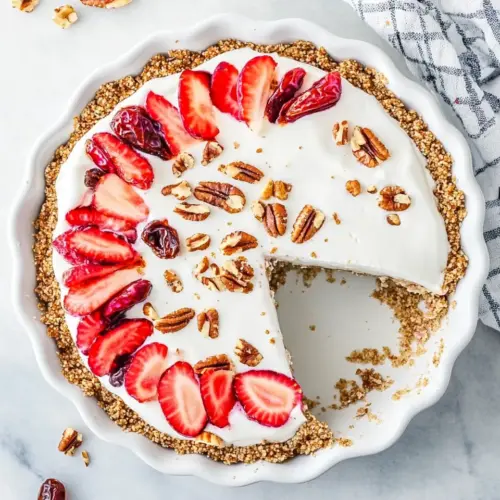
No Bake Yogurt Pie with Date Nut Crust
No Bake Yogurt Pie with Date Nut Crust is a creamy, tangy dessert with a naturally sweet, chewy date and nut base. This easy no bake treat layers thick whole milk greek yogurt with bright mixed berries for a light, crowd pleasing finish, perfect for summer gatherings or relaxed brunches. Make it for an effortless, impressive sweet that tastes indulgent and wholesome.
Equipment
- Food Processor
- 8 inch pie plate
- Small offset spatula
- Mixing Bowl
- Fine mesh sieve
Ingredients
- 15 medjool dates, with the pits Soak and sweeten the filling by softening pits inside the dates and blending them into a sticky base for the crust; pitting before processing creates a smooth texture and natural sweetness that binds the nuts together.
- 3/4 cup walnuts Toast or pulse to coarse crumbs to provide rich, buttery flavor and crunchy structure to the crust; walnuts add depth and a slightly bitter counterpoint to the dates.
- 3/4 cup unsalted roasted almonds Chop or pulse until coarse to contribute firm, nutty texture and structure to the crust; roasted almonds enhance the overall crunch and buttery flavor profile.
- 1/4 teaspoon kosher salt Season the nut-date crust by balancing sweetness and intensifying flavors; a small amount of kosher salt highlights the nuts and dates without making the crust salty.
- 1 1/4 cups whole milk greek yogurt Thicken and tang the filling by providing creamy body and a rich dairy backbone; whole milk Greek yogurt creates a stable, smooth no-bake custard with pleasant acidity.
- 1 teaspoon vanilla bean paste or vanilla extract Flavor the filling with warm aromatic notes by incorporating vanilla bean paste or extract; it rounds out the yogurt’s tang and complements the fruit topping.
- 1/2 teaspoon orange zest Brighten the filling and complement the berries by adding concentrated citrus aroma; orange zest lifts the flavor and adds freshness without extra liquid.
- 2 teaspoons honey Sweeten and lightly glaze the fruit topping with natural sweetness; honey enhances berry flavor and helps hold sliced fruit together with a glossy finish.
- 1 1/2 cups mixed berries, sliced strawberries, raspberries, blackberries, blueberries Top and decorate the finished pie using a mix of sliced strawberries, raspberries, blackberries, and blueberries; mixed berries provide tartness, color contrast, and juicy texture.
- Nonstick cooking spray Prepare the pan by preventing sticking and allowing easy release of the pie; nonstick cooking spray makes removing the finished no-bake pie simple and clean.
Instructions
- Add the dates to a bowl and cover with very hot water. Cover and let sit for 15 minutes. Drain, pat dry, and cut in half, removing the pit.: The softened and warmed water will plump the medjool dates and release some of their sticky sugars, creating a smoother texture when blended. You should notice the dates becoming glossy and tender after sitting, and the aroma will become more caramel like. A common mistake is under soaking, which leaves the dates dry and prevents the crust from binding; if any dates feel firm after the recommended time, let them sit a little longer. Drain and pat the dates dry so excess water does not make the crust too wet.
- Spray a 8-inch pie plate with nonstick cooking spray and set aside.: Preparing the pan first ensures the crust will release easily later, and a light coating on the plate also prevents the bottom from clinging. When you press the crust in, you want the surface to glide under the crust edges, not tear them. Over spraying can create slippery patches where the crust will not adhere well, so use a light, even mist.
- Add the soaked dates, nuts, and salt to the bowl of a food processor fitted with the blade attachment. Pulse together until the mixture is finely chopped. The mixture should hold together when pressed between your fingers.: Pulse these ingredients until finely chopped so the texture becomes uniformly small and able to stick together. As the mixture comes together you will see a cohesive, slightly tacky mass that holds when pinched. If you over process, the nuts will release too much oil and the mixture will become pasty, so pulse in short bursts and check frequently. Make sure the kosher salt is evenly distributed for balanced flavor.
- Transfer the mixture to the prepared pie plate. Lightly spray your hands or the bottom of a flat dry measuring cup with nonstick spray and gently press the crust out to cover the base and the sides of the pie plate.: Pressing the crust into the pan defines the structure of the pie, so focus on evenness and thickness across the base and sides. Lightly spray your hands or the bottom of a flat dry measuring cup with nonstick cooking spray and gently press the crust out to cover the base and the sides of the pie plate. You want a compact, level surface without holes. A common error is packing too loosely which causes crumbs to fall away when slicing; press firmly but not so hard that the crust becomes overly dense.
- In a medium bowl, mix together the yogurt, vanilla bean paste, orange zest, and honey. Spoon the mixture into the pie plate and smooth into an even layer.: The filling blends quickly, and you should notice a fragrant lift from the orange zest and vanilla bean paste as you stir. The texture should be creamy and thick; if the whole milk greek yogurt seems thin, let it drain briefly in a strainer for a firmer finish. Over mixing introduces air which can make the filling settle oddly, so combine until smooth and uniform.
- Arrange the fruit in your desired pattern. Loosely cover with plastic wrap and refrigerate for 1 hour before serving.: Use an offset spatula or the back of a spoon to level the filling so it meets the crust edges cleanly. You want a flat, even surface for the berries to sit on. Work quickly but gently so the filling does not become grainy from over handling. If the filling is too loose, chill the pie briefly before arranging fruit to prevent sliding.
- Slice into wedges and use a small offset spatula to remove the slices.: Place the mixed berries on top in a pattern that pleases you, whether casual or precise. The bright colors will create contrast against the creamy white filling. Pat the berries lightly so they sit snugly, and avoid stacking too high which can cause them to slip off when slicing. If using very juicy berries, consider patting them dry first to prevent extra moisture pooling on the surface.
- Loosely cover with plastic wrap and refrigerate for 1 hour before serving: Chilling firms the filling and helps the crust set so slices hold their shape. You will feel the pie go from squishy to pleasantly set, and the flavors will meld in the cold environment. A mistake some people make is refrigerating for too long without protection, which can pick up other fridge odors; keep it loosely covered to allow a slight exchange while preventing a film from forming.
- Slice into wedges and use a small offset spatula to remove the slices: For clean slices, run a clean, warm knife between cuts and wipe it dry after each pass. The contrast you want is a neat edge where the creamy filling meets the compact crust and the berries sit on top. If the pie is too cold, let it sit five minutes to soften slightly for easier cutting. Avoid tearing the crust by using a steady lift with an offset spatula under each wedge.
Notes
- Choose thick whole milk greek yogurt — The richness of whole milk greek yogurt gives the filling a silky mouthfeel and helps it set without heavy cream, producing a satisfying, creamy slice.
- Soak dates properly — Soaking medjool dates in very hot water for the suggested time softens them and releases natural sugars which blend smoothly into the crust, preventing dry pockets.
- Pulse, do not puree — When processing the walnuts and unsalted roasted almonds with dates, use short pulses to maintain a slightly textured crumb that binds without becoming oily.
- Lightly oil your pressing tool — Spraying the bottom of a measuring cup or your hands with nonstick cooking spray ensures an even, neat crust surface and reduces sticking while pressing into the pan.
- Balance sweetness with bright fruit — The mixed berries add tartness that contrasts the date sweetness and the creamy filling, creating a lively, balanced dessert.