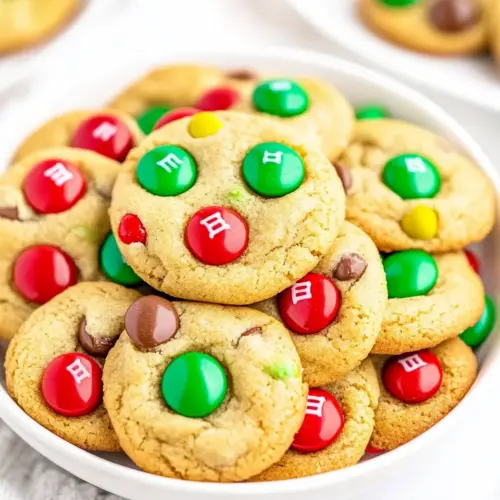
M&M Christmas Cookies
M&M Christmas Cookies deliver a buttery, slightly chewy cookie dotted with melted chocolate and festive red and green candies. This easy, crowd pleasing cookie brings cheerful color and reliable texture, perfect for holiday cookie swaps and school parties. Bake a batch for gifting or a weekend treat, and enjoy cookies that stay soft with crisp edges for days.
Equipment
- Kitchen Scale(optional)
- Hand Mixer
- Baking Sheet
- Cookie Portion Scoop
Ingredients
- 2 1/3 cups all-purpose flour 280 grams Measure precisely to provide the structure and bulk of the cookie dough; contributes gluten that gives chewiness while allowing other ingredients to distribute evenly. Sift or whisk if desired to remove lumps and ensure uniform texture when combined with leaveners and fats.
- 1 teaspoon baking soda 6 grams Act as a chemical leavening agent to help cookies spread and rise slightly; neutralizes acids and creates lift when heated. Dissolve evenly into dry ingredients to avoid uneven pockets of rising during baking.
- 1 1/2 teaspoons cornstarch 5 grams Add light thickening and tenderizing properties to the dough; helps create a softer, cakier crumb by inhibiting gluten development. Blend thoroughly with dry ingredients to distribute small amounts evenly throughout the batter.
- 1/2 teaspoon kosher salt Provide seasoning that enhances and balances the sweetness and chocolate notes; helps control overall flavor perception. Use measured kosher salt to avoid overly salty cookies and to strengthen dough structure slightly.
- 3/4 cup unsalted butter 170 grams, melted (1 1/2 sticks) Contribute fat and richness that tenderizes the crumb and influences spread; melted butter encourages a chewier, slightly crisper edge compared to creamed butter. Use measured melted unsalted butter to control salt levels and incorporate smoothly into sugars and eggs.
- 3/4 cup light brown sugar 160 grams Supply moisture, deep caramel notes, and additional fat which enhance chewiness and color; light brown sugar helps retain softness due to its molasses content. Cream with melted butter and granulated sugar to dissolve and evenly distribute flavor throughout the dough.
- 1/2 cup granulated sugar 100 grams Add sweetness and assist with spreading and texture; granulated sugar helps create crisp edges and balanced sweetness. Combine with brown sugar to achieve desired chew and sweetness ratio in the finished cookie.
- 2 large eggs 100 grams, room temperature Provide structure, moisture, and leavening through coagulation of proteins when baked; eggs also help bind ingredients and contribute to tenderness. Use large eggs at room temperature for better emulsion and incorporation into the batter.
- 2 teaspoons pure vanilla extract 8 grams Contribute aromatic sweetness and depth of flavor that complements chocolate and brown sugar; vanilla enhances overall taste without adding moisture. Stir in with eggs or wet ingredients to evenly infuse flavor throughout the dough.
- 1/2 cup semisweet chocolate chips 85 grams Introduce concentrated chocolate flavor pockets and textural contrast; semisweet chips provide melting points and chocolate bursts in each bite. Fold gently into dough to distribute without causing excessive melting or color bleed.
- 10 tablespoons red and green M&M's 106 grams, divided (1/2 cup + 2 tablespoons for topping) Provide colorful candy pieces for festive appearance and small chocolate-sugar bites; divided amounts allow mixing into dough and extra topping for visual appeal. Press reserved M&M's on cookie tops before baking to maintain bright, intact colors.
Instructions
- In a small mixing bowl, combine the flour, baking soda, cornstarch, and salt with a whisk. Set aside.: You will notice a dry, slightly powdery scent as you whisk the flour and baking soda together, and the cornstarch lightens the mixture visually. This step ensures the leaveners are evenly distributed so cookies rise and brown uniformly. If you skip thorough whisking, pockets of baking soda can create uneven spots or odd flavor. A common mistake is dumping the dry ingredients without mixing, which can lead to uneven texture and blotchy cookies.
- In a medium mixing bowl with a hand mixer, beat the butter, brown sugar, and granulated sugar.: As you beat, the aroma of butter and brown sugar will bloom, and the mixture will look glossy and slightly aerated. This aeration traps small pockets of air that help the cookies puff gently in the oven. Overbeating can incorporate too much air, leading to excessive spreading, so stop once the mixture is smooth and homogenous. If the butter is too hot, it can melt the sugars and upset texture, so let the melted butter cool briefly before mixing.
- Add the eggs and vanilla. Mix until combined.: When you add the eggs and vanilla , the batter will thin slightly and the vanilla scent will become more pronounced. Proper incorporation prevents streaks of egg white and ensures even binding. A common error is adding cold eggs straight from the fridge, which can chill the butter and cause the mixture to seize up. Bring eggs to room temperature to avoid that.
- Add the dry mixture, and mix with a large spoon or rubber spatula until completely combined.: The batter will turn into a cohesive dough with a soft, slightly sticky texture. Using a spatula helps you fold without overworking the dough, which keeps cookies tender. If you use the mixer on high here, you risk developing gluten, which may make the cookies tough. Avoid overmixing and stop as soon as flour streaks disappear.
- Fold in the chocolate chips and M&M's.: Folding introduces the chocolate chips and M&M's without crushing them, so you keep pockets of melty chocolate and intact candies. You should hear a slight crunch as candies mingle into the dough, and visually the dough will be speckled with color. A mistake to avoid is adding the candies to a very warm dough, which can melt the coating; chill briefly if the dough feels too soft before folding.
- Cover and chill for at least 1 hour to prevent the cookies from spreading.: Chilling firms the fat so the cookies hold shape and develop a better crumb. You will notice the dough becomes denser and easier to scoop. Skipping this step is often why cookies spread too thin and lose their soft centers. If you are impatient, a minimum thirty minutes helps, but the full hour gives the best texture.
- Preheat oven to 325°F and line a large baking sheet with parchment paper.: You will smell nothing yet, but preheating ensures a consistent oven environment. Using parchment prevents sticking and encourages even browning on the bottom. A hot oven helps the edges set quickly while the centers remain soft. Oven temperature varies, so use an oven thermometer if you suspect inaccurate temps, because uneven heat can cause inconsistency between batches.
- Use a cookie scoop to measure 3 tablespoons of dough. Roll into a smooth ball. Place 6 on each baking sheet.: Scooping yields uniform cookies so they bake evenly, and rolling into smooth balls encourages even spreading and attractive shaping. You should feel a soft, slightly tacky dough under your hands. If dough is too sticky to roll, briefly chill it to firm up. Crowding the sheet is a common mistake, which causes cookies to merge; leave proper space between each ball.
- Bake for 12-14 minutes, or until the edges begin to brown.: While baking, you will notice the kitchen scent shift to rich, toasty notes as sugars caramelize and butter browns slightly. Look for lightly browned edges and centers that still look set but not dry. The crisp edge and soft center are signs of done cookies. Overbaking is the usual mistake here, which yields a dry cookie, so pull them as soon as edges color.
- While the cookies are still warm, press in the remaining M&M's in (just for looks).: Pressing a few candies on top after baking gives a polished, festive look and lets the candies sit prominently on the surface. You will feel the warm cookie give slightly under the press, and the candies will adhere without melting entirely. Press gently to avoid embedding them too deeply. A misstep is leaving this until the cookies are cold, which makes the candies sit loosely and fall off during transfer.
- Allow the cookies to cool for 10 minutes before transferring to a wire cooling rack.: Cooling stabilizes the interior and completes the set, and you will notice steam fade and the cookie texture firm. Ten minutes lets the bottoms finish crisping while centers remain soft. Move carefully with a spatula to avoid breaking warm cookies. A common mistake is moving them too soon, which can cause them to break or smear on the pan.
Notes
- Make them chewier by increasing the brown sugar slightly and baking at the lower end of the time range, which locks in moisture and produces a soft center.
- Add more festive color by mixing in extra red and green candies, keeping a few to press on top for presentation so each cookie looks intentional.
- Switch chocolate intensity by using dark or milk chocolate chips instead of semisweet to tailor the sweetness level to your preference.
- Portion control by using a smaller scoop, which yields bite sized cookies ideal for cookie plates or gifting, and reduces bake time slightly.
- Make ahead by freezing scooped dough balls on a tray, then transferring to a bag; bake from frozen with an extra minute or two so they set properly.