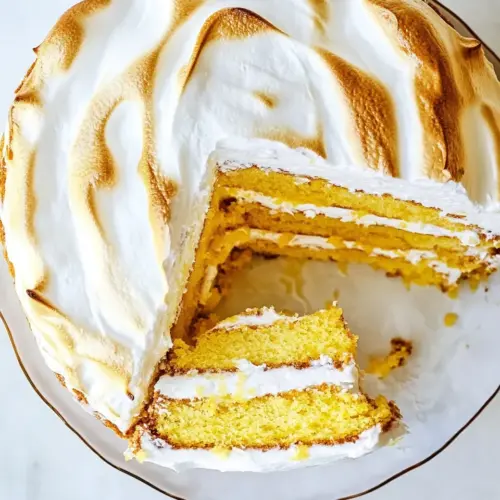
Lemon Meringue Cake
Lemon Meringue Cake delivers a creamy lemon curd, a tender buttery cake, and a light crispy meringue topping. This easy to impressive dessert blends bright citrus with silky textures, perfect for spring gatherings and easy weeknight entertaining. Make it for special occasions to wow guests with a beautiful, torch browned finish and a delicious balance of sweet and tart flavors.
Equipment
- Kitchen Scale (optional)
- 9×5-inch loaf pan
- Stand mixer
- Hand Mixer
- Baking Sheet
- Kitchen Torch (optional)
Ingredients
- 1 1/2 cups all-purpose flour 180 grams Measure and sift to provide structure and bulk for the cake batter; contributes gluten for crumb development and absorbs liquids to create the cake's framework. Use room-temperature handling for even mixing and to ensure consistent texture throughout the bake.
- 1 1/2 teaspoons baking powder 6 grams Spark leavening and lightness by releasing carbon dioxide when activated; balances batter density to produce a tender, risen cake. Ensure even distribution by whisking into the dry ingredients before combining with wet components.
- 1 tablespoon lemon zest 6 grams, from 1 lemon Grate finely to release fragrant citrus oils and bright aromatic notes; enhances overall lemon character and provides bursts of fresh flavor in the crumb. Add early in mixing to allow oils to infuse the batter for a more pronounced lemon scent.
- 1/2 teaspoon kosher salt Season and balance sweetness to enhance other flavors and control taste perception; helps strengthen gluten slightly and improves overall flavor depth. Use measured amount to avoid over-salting which can overpower delicate lemon and sweet elements.
- 1/2 cup European Style Unsalted Butter 113 grams, room temperature (1 stick) Soften and aerate to create tender crumb and rich mouthfeel; beaten with sugar it traps air that expands during baking to lighten texture. Ensure butter is at room temperature for proper creaming and even incorporation.
- 1 cup granulated sugar 200 grams Sweeten and assist with creaming to incorporate air for lift; contributes to browning and moistness while balancing tart lemon flavors. Gradually add during creaming to dissolve properly and produce a smooth, fluffy batter.
- 2 large eggs 100 grams, room temperature Bind and enrich the batter while providing structure and moisture; eggs contribute proteins that set during baking and help emulsify fats for uniform texture. Use at room temperature to achieve optimal volume when beaten and to ensure even mixing.
- 1 teaspoon pure vanilla extract 4 grams Provide subtle sweetness and rounded flavor while enhancing the cake's aroma; vanilla deepens and complements citrus notes without dominating. Add with wet ingredients to distribute flavor evenly throughout the batter.
- 2 tablespoons lemon juice 28 grams, about 1/2 lemon Deliver bright acidity and concentrated lemon flavor while adjusting batter pH for tenderness; juice adds freshness and helps balance the sugar. Measure precisely to maintain proper liquid ratio and avoid making batter too wet.
- 1/2 cup buttermilk 114 grams, room temperature (see note) Add tanginess and acidity to tenderize crumb while contributing slight richness; buttermilk reacts with baking powder for lift and creates a moist, tender texture. Use at room temperature to prevent curdling and ensure even mixing.
- 1/2 cup European Style Unsalted Butter 113 grams (1 stick) Melt or cream to create a rich, buttery layer or component in the recipe; provides additional fat for moistness and flavor depth in fillings or layers. Handle according to the recipe step to maintain intended texture and consistency.
- 1/2 cup fresh lemon juice 114 grams, from 4 lemons Concentrate lemon flavor and acidity for curd or sauce components; fresh juice supplies bright tartness and natural aroma critical to lemon meringue profile. Strain if desired to remove pulp and seeds for a silky, smooth curd.
- 3/4 cup granulated sugar 150 grams Increase sweetness and help stabilize texture in curds or syrups while balancing lemon tartness; sugar also aids in preservation and glossy finish. Dissolve fully when heating to prevent graininess in cooked fillings.
- 8 egg yolks 112 grams Thicken and enrich curd or custard by adding body, protein, and silkiness; yolks create a creamy texture and help set the lemon curd when cooked. Temper yolks gradually with hot liquids to avoid curdling and ensure smoothness.
- 8 egg whites 280 grams (about 1 cup) Aerate and provide lift for the meringue topping while offering structure when whipped; whites whip to stable peaks that brown when baked, creating the signature meringue. Ensure whites are free of fat or yolk for optimal volume and stability.
- 1 cup granulated sugar 200 grams Stabilize and sweeten whipped meringue, contributing to glossy peaks and structure when heated; sugar helps create a crisp exterior and tender interior in baked meringue. Add gradually to egg whites while whipping to dissolve fully and prevent graininess.
Instructions
- Preheat oven to 350°F. Grease a 9×5-inch loaf pan with butter. Add a piece of parchment paper lengthwise to help with removing the cake after baking.: You will smell a faint warmth from the oven as it reaches 350°F , and the room will feel cozier, signaling readiness. Greasing and lining the pan ensures the loaf releases cleanly, avoid skipping the parchment placement because the cake can stick along the bottom edges, tearing the crumb. When the pan is properly prepped, the batter will slide in smoothly and bake evenly. If your oven runs hot, it can brown the edges too quickly; consider using an oven thermometer to verify temperature.
- In a medium mixing bowl, combine the flour, baking powder, zest, and salt.: As you whisk these dry ingredients together, inhale the bright scent of lemon zest mingling with the neutral, floury aroma. This step evenly distributes the baking powder so the rise is uniform through the loaf. A common mistake is failing to break up lumps of flour, which causes uneven texture. Sift or whisk thoroughly until the mixture looks homogenous and the zest is evenly speckled throughout.
- In the bowl of a stand mixer fitted with the paddle attachment, cream the butter and sugar together until fluffy, about 2 minutes.: As you cream butter and sugar , listen for a gentle change in texture and notice the mixture lighten in color; it will smell rich and slightly sweet. Proper creaming aerates the batter for lift, so stopping too early leaves a dense cake. Avoid overheating the butter as melted butter will not trap air the same way, so work with room temperature butter for about two minutes until fluffy.
- Add the eggs, one at a time, mixing on a low speed. Turn the speed up to medium-high and add in the vanilla and lemon juice.: Adding each egg slowly ensures the batter emulsifies, creating a glossy, smooth texture. You may hear a quieter mixer hum as the batter becomes silkier, and a citrusy perfume from the lemon juice will emerge. A mistake here is adding eggs too quickly, which can cause separation. If curdling happens, reduce speed and scrape the bowl, then continue to incorporate gently.
- Put the mixer back on low and add about 1/2 of the flour mixture. Then half the buttermilk. Repeat until all of the flour and buttermilk are incorporated.: The batter should feel silky and slightly thick, with a faint tang from buttermilk . Adding dry and wet in alternating portions prevents overmixing which can develop gluten and lead to toughness. Work slowly; over-beating at this stage will make the crumb tight rather than tender. If you see streaks of flour, stop and fold gently until just combined.
- Pour the batter into the loaf pan. Bake for approximately 50 minutes, or until a toothpick comes out clean. Allow to cool while making your lemon curd and meringue.: As the cake bakes, the kitchen fills with a warm, buttery aroma punctuated by lemon; the top should turn a gentle golden color. A clean toothpick indicates doneness, but be mindful that ovens vary, so start checking at about 45 minutes. Cutting too early traps steam and leads to a gummy interior. Letting it cool slightly before slicing helps maintain shape and keeps the curd from melting the crumb during assembly.
- Prepare the lemon curd. In a heavy bottomed saucepan, melt the butter and lemon juice over high heat. In a separate bowl, whisk the sugar and yolks.: The moment the butter and lemon juice heat, you will sense a bright citrus steam; a heavy bottom pan prevents hotspots so the mixture heats evenly. Whisking sugar with egg yolks creates a pale, cohesive mixture that will incorporate without scrambling. Pouring hot liquid into yolks too quickly causes curdling, so temper gradually. Keep stirring to avoid hotspots and uneven thickening.
- Slowly whisk together the hot lemon mixture into the egg mixture, a little at a time. Place the mixture back into the saucepan, stirring constantly. Allow to thicken for 6-8 minutes.: As the curd cooks, you will notice it deepen in color and become glossy, with a custard like viscosity that coats a spoon. Constant stirring prevents the yolks from scrambling and ensures smoothness. Common errors include cooking at too high a heat which cooks the curd too fast and curdles it; maintain moderate heat and patience for a silky finish.
- Pour the lemon curd into a glass bowl and cover with plastic wrap, pressing down to cover the entire top. Chill for 1 hour or until the cake has cooked and cooled.: Pressing plastic wrap directly onto the surface prevents a skin from forming and preserves that bright, glossy texture. As it cools in the fridge the curd will firm to a spreadable consistency and smell intensely of lemon. If you skip chilling, the curd may be too loose to layer and could make the cake soggy.
- Prepare the meringue: Using a hand mixer, whisk together the egg whites and sugar in a clean metal bowl set over a saucepan of simmering water. Whisk constantly until the mixture is warm and the sugar has fully dissolved, about 1-2 minutes.: Using a hand mixer, whisk together the egg whites and sugar in a clean metal bowl set over a saucepan of simmering water. Whisk constantly until the mixture is warm and the sugar has fully dissolved, about 1 to 2 minutes. : The warm sugar dissolving into egg whites gives a satiny base for glossy meringue; you will feel the bowl warm to the touch. This step is essentially an Italian or Swiss style start that helps stability. If any grease or yolk contaminates the whites they will refuse to whip properly, so ensure everything is spotless.
- Place the meringue mixture in the clean bowl of a stand mixer fitted with the whisk attachment. Whisk on high speed until light and fluffy, usually about 2 additional minutes.: The mixture will transform from glossy to voluminous, with soft peaks that catch the light; you can hear a change in the mixer as it works harder against the aerated foam. The texture should be pillowy and hold its shape. Underwhipping yields a floppy meringue that will not keep peaks, while overwhipping dries it out, so stop when glossy stable peaks form.
- Assemble the cake: Slice the baked and cooled cake into 3 horizontal layers. Trim the sides and top to make 3 even layers.: Slice the baked and cooled cake into 3 horizontal layers. Trim the sides and top to make 3 even layers. : When you slice, the crumb should feel tender but sturdy under the knife, and the aroma of baked lemon will be faintly present. Trimming creates even layers that stack without wobbling. A dull knife can tear the cake, so use a sharp serrated blade and a gentle sawing motion to avoid compressing the crumb.
- Place the bottom of the cake on a rimmed baking sheet. Top with a layer of the lemon curd. Repeat with the second layer of cake and curd. Top finally with the top layer of cake.: Spreading the lemon curd will be tactile, smooth, and glossy; it should cling to the cake rather than run if chilled properly. Stacking on a rimmed baking sheet guards against messy spills. A common mistake is overfilling with curd, which causes slipping; aim for a thin, even layer to hold the structure.
- Using a rubber spatula or offset spatula, cover the entire outside of the cake in meringue. Make peaks or swirls as you go to make it extra pretty.: As you spread the meringue , it feels light and marshmallow like, and sculpting peaks creates areas that will brown beautifully when heated. The meringue insulates the curd slightly, so work quickly to maintain volume. If you press too hard while spreading, you can flatten the peaks and lose the dramatic finish.
- Broil in the oven or use a small hand held kitchen torch to brown the meringue until golden brown. In the oven this would be just about 1 minute, watching carefully. You can also broil just slightly and then further toast the peaks.: Browning releases a toasty, caramel aroma and transforms the meringue surface to crisp edges with a warm, soft interior. If broiling, stay close and watch, because it can go from golden to burnt very quickly; a kitchen torch gives more control. Avoid charring by moving the torch constantly and stopping at the first golden moments.
- Slice and serve!: The final presentation yields layers of tender cake, vibrant curd, and toasted meringue that sparkle on the plate. Use a clean, sharp knife to slice, wiping the blade between cuts for neat servings. A common error is serving too soon, which causes the curd to ooze; allow the assembled cake a moment to settle before cutting.
Notes
- Room temperature ingredients ensure even mixing and a smooth batter, which results in a tender, uniform crumb.
- Use fresh lemons for the clearest, brightest curd flavor; bottled juice lacks the aromatic oils found in fresh juice and zest.
- Chill curd fully before assembly to prevent sliding layers and to make spreading easier and cleaner.
- Scrape the bowl while mixing to make sure ingredients are fully incorporated and to avoid pockets of unmixed flour or butter.
- Test doneness with a toothpick inserted near the center to avoid overbaking; a clean pick means the cake is ready.