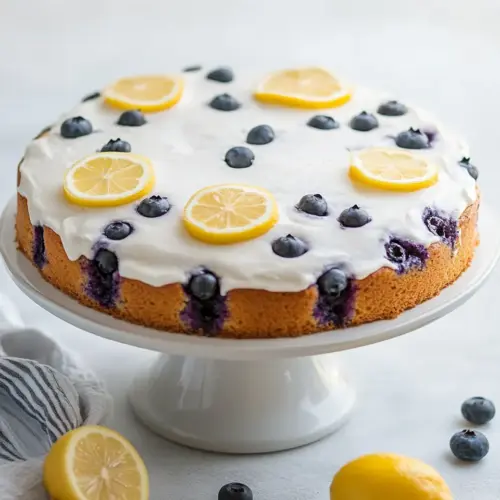
Lemon Blueberry Cake
Lemon Blueberry Cake is a moist, bright dessert with creamy lemon frosting and bursts of juicy blueberries. The tender crumb from Greek yogurt and oil keeps slices soft, while the lemon sugar pairing adds aromatic zip. Ideal for brunch or casual get togethers, this easy to make cake delivers uplifting flavor and a beautiful presentation worth sharing.
Equipment
- 9 by 2 inch round cake pan
- Parchment Paper
- Wire Rack
- Mixing Bowls
- Whisk
- Spatula
Ingredients
- 2 cups all-purpose flour Provide structure and bulk to the cake batter, absorbing liquids and developing gluten for a tender crumb when mixed just until combined. Sift or whisk before measuring to ensure even distribution and lighter texture. Use room-temperature dry ingredients to blend smoothly with wet components.
- 3 teaspoons baking powder Act as a leavening agent to introduce air pockets and help the cake rise evenly during baking. Whisk into the dry ingredients to ensure even dispersion and avoid clumping. Balance with acidic components for optimal lift.
- 1/2 teaspoons salt Season the batter mildly to enhance overall flavor balance and accentuate sweetness and lemon brightness. Dissolve evenly with the dry ingredients to avoid concentrated salty pockets. Small amount is sufficient to improve depth without overt saltiness.
- 1 cup granulated sugar Sweeten the cake and contribute to tenderness by interfering with gluten formation and helping retain moisture. Cream with wet ingredients to aerate and help create a light crumb. Adjust sweetness to taste but follow proportions for intended texture.
- Zest of 1 large lemon Impart bright citrus aroma and concentrated lemon oils that elevate the cake’s flavor without adding liquid, intensifying the lemon profile. Zest should be finely grated to distribute evenly throughout the batter. Combine with sugar to help release essential oils before mixing.
- 2 large eggs, room temperature Bind ingredients together and add richness, structure, and leavening support through protein coagulation during baking. Bring to room temperature so they blend smoothly and trap air when beaten. Beat briefly to incorporate without overmixing.
- 3/4 cup canola, grapeseed, or vegetable oil Provide moistness and tenderness while contributing a neutral-fat base that carries flavors and helps create a soft crumb. Measure by volume and pour at room temperature for even incorporation into batter. Choose a light-flavored oil to avoid masking lemon and blueberry notes.
- 1 cup plain whole milk Greek yogurt Introduce tanginess, moisture, and density with high-fat content that yields a creamy texture and slight richness. Use plain whole milk yogurt to maintain flavor and stability; fold gently to preserve air in the batter. Can also contribute mild acidity to react with leavening agents.
- 1/3 cup fresh lemon juice Add concentrated lemon flavor and acidity to brighten and balance the sweetness while activating baking powder for lift. Strain seeds if needed and measure freshly squeezed juice for optimal flavor. Combine with wet ingredients for even distribution.
- 1 teaspoon pure vanilla extract Provide warm aromatic notes and enhance overall flavor depth with a small amount that rounds out the lemon and blueberry profile. Use pure vanilla extract for the cleanest taste and add to wet mixture to integrate with eggs and yogurt. Avoid imitation extracts for best results.
- 1 1/4 cups blueberries, tossed in 1 tablespoon flour Supply bursts of juicy fruit flavor and visual appeal, while the flour coating prevents them from sinking to the bottom during baking. Use fresh blueberries and toss evenly in flour to create better suspension in the batter. Fold in gently to avoid crushing berries.
- 1 1/2 cups confectioner’s sugar Form a smooth, sweet glaze when mixed with lemon juice and butter, adding shine and extra sweetness to the finished cake. Sift confectioner’s sugar to remove lumps and achieve a silky consistency for drizzling or spreading. Adjust thickness with small amounts of liquid for desired coverage.
- 1 tablespoon unsalted butter, melted Add richness and a glossy finish to the glaze while tempering the tartness of lemon juice for a balanced topping. Melt gently and cool slightly before whisking into confectioner’s sugar to avoid graininess. Use unsalted butter to control overall salt level in the glaze.
- 2 tablespoons fresh lemon juice Concentrate lemon flavor and acidity in the glaze or drizzle, intensifying brightness and cutting through sweetness for a fresh finish. Use freshly squeezed juice for the cleanest citrus note and adjust amount to reach your preferred tanginess. Incorporate gradually to achieve desired glaze consistency.
- Blueberries, for garnish, optional Provide fresh fruity garnish and extra visual appeal, offering bursts of natural sweetness and color on the finished cake. Rinse and pat dry before arranging to prevent excess moisture on the glaze. Use sparingly or generously according to presentation preference.
Instructions
- Preheat oven to 350 degrees. Grease a 9 by 2-inch round cake pan with butter or nonstick cooking spray. Line the bottom with a round of parchment paper and grease the paper. Set the pan aside.: When you set the oven to 350 degrees , you should notice the room begin to fill with a gentle warm scent typical of an oven coming to life. Proper preheating ensures the cake gets an immediate, even spring in the first minutes of baking, which helps create an even crumb. A common mistake is placing the pan into an oven that is not fully up to temperature, which can lead to a dense center. Use an oven thermometer if your oven runs cool, and give it time to stabilize before baking.
- In a medium bowl, sift together the flour, baking powder, and salt.: Greasing the pan helps prevent sticking and protects the delicate crumb. I trace the bottom and sides with softened butter , then press a round of parchment into the base for an easy release. The tactile cue is when the parchment lays flat and the butter glows slightly. A common error is skimping on grease, which can tear the cake when you invert it; be thorough so the cake slides out cleanly.
- In a small bowl, combine the sugar and lemon zest. Rub the sugar and zest together with your fingers until fragrant. Pour the mixture into a large bowl. Add the eggs, oil, yogurt, lemon juice, and vanilla extract. Stir until well combined and smooth.: Lining the pan ensures the cake will release perfectly, and greasing the parchment helps it adhere so it does not shift. Smooth the paper so it sits flush against the pan. If the parchment crinkles, the cake bottom can show marks; smoothing avoids that and gives a clean edge.
- Add the dry ingredients to the wet ingredients and whisk until there are no lumps and the batter is smooth. Gently fold in the blueberries.: Letting the prepared pan rest means you can move quickly when the batter is ready. This downtime is a good moment to premeasure ingredients so you stay organized. If you rush and forget the pan, you risk overmixing the batter while preparing the tin, so doing this first is practical and calming.
- Pour the batter into the prepared pan and smooth the top. Bake for 35-50 minutes or until a toothpick inserted in the center comes out clean, and the cake bounces back when lightly pressed. Mine takes around 45 minutes, but check early to be safe. Remove the cake from the oven and let cool on a wire rack for 20 minutes. Run a butter knife around the edges to gently release the cake from the sides of the pan. Turn it out onto a wire rack and carefully remove the parchment paper. Let the cake cool completely.: Sifting aerates the dry mix and removes lumps, creating a light texture in the final cake. The visual cue is a pale, powdery mixture that falls freely. If you skip sifting, the leavening may not distribute evenly, which can produce uneven rise; whisk thoroughly if you cannot sift.
- While the cake is cooling, make the lemon frosting. Sift the confectioner’s sugar into a small mixing bowl. Add the melted butter and the lemon juice. Whisk together until smooth.: Rubbing granulated sugar with the lemon zest releases fragrant oils that infuse the sugar. Use your fingertips to rub until the sugar smells intensely citrusy, a little wet from the oil. Missing this step leaves the zest's aroma muted, so take the moment to coax out those oils for maximum flavor.
- When the cake is cool, pour the frosting onto the center of the cake. Smooth with a spatula or butter knife. Garnish with fresh blueberries, if desired. Cut into pieces and serve.: The aroma will be unmistakable, a bright citrus perfume that promises flavor in every bite. This simple action distributes the zest and prevents concentrated pockets of zest in the cake. A mistake is to skip rubbing and simply stir, which reduces the release of essential oils; use your fingers for best results.
- Pour the mixture into a large bowl: Moving the scented sugar into a larger bowl gives you space to whisk the wet ingredients. At this stage the bowl will carry the lemon scent, which is a good sign. If the bowl is too small, you risk splashing when combining the wet ingredients; use a roomy bowl to keep things tidy.
- Add the eggs, oil, yogurt, lemon juice, and vanilla extract: When these wet elements meet, the batter begins to look silky. I crack the eggs in one at a time, then whisk in the oil , Greek yogurt , lemon juice , and vanilla . The mixture should be smooth and slightly glossy. If the ingredients are cold, the batter may seize or look lumpy; bringing eggs to room temperature helps achieve a cohesive emulsion.
- Stir until well combined and smooth: A smooth batter indicates the fat and liquids are emulsified around the sugar. The texture should be uniform and pourable but not thin. Overmixing will develop gluten, resulting in a tougher crumb, so stop as soon as the last streaks disappear.
- Add the dry ingredients to the wet ingredients and whisk until there are no lumps and the batter is smooth: Folding the dry into the wet gently preserves air while eliminating flour pockets. Use a whisk or spatula and stop when the batter is uniform; small streaks of flour can mean uneven pockets after baking. If you overwork the batter, the cake can become tight, so keep movements deliberate and minimal.
- Gently fold in the blueberries: Folding in the blueberries by hand prevents them from breaking and bleeding too much color into the batter. Look for an even distribution of berries without streaks of blue; a few swirls are fine. A common mistake is vigorous stirring, which bruises the berries and creates purple swirls rather than pretty pockets of fruit.
- Pour the batter into the prepared pan and smooth the top: Use a spatula to level the surface so the cake rises evenly. The batter should settle into the pan with a slightly glossy top. If you leave peaks, the cake may dome unevenly; smoothing helps achieve a flat, attractive top for frosting.
- Bake for 35 to 50 minutes or until a toothpick inserted in the center comes out clean and the cake bounces back when lightly pressed: As the cake bakes, aromas intensify and the top will take on a warm golden color. The toothpick test and a gentle spring when pressed are the best cues that the interior is done. Avoid opening the oven repeatedly, which can cause the center to sink. My cake often needs around 45 minutes, but ovens vary so check early to avoid overbaking.
- Remove the cake from the oven and let cool on a wire rack for 20 minutes: Cooling on a rack allows air to circulate so the cake does not sweat. You will notice steam release and the cake will firm slightly as it cools. If you try to unmold while too hot, the cake can break; patience here prevents a ruined presentation.
- Run a butter knife around the edges to gently release the cake from the sides of the pan: This step helps the cake free itself without tearing. The knife should glide and you may feel the cake lift slightly. Forcing the cake out can crack it, so be gentle and methodical.
- Turn it out onto a wire rack and carefully remove the parchment paper: Inverting the cake onto the rack reveals the base, which should be even and golden. Peel the parchment away slowly so you do not pull crumbs. If the cake sticks, slide the knife under the parchment as you lift.
- Let the cake cool completely: Cooling fully before frosting prevents the glaze from melting into the crumb. It may feel like a long wait, but the final texture and appearance are worth it. If you frost while the cake is warm, the frosting will run and lose its glossy finish.
- While the cake is cooling make the lemon frosting: As you sift the confectioner’s sugar into a bowl, the powder will fall like soft snow. Add the melted butter and lemon juice , then whisk to a smooth, glossy consistency. If the frosting seems too thick, a splash more lemon juice thins it; too thin and it will run off, so aim for a pourable yet clingy texture.
- Sift the confectioner’s sugar into a small mixing bowl: Sifting removes lumps for a silky glaze. The sound is faint and dry, the texture light. If you skip sifting, you risk gritty spots in the frosting, so take the extra minute for a smooth result.
- Add the melted butter and the lemon juice: The butter adds richness while the lemon juice adds brightness and thins the sugar into a glossy glaze. Whisk until it looks smooth and shines. A common issue is adding too much liquid at once, which makes the glaze runny; add juice gradually.
- Whisk together until smooth: The final frosting should be silky and hold on a spoon without sliding off quickly. If you see small lumps, continue whisking until they vanish. Overwhisking will incorporate air that changes the texture, so reach a smooth balance and stop.
- When the cake is cool pour the frosting onto the center of the cake: Pouring the glaze in the center lets it spread naturally toward the edges, forming a glossy cap. The visual cue is a thin sheet that slowly creeps outward. Pouring too early while the cake is warm will cause the frosting to melt into the crumb, so ensure the cake is fully cool.
- Smooth with a spatula or butter knife: Gently guide the frosting to the edges for a neat finish. The surface should be even and reflective. Heavy handed spreading can reveal crumbs, so use light motions.
- Garnish with fresh blueberries if desired: Scatter fresh blueberries for color and a juicy counterpoint to the glaze. They make the cake visually striking and add little pops of fruit in each slice. If you add berries, press them slightly into the glaze so they stay put.
- Cut into pieces and serve: Use a sharp knife for clean slices and enjoy the contrast of moist crumb, bright glaze, and berry bursts. The cake pairs well with coffee or a simple tea for an effortless treat.
Notes
- Room Temperature Ingredients: Make sure eggs and Greek yogurt are at room temperature so the batter emulsifies smoothly and you avoid a curdled texture.
- Oven Accuracy: Use an oven thermometer to confirm your oven is actually at 350 degrees, which prevents under or overbaking and helps you hit the ideal crumb.
- Don’t Overmix: Stir the batter only until combined to keep the cake tender; overmixing develops gluten and yields a tougher texture.
- Blueberry Care: Toss berries in a tablespoon of flour to stop them from sinking, and fold gently to avoid bruising and color bleeding.
- Glaze Consistency: Adjust the frosting by adding more confectioner’s sugar to thicken or a touch more lemon juice to thin, aiming for a pourable but clingy finish.