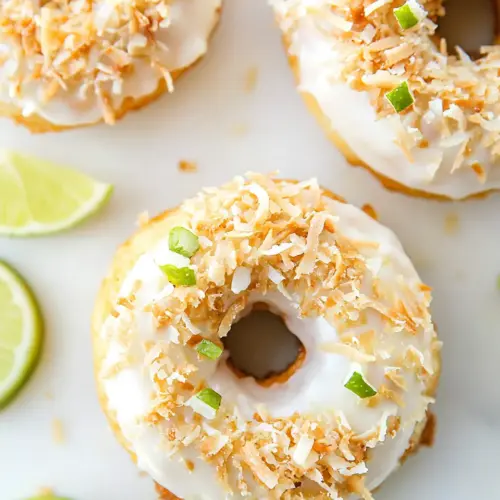
Key Lime Coconut Donuts
Key Lime Coconut Donuts are bright, tender rings with zesty lime and tropical coconut flavor. These easy baked donuts deliver a soft crumb, glossy key lime glaze, and toasted coconut crunch, perfect for a summer brunch or casual gathering. They are quick to make and irresistibly fragrant, a simple treat worth baking today.
Equipment
- Doughnut pan
- Mixing Bowls
- Whisk
- Rubber spatula
- Cooling rack
- Skillet for toasting coconut
Ingredients
- 1 and 1/4 cups all purpose flour Provide structure and bulk to the donuts, creating the framework for a tender crumb when combined with wet ingredients. Sift or whisk before measuring to ensure even distribution of leavening agents. Use slightly packed measuring for consistent results in baked goods.
- 1 teaspoon baking powder Lighten the batter by producing gas bubbles during baking, helping donuts rise and gain a light texture. Measure level and ensure freshness for reliable leavening. Mix into the dry ingredients to distribute evenly before combining with wet components.
- 1/2 teaspoons salt Balance flavor and strengthen gluten network slightly while controlling yeast or chemical leavening activity. Dissolve into dry mixture to avoid localized salty pockets that could affect taste. Use a measured pinch if adjusting for dietary sodium considerations.
- 1/2 cup granulated sugar Add sweetness and tenderness while promoting browning and moisture retention in the donut crumb. Cream briefly with oils or mix with dry ingredients to dissolve granules for even sweetness. Adjust slightly if preferring less sweet or if additional glazes will be used.
- 2 teaspoons fresh lime zest Deliver bright citrus aroma and concentrated lime flavor that complements the key lime juice in the glaze. Zest just the colored outer peel to avoid bitter white pith and measure after zesting for accuracy. Fold into batter to evenly distribute aromatic oils for a fresher flavor profile.
- 2 1/2 tablespoons coconut oil, melted Contribute fat for moistness, richness, and subtle coconut flavor while helping tenderize the crumb. Melt and cool slightly before whisking into batter to prevent cooking the egg when combined. Use refined or unrefined coconut oil depending on desired coconut intensity.
- 1 large egg, at room temperature Bind ingredients together, provide structure, and aid in emulsifying fats for a uniform batter. Bring to room temperature to ensure smooth incorporation and reduce risk of deflating the batter. Beat lightly with wet ingredients until just combined to maintain tender texture.
- 1/2 cup coconut milk Moisten the batter and contribute mild coconut flavor and richness while affecting crumb density. Shake or stir canned coconut milk before measuring to mix solids and liquid for consistent texture. Combine with egg and oil for an even wet mixture prior to adding to dry ingredients.
- 1 cup confectioners' sugar Create a silky, sweet glaze base that dissolves easily and firms to a smooth finish on the donuts. Sift before use to avoid lumps and whisk with liquid until glossy. Adjust consistency with more or less liquid for dipping or drizzling as desired.
- 1 and 1/2 tablespoons key lime juice Provide bright, tart acidity to balance sweetness in the glaze and reinforce lime character. Measure fresh key lime juice for authentic flavor intensity and avoid bottled substitutes for best results. Stir into confectioners' sugar gradually to achieve desired glaze thickness.
- 1 teaspoon lime zest Intensify lime aroma and add fresh citrus notes to the glaze or garnish for layered flavor. Zest finely and sprinkle into the glaze or on finished donuts for visual appeal and aroma. Avoid including the bitter white pith when zesting to keep flavors bright.
- 1/8 teaspoons salt Enhance overall flavor balance by adding a subtle saline contrast that brightens sweetness without being detectable. Measure precisely as small amounts can strongly influence taste. Dissolve into the glaze for even distribution and to prevent graininess.
- 1/2 cup shredded coconut, toasted Provide chewy texture contrast and pronounced coconut flavor when toasted, adding visual appeal and nuttiness. Toast until golden brown and cool completely to maintain crispness on the donut surface. Sprinkle on top of glaze for crunch and aromatic enhancement.
- 2 teaspoons lime zest Amplify citrus fragrance and finish by layering additional lime zest as a garnish or mix-in for intense aroma. Zest finely and apply sparingly to avoid overpowering other flavors while delivering a fresh scent. Use as a final touch to visually signal the lime profile of the donuts.
Instructions
- Preheat oven to 350 degrees (F). Generously grease a doughnut pan; set aside.: You will notice an instant warm, dry smell as the oven comes up to temperature, which signals the correct environment for even baking. Getting the pan well greased prevents sticking and helps the donuts release cleanly, so use a pastry brush or nonstick spray to coat the molds thoroughly, paying attention to the inner edges where batter can cling. A common mistake here is skimping on grease, which causes donuts to tear when unmolding. If you have a silicone pan, still grease lightly for the best finish. Proper preheating also sets the stage for an immediate burst of steam inside the batter, aiding rise and forming a delicate crust that contrasts with the tender interior.
- In a small bowl whisk together flour, baking powder and salt; set aside.: The dry ingredients will smell faintly of flour and a hint of mineral tang from the baking powder, a subtle sign they are ready to work. Sifting or whisking distributes the leavening evenly, which prevents pockets of metallic taste and ensures a uniform lift. If you skip this blending step, you risk uneven rise and dense spots in the crumb, so take the minute to whisk until everything looks homogeneous. This step also removes lumps, making it easier to fold into the wet mixture without overmixing.
- In a large bowl combine the granulated sugar and lime zest; mix together with your fingers until zest is evenly distributed in the sugar. Add in the melted coconut oil and, using a whisk, mix until combined. Beat in the egg, then stir in coconut milk.: Rubbing the zest into the sugar releases fragrant citrus oils, and you should see tiny green flecks throughout the granulated sugar, which is a good visual cue. Once you add the melted coconut oil , the mixture will look glossy and slightly looser, and whisking helps emulsify fat into the sugar. When you beat in the large egg , the mixture will thicken and gain a silky sheen; this is the moment flavors marry. Stirring in the coconut milk gives the batter body and a subtle coconut aroma. A common pitfall is adding hot oil, which can partially cook the egg; ensure the oil is only warm. Listen for the quiet swirl as you whisk, and smell the lime lift that tells you the base is flavorful.
- Add in the dry ingredients and gently fold the mixture together using a rubber spatula, stirring only until mixture is evenly combined.: At this point you will see streaks of dry flour disappear into a thick batter, and the key is to fold with gentle turns to keep the texture tender. Overmixing develops gluten and results in dense donuts, so stop folding as soon as the batter looks uniform. The batter should be thick but pipeable or spoonable; if it feels too stiff, a tiny splash more coconut milk can soften it. Avoid vigorous stirring that introduces extra air, because that can cause irregular air pockets and uneven rise during baking.
- Divide the thick batter evenly among the molds of your prepared pan, filling each mold up 2/3 of the way. Bake for 10-11 minutes, or until firm and lightly golden on the tops.: Filling to two thirds creates room for the batter to rise without overflowing, and as the donuts bake you will notice a subtle aroma of toasted coconut and baked flour. The tops should become springy to the touch and show a light golden hue; a toothpick inserted into the inner ring should come out clean. Avoid opening the oven frequently, because temperature fluctuations can deflate the rise. If donuts brown too quickly, lower the oven temperature slightly; if they remain pale after the time, give them an extra minute or two and watch closely.
- Remove pan from oven and allow doughnuts to cool for at least 10 minutes in the tray before transferring to a cooling rack to cool completely.: Cooling in the pan allows the structure to set gently, preventing the donuts from collapsing. You will feel the heat fade from the tray and see the surface become drier, which are cues the donuts are stabilizing. A common error is trying to unmold while still hot, which leads to tearing; patience here preserves their shape. Once transferred to a rack, they will cool evenly and you can run your hand above them to gauge temperature before glazing, since warm donuts will melt the glaze too much.
- Once cool, dip each doughnut in glaze and serve! The glaze does take a few minutes to set, so you may want to wait about 5 minutes after glazing to dig in... but it's hard!: The glaze should be glossy and cling to the donut, creating a smooth sheen that catches the light. Dipping produces a satisfying swoosh sound and a thin veil of glaze that will begin to dry in a few minutes; this is when the scent of lime intensifies. Resist the urge to stack glazed donuts too soon, because the glaze will stick. If your glaze seems too runny, a short chill in the fridge for the donuts helps it set quicker. The visual cue of a shiny surface that dulls slightly signals the glaze is ready for garnishing.
- In a wide, shallow dish combine juice and sugar, and whisk to combine. If the glaze appears too thick, add a little more lime juice until desired consistency is achieved; if glaze appears too thin, add a little more confectioners' sugar until desired consistency is achieved. Carefully dip cooled doughnuts in the glaze, and let rest for 5 minutes - if you can wait - before serving. If you'd like your donuts to look exactly like mine do in the photos, top each glazed donut with toasted coconut and extra lime zest.: When you whisk the key lime juice into the confectioners' sugar , the mixture will turn into a satiny glaze that smells unmistakably citrusy. Adjusting viscosity is a tactile process; the ideal glaze will coat the back of a spoon and drip slowly. After dipping, rest the donuts on a rack to allow excess glaze to drip away. Sprinkle the toasted shredded coconut and additional zest immediately so they adhere before the glaze sets. One common mistake is glazing while donuts are warm, which causes the glaze to run off and pools beneath, losing the pretty finish.
Notes
- Room Temperature Ingredients allow quicker emulsification and a more uniform batter texture, which helps the donuts bake evenly.
- Rubbing Zest with Sugar releases essential oil that perfumes the batter, giving a brighter lime aroma in every bite.
- Control Coconut Toasting by using medium heat and stirring constantly to develop nutty notes without burning, which would create bitterness.
- Adjust Glaze Consistency by adding more key lime juice to thin or more confectioners' sugar to thicken, aiming for a slow drip from a spoon.
- Fill Molds Consistently by using a piping bag or a zip top bag with a corner snipped, ensuring each donut bakes the same and you avoid uneven tops.