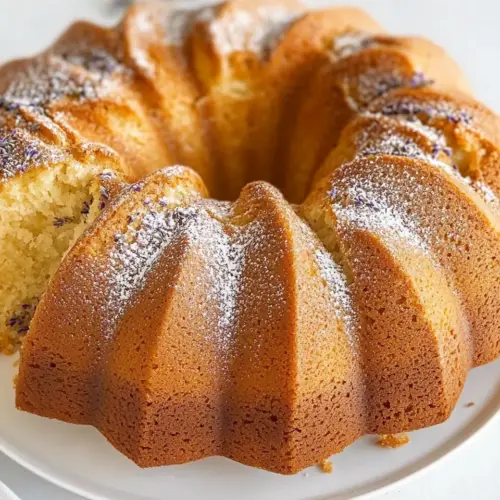
Honey Lavender Bundt Cake
Honey Lavender Bundt Cake is a tender, floral loaf that combines creamy crumb, subtle lavender aroma, and warm honey glaze. This easy yet elegant cake uses cake flour and sour cream for a moist texture, while lemon zest brightens the profile, making it perfect for brunch or a special afternoon treat. Try it to enjoy a refined, unforgettable slice.
Equipment
- Bundt Pan
- Spice grinder
- Instant read thermometer
- Wire Rack
- Mixing Bowls
- Offset Spatula
Ingredients
- 2 cups (400 grams) granulated sugar, divided Provides sweetness and structure when creamed with fat; divided quantities allow for caramelization or a topping while preserving batter balance. Helps tenderize the crumb and contributes to browning during baking. Use superfine or granulated sugar measured accurately for consistent texture.
- 1 tablespoon (3 grams) dried culinary lavender (see Notes) Infuses a floral, aromatic note that complements honey and lemon; dried culinary lavender should be food-grade and lightly crushed to release oils. Can be steeped in warm liquid or mixed directly into batter for delicate flavor distribution. Avoid overusing to prevent a soapy aftertaste.
- 1 cup (224 grams) neutral oil Adds moistness and a tender crumb while allowing the cake to remain soft; neutral oil does not compete with delicate lavender and lemon flavors. Contributes to even texture and helps extend shelf life compared with butter-based cakes. Measure by weight or standard cup for consistent results.
- 5 large eggs (250 grams), room temperature Provides structure, moisture, and emulsification; eggs bind ingredients and create lift when beaten. Room-temperature eggs incorporate more evenly into batter, yielding a smooth emulsion and improved volume. Weighing eggs ensures accuracy, especially in delicate cakes.
- 1/2 cup (170 grams) plus 2 tablespoons (42 grams) honey, divided Contributes concentrated floral sweetness and moisture; dividing the honey lets some flavor infuse the batter while reserved portion can glaze or finish the cake. Adds tenderness and enhances browning due to its sugars. Use mild-flavored honey that complements lavender and lemon.
- 2 tablespoons (10 grams) packed lemon zest (about 3 large lemons) Delivers bright citrus aroma and essential oils that cut through sweetness; packed lemon zest intensifies lemon character without adding liquid. Balances floral lavender and honey while enhancing overall freshness. Use only the yellow outer peel, avoiding bitter white pith.
- 1 teaspoon (4 grams) vanilla extract Imparts warm, familiar sweet flavor and enhances other aromatics; vanilla extract rounds and deepens the cake’s overall taste profile. Adds subtle complexity without overpowering the lavender and lemon. Use pure vanilla for best results.
- 2 1/2 cups (312 grams) unbleached cake flour Forms the cake's primary structure while producing a tender, delicate crumb; cake flour’s lower protein yields softer texture than all-purpose flour. Sift or whisk to aerate and ensure uniform mixing with other dry ingredients. Measure by weight for consistent results.
- 1 1/4 teaspoons (3.75 grams) kosher salt Enhances flavor balance and controls sweetness; kosher salt season the batter to brighten and deepen flavors. Dissolves into the mixture to ensure even seasoning throughout the cake. Adjust type of salt only if recalculating volume measurements.
- 1/2 teaspoon (2.5 grams) baking soda Provides gentle leavening and reacts with acidic components to create lift; baking soda helps the cake rise and achieve a light texture. Must be evenly distributed to avoid metallic or uneven pockets. Combine with sour cream or honey-acid to activate fully.
- 1 cup (240 grams) sour cream, room temperature Adds tang, moisture, and acidity that tenderizes the crumb and activates baking soda for lift; room-temperature sour cream blends smoothly into batter. Contributes richness and a subtle tang that balances sweet honey and floral lavender. Use full-fat sour cream for best texture and flavor.
Instructions
- Preheat oven to 300°F (150°C).: Warm air and a steady low temperature create even baking for this deep Bundt shape, which helps the center cook without the edges overbrowning. You should feel a gentle rise in the smell of warm kitchen air as the oven comes to temp. A common mistake is rushing to bake in an oven that is not fully heated, which can cause uneven rise and a dense center, so always wait until the oven indicator shows stable heat.
- In a spice grinder, combine 1/4 cup (50 grams) sugar and lavender; process until lavender is finely ground and mixture is combined. Transfer to a small bowl, and add remaining 1 3/4 cups (350 grams) sugar, stirring until well combined.: The scent should open up as the lavender is ground, releasing sweet floral oils into the sugar so the aroma becomes warm and fragrant rather than sharp. The texture of the lavender sugar will be powdery and slightly perfumed, which helps disperse flavor evenly in the batter. Avoid leaving large pieces of lavender, since they can create bitter pockets; if you find clumps, regrind briefly.
- In a large bowl, whisk together 1 1/2 cups (300 grams) lavender sugar, oil, eggs, 1/2 cup (170 grams) honey, lemon zest, and vanilla until well combined.: You will notice the mixture thicken and glisten as the oil and honey emulsify with the eggs, and the lemon zest releases bright citrus oils that pop visually and aromatically. The batter will smell floral, sweet, and citrusy, which is the goal. A common issue here is over-whisking, which can incorporate too much air and cause the cake to dome or crack, so whisk just until homogeneous.
- In a medium bowl, whisk together flour, salt, and baking soda. Gradually add flour mixture to sugar mixture alternately with sour cream, beginning and ending with flour mixture, whisking just until combined after each addition and stopping to scrape sides of bowl.: As you fold in the cake flour and sour cream , the batter should become thick but still pourable, with no streaks of flour. The sour cream will smooth the batter and add a slight tang that balances sweetness. If you overmix, gluten will develop and the cake may be tough, so stop when the last streaks disappear and scrape the bowl cleanly.
- Spray a 10-cup Bundt pan with baking spray with flour. Pour batter into prepared pan. Tap pan on a kitchen towel-lined counter a few times to release any air bubbles. (Pan will be quite full, but batter will not overflow.): Filling the Bundt pan almost to the top is normal; the batter will settle as it bakes. Tapping helps bubbles surface and pop, preventing large tunnels in the crumb. Be mindful of spills, because sugary batter that drips can darken and smoke in the oven. If your pan seems overfull, use a small spatula to even the top rather than pressing down, which can degas the batter too much.
- Bake until a wooden pick inserted near center comes out clean and an instant-read thermometer inserted near center registers at least 205°F (96°C), 1 hour and 12 minutes to 1 hour and 20 minutes, rotating pan after 50 minutes of baking and loosely covering with foil to prevent excess browning, if necessary. Let cool in pan for 20 minutes. Using a small offset spatula, gently loosen cake from center and edges of pan. Invert cake onto a wire rack; gently tap wire rack with pan on counter a few times to help loosen cake. Remove pan, and place wire rack on a rimmed baking sheet.: As the cake bakes, the kitchen will fill with a warm, honeyed floral aroma and the crust should develop a deep golden color. Rotating the pan encourages even color, and tenting with foil stops the top from getting too dark. Cooling in the pan for the prescribed time lets the crumb set so the cake releases cleanly; forcing it too soon risks breakage. If the cake sticks, wait a few extra minutes and try again, sliding a small offset spatula around the edges carefully.
- In a small microwave-safe bowl, heat remaining 2 tablespoons (42 grams) honey on high in 10-second intervals, stirring between each, until loose and fluid. Quickly and carefully brush over warm cake. Let cake cool completely.: Warm honey is thinner and spreads easily, producing a shiny, slightly sticky surface that locks in moisture and enhances color. The aroma will intensify as the honey heats and melds with the lavender scent. Be cautious with hot honey, and brush gently to avoid gouging the soft crumb. A frequent mistake is waiting too long to brush, which makes the honey less likely to adhere and reduces the glossy finish.
- Cover cooled cake with remaining 1/2 cup (100 grams) lavender sugar, gently pressing to adhere.: The final sugar coating should feel slightly velvety and fragrant, giving each slice a faint sparkle and a whisper of lavender on the tongue. Press lightly so the sugar bonds to the honey layer without dissolving completely, preserving texture contrast. If you press too hard, you may embed sugar into the crust and lose the delicate visual effect, so a gentle touch is best.
Notes
- Temperature matters, always bring eggs and sour cream to room temperature before mixing. Room temperature ingredients integrate more smoothly, creating a uniform batter and helping the cake rise evenly. Cold ingredients can cause curdling, which leads to uneven texture and possible dense pockets.
- Measure precisely, especially with cake flour and leaveners. Spoon and level your flour for accuracy. Too much flour yields a dry, heavy crumb; too little can make the cake collapse. Using a scale, when possible, gives consistent results across bakes.
- Mind the lavender amount, start with the recipe quantity and only increase slightly if you prefer a pronounced floral note. Overdoing lavender can quickly become soapy, so increase in small increments and taste your ground lavender sugar first.
- Brush while warm, heat the honey until it is fluid and apply to the warm cake to lock in moisture and add shine. If you wait until the cake is cold, the honey will not absorb and the crust may be sticky rather than glossy.
- Store properly, keep the cake covered at room temperature for up to three days or tightly wrapped in the fridge for longer life. Bring to room temperature before serving to let the honey sheen soften and the aroma reawaken.