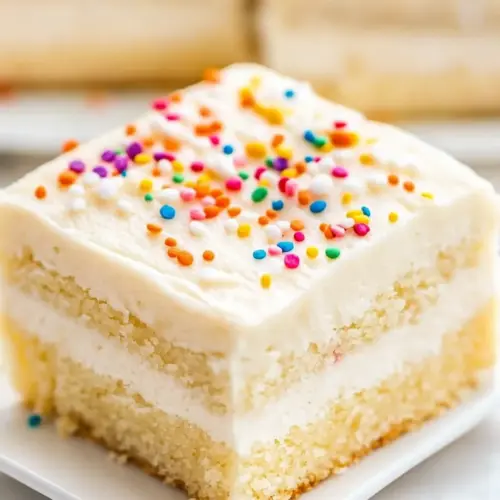
Frosted Sugar Cookie Bars
Frosted Sugar Cookie Bars are a creamy, tender traybake with a soft, buttery base and light vanilla frosting topped with sprinkles. This easy crowd pleasing dessert is perfect for bake sales, parties, or a cozy afternoon treat. The simple method yields consistently soft centers and golden edges, making it a must make when you want a reassuringly sweet finish to any gathering.
Equipment
- 9x13-inch Baking Pan
- Electric Mixer
- Wire whisk
- wire cooling rack
- Rubber spatula
Ingredients
- 21/2 cups (312.5 g) all-purpose flour Provide structure and bulk to the bars, forming the base of the dough while contributing tenderness when properly measured and mixed; sift or whisk for even distribution before combining with wet ingredients to avoid lumps.
- 1 teaspoon baking powder Leaven gently by creating air pockets that help the bars rise slightly and stay tender; whisk into dry ingredients to ensure even distribution and predictable texture.
- 1/2 teaspoon (0.5 teaspoon) baking soda React with acidic components to produce carbon dioxide for lift and a lighter crumb; measure accurately and avoid overmixing to prevent soapy flavors or excessive rising.
- 1 teaspoon salt Enhance overall flavor balance and strengthen gluten network slightly for improved texture; dissolve evenly within dry ingredients to season the dough throughout.
- 3/4 cup (170.25 g) unsalted butter, at room temperature Cream for richness and moisture while incorporating air when beaten with sugar; ensure it is at room temperature so it blends smoothly with cream cheese and sugars for a tender crumb.
- 4 ounces (113.4 g) cream cheese, at room temperature Add tangy richness and contribute to a soft, tender crumb while improving moisture and flavor depth; beat with butter to create a smooth, creamy base for the cookie batter.
- 11/2 cups (300 g) granulated sugar Sweeten and tenderize by absorbing fat and liquid, helping create a fine crumb and contributing to spread; creamed with butter and cream cheese to incorporate air into the batter.
- 1 egg Bind ingredients together, provide moisture, emulsify fats, and contribute to structure and richness; bring to room temperature to ensure even incorporation and prevent curdling.
- 2 teaspoons vanilla extract Impart aromatic flavor and complexity to both the bars and frosting, rounding out sweetness with a warm, floral note; add with other wet ingredients for uniform distribution.
- 1 cup (227 g) unsalted butter, at room temperature Contribute creaminess and fat to the frosting, creating a silky texture and stable spread while carrying flavor; ensure it is softened to room temperature for smooth whipping.
- 21/2 cups (300 g) powdered sugar Sweeten and stabilize the frosting while providing structure and pipeability; sift to remove lumps and add gradually to reach desired consistency and sweetness.
- 1 tablespoon vanilla extract Flavor the frosting with a warm, aromatic note and enhance the overall sweetness profile; stir in toward the end of mixing to preserve vanilla character without overworking.
- Rainbow sprinkles, for decorating Decorate and add a colorful, crunchy contrast to the soft, sweet bars; sprinkle immediately after frosting to ensure proper adhesion and an attractive finished appearance.
Instructions
- Make the Cookie Bars: Preheat oven to 350 degrees F. Grease a 9×13-inch baking pan or line with parchment paper; set aside.: When you open the oven and hear the faint hiss of heat, the aroma of warm vanilla and butter will begin to fill the kitchen, signaling the start of caramelization and browning that gives the edges their pleasant chew. Greasing or lining your 9 by 13 inch pan ensures the bars release cleanly once baked. A common mistake is not preheating the oven fully, which can lead to uneven rise and a dense center, so give your oven the full time to reach 350 degrees F. Listen for a gentle, steady crackle from the oven as moisture escapes during the first half of baking, and look for a light golden color at the edges as your visual cue that the bars are approaching doneness.
- In a medium bowl, whisk together the flour, baking powder, baking soda, and salt; set aside.: The dry mix should look uniform, and whisking breaks up any lumps in the flour while distributing the leaveners evenly, which prevents pockets of bitter baking soda or pinched spots of baking powder. If your mixture is clumpy, sift it or press through a mesh to loosen it up. A frequent oversight is dumping the dry and wet ingredients together without first combining the dry, which can yield uneven texture and places that are overly salty or metallic from leavening agents.
- Using an electric mixer, cream together the butter and cream cheese on medium speed until smooth, about 1 minute. Add the sugar and continue to beat until light and fluffy, about 3 minutes. Add the egg and vanilla extract and beat to combine, about 1 minute. Reduce the mixer speed to low and gradually add the flour mixture, mixing only until barely combined. Use a rubber spatula to finish mixing, ensuring there are no pockets of flour remaining.: You will notice the mixture lighten in color and take on a silky sheen as air is incorporated, which helps create a tender crumb. Adding the granulated sugar and beating until light and fluffy is where you intentionally trap tiny air bubbles that expand in the oven for lift. When you add the egg and vanilla extract , the batter will become more cohesive. Reduce speed and add the flour mixture only until barely combined to avoid overworking the gluten which would make the bars tough. A common error here is overmixing on high speed, which makes the dough dense, so switch to a spatula for the final fold to ensure no streaks of flour remain.
- Using a spatula, spread the dough into an even layer in the prepared pan (the dough will be thick!). Bake until light golden brown and a toothpick inserted in the center comes out clean, 20 to 25 minutes. Place the pan on a wire rack to cool completely before frosting.: The tactile resistance of the dough should feel firm but spreadable, and smoothing it evenly ensures a uniform bake. When the dough is in the pan you might press slightly with parchment or an offset spatula to level it out; any high spots can bake faster and become too brown. Bake until light golden brown and a toothpick inserted in the center comes out clean which usually takes 20 to 25 minutes. Avoid opening the oven door repeatedly during baking as the temperature drop can cause sinking, and watch for the telltale faint pull away from the pan edges that indicates readiness.
- Make the Vanilla Frosting: Using the wire whisk attachment of your stand mixer, whip the butter on medium-high speed for 5 minutes, stopping to scrape the bowl once or twice. Reduce the speed to low and gradually add the powdered sugar. Once all of the powdered sugar is incorporated, increase the speed to medium-high and add the vanilla, mixing until incorporated. Whip at medium-high speed until light and fluffy, about 2 minutes, scraping the bowl as needed.: Cooling is essential because warm bars will cause the frosting to melt and slide, resulting in a greasy finish. As the bars cool you can smell a toasted note developing from the butter, and the center will set from a glossy to a matte appearance. A pitfall is trying to frost too soon which ruins the texture and appearance, so be patient and allow a full cool down on the rack.
- Spread the frosting over the cookie bars and decorate with sprinkles, if desired. Cut the bars into squares and serve. The cookie bars should be kept in an airtight container at room temperature for up to 3 days (you can store them in the refrigerator for up to 1 week).: Whipping unsalted butter on medium high for about 5 minutes aerates it, making the frosting light and silky; you will see it grow in volume and turn paler. Adding powdered sugar slowly prevents clouds of sugar and helps it incorporate smoothly, while the final medium high whip gives a fluffy, pipeable consistency. If your frosting feels too dense, a splash of milk can loosen it, and if it is too soft refrigerate briefly. A common mistake is rushing the whipping which leaves a heavy frosting that lacks lift and pipeability.
- Reduce the speed to low and gradually add the powdered sugar once all of the powdered sugar is incorporated increase the speed to medium high and add the vanilla mixing until incorporated: When the sugar is fully folded in the texture should be satiny and free of grit, and the vanilla will round out the flavor. Scrape the bowl often to ensure even mixing and to avoid lumps of powdered sugar hiding at the bottom. Overbeating here can make the frosting greasy, so stop when you reach a smooth, billowy texture.
- Whip at medium high speed until light and fluffy about 2 minutes scraping the bowl as needed: At this stage the frosting should hold soft peaks and spread smoothly without drooping. The visual cue is a sheen that fades to a matte finish as air is incorporated. One trap is adding liquid too soon which can make the frosting runny, so add any liquid in tiny increments and test consistency as you go.
- Spread the frosting over the cookie bars and decorate with sprinkles if desired: The feel of the frosting as you spread it should be cool and creamy, and gentle strokes with an offset spatula will create an even top. Press sprinkles lightly so they adhere, and decorate right after frosting while it is fresh. Avoid piling on sprinkles too heavily, which can overwhelm the balance of sweetness and texture.
- Cut the bars into squares and serve: A sharp knife wiped between cuts produces clean edges and neat squares. The first bite should show a contrast between the tender crumb and creamy frosting, with a slight crunch if you added sprinkles. If bars crumble when cut, chill them briefly to firm up so you get clean slices.
- The cookie bars should be kept in an airtight container at room temperature for up to 3 days: Storing at room temperature preserves the tender texture while the frosting remains spreadable. Refrigeration extends life to a week but can slightly firm the crumb and frosting, so bring to room temperature before serving. A common storage mistake is leaving them uncovered which dries them out quickly, so always use an airtight container.
Notes
- Softening dairy Make sure both the unsalted butter and cream cheese are fully softened to room temperature to ensure they cream together smoothly, which yields a light and even dough.
- Measuring flour Spoon the all-purpose flour into your measuring cup and level with a knife or better yet weigh it for accuracy to avoid a dry, dense bar.
- Mixing order Always combine the dry ingredients separately first, then add them gradually to the wet mixture to prevent overmixing which makes bars tough.
- Frosting texture Whip the frosting at medium high to incorporate air and achieve a light spreadable consistency, stopping to scrape the bowl to ensure even texture.
- Decoration timing Apply rainbow sprinkles immediately after frosting so they adhere and look vibrant, avoiding a dull, soggy appearance.
- Storage Keep the bars airtight at room temperature for up to three days, or refrigerate for up to one week and bring to room temperature before serving to restore softness.