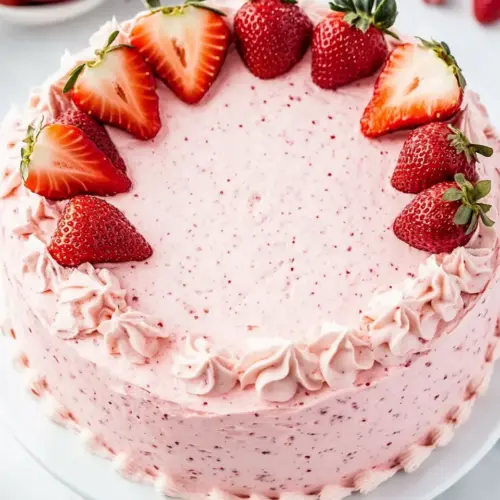
Fresh Strawberry Cake
Fresh Strawberry Cake is a soft, tender layer cake that bursts with concentrated strawberry flavor from a reduced fresh strawberry puree, complemented by a tangy cream cheese frosting made with powdered freeze dried strawberries. This cake is fruity, creamy, and delightfully pretty, perfect for an easy spring celebration or an easy weeknight dessert you ll want to make again and again.
Equipment
- Saucepan
- Blender
- Stand mixer
- 9-inch Round Cake Pans
- Food Processor
Ingredients
- 1 pound fresh strawberries, rinsed, hulled and pureed in a blender Pureed to provide a vibrant strawberry base that infuses the cake batter with fresh fruit flavor and natural moisture. Rinsed and hulled to remove impurities and tough tops so the puree yields a smooth texture when blended. Used to color the cake naturally and contribute to overall strawberry intensity throughout the crumb.
- 1 tablespoon granulated sugar Added to enhance sweetness and help macerate fresh strawberries when combined with puree for brighter fruit flavor. Sprinkled into batter to balance tartness from lemon and berries while helping with slight caramelization during baking. Measured precisely to avoid making the cake overly sweet and to support proper texture.
- 2 teaspoons lemon juice Squeezed in to brighten and balance the strawberry sweetness with acidity that enhances overall flavor. Mixed into batter and puree to maintain a fresh, citrus lift that elevates fruity notes and helps activate baking soda slightly. Used sparingly to prevent overwhelming the delicate strawberry profile.
- 2 3/4 cups all-purpose flour, spooned and leveled Sifted or spooned and leveled to provide the cake's structural framework and gluten that supports leavening. Combined with chemical leaveners to create a tender yet stable crumb suitable for layers or a single loaf. Measured accurately to ensure proper batter consistency and avoid dense or gummy texture.
- 2 1/2 teaspoons baking powder Whisked into dry ingredients to supply reliable rising power and create a light, airy cake texture when combined with creamed fats and eggs. Balanced with baking soda to achieve even lift while avoiding metallic or chemical aftertastes. Distributed throughout the flour ensures uniform leavening in every bite.
- 1 teaspoon salt Dissolved among dry ingredients to season and amplify flavor, helping balance sweetness and enhance other aromatic components. Controls yeast or chemical reaction sensitivity and supports proper rise by moderating the batter's ionic balance. Kept to a small amount to prevent a salty profile.
- 1/4 teaspoon baking soda Blended with acidic components to help neutralize and produce additional leavening gas, improving tenderness and lift. Added sparingly to react with lemon juice or yogurt in the recipe for a finer crumb structure. Complements baking powder to fine-tune expansion during baking.
- 1 cup unsalted butter, softened Creamed with sugar to create an emulsion that traps air for increased volume and lightness in the cake. Softened to integrate smoothly with egg whites and flavorings, contributing richness and mouthfeel. Quality and temperature of butter influence final texture and moistness.
- 2 cups granulated sugar Combined with butter to aerate and sweeten the batter, providing bulk sweetness and promoting proper creaming for rise. Layered into both batter and possible fillings to balance tartness from strawberries and acids. Even distribution is important to avoid grainy texture in the finished cake.
- 4 large egg whites, at room temperature Beaten to incorporate air and provide structure while keeping the cake lighter and less dense than whole eggs would. Brought to room temperature for maximum volume and stability when folded into the batter. Contributes protein-based structure without added yolk fat, yielding a finer crumb.
- 1 1/2 teaspoons vanilla extract Stirred in to contribute depth and roundness to the cake's flavor profile and harmonize with vanilla-like strawberry notes. Added after creaming to retain aromatic presence without being diminished during baking. Helps bridge dairy and fruit flavors for a cohesive taste.
- 1/2 teaspoon strawberry extract, optional (could substitute this with vanilla extract) Optional splash added to intensify strawberry aroma and mimic concentrated berry flavor when fresh strawberries are subtle. Can be substituted with vanilla for a milder profile, or omitted for a purely natural-fruit-forward cake. Used sparingly to avoid artificial or overpowering flavor.
- 1 1/2 teaspoons lemon zest Zested into batter to impart concentrated citrus oils that brighten and lift fruity flavors without adding liquid. Combined with lemon juice to layer citrus acidity and aromatic complexity, enhancing the perception of freshness. Carefully measured to prevent bitter pith from affecting the cake.
- 1/2 cup whole milk Stirred in to adjust batter consistency and add subtle richness, helping to dissolve sugar and distribute flavors evenly. Warmed slightly or at room temperature to blend smoothly with creamed butter and egg whites. Complements dairy-based frosting components when used in fillings.
- Red or pink food coloring, optional Added optionally to intensify or correct cake color when natural puree is too pale, achieving an attractive red or pink hue for presentation. Used sparingly to avoid altering flavor while ensuring the cake's appearance matches a strawberry theme. Chosen color should be food-safe and used according to manufacturer guidance.
- 1 1/2 cup freeze-dried strawberries Ground or pulsed to powder then folded in for concentrated strawberry flavor and crunchy freeze-dried pieces that rehydrate slightly in fillings or batter. Provides intense fruit aroma without adding moisture, useful for both batter and frosting to boost strawberry presence. Helps deepen flavor while preserving texture.
- 6 ounces cream cheese, at room temperature Softened to room temperature and beaten until smooth to create a tangy-sweet base for frosting that complements strawberry notes. Cream cheese contributes creaminess and slight acidity that balances sugar and enhances overall flavor complexity. Proper temperature prevents lumps and ensures a silky frosting consistency.
- 1/2 cup salted butter, softened Softened and creamed with cream cheese to add butteriness and structure to frosting while providing salt contrast to sweet components. Salted butter adds nuanced savory depth that tempers the sweetness of powdered sugar in the icing. Should be at consistent softness for even incorporation.
- 3 cups powdered sugar Sifted and added gradually to sweeten and thicken frosting, creating a smooth, scoopable consistency for spreading or piping. Helps stabilize the frosting and deliver the correct sweetness level while absorbing some moisture from cream cheese or fruit components. Adjusted slightly for desired stiffness.
- 1 teaspoon vanilla extract Mixed in to provide a secondary vanilla note and aromatic warmth that rounds out frosting flavors once sugar is incorporated. Added after creaming to preserve volatile aromatics and enhance overall taste. Quantity is calibrated so vanilla complements but does not overpower strawberry.
- 1 tablespoon whole milk Stirred in a tablespoon at a time to adjust frosting consistency and help achieve a silky, spreadable texture without thinning the mixture excessively. Adds a small amount of dairy richness that smooths the icing and aids in achieving the desired mouthfeel. Can be increased slightly if frosting is too thick.
Instructions
- Start by making the strawberry puree reduction. Combine one pound pureed strawberries, 1 tablespoon sugar and 2 teaspoons lemon juice in a small saucepan. Stirring occasionally, simmer over medium-low heat for 25 minutes or until the mixture has reduced by half. You should end up with a little more than 1/2 cup. Allow the reduction to cool completely before adding to the cake batter.: As the fruit simmers, you will notice the bubbling sound soften into a gentle simmer, and a fragrant, jam like aroma will rise from the saucepan. The mixture should reduce until it is slightly syrupy and a little more than 1/2 cup remains, which concentrates the sweet tartness of the fresh strawberries . Cooling the reduction completely before adding it to the batter prevents the eggs and butter from losing their structure. A common mistake is rushing the reduction on too high a heat, which can scorch the sugars and give a cooked flavor, so maintain medium low and stir occasionally to prevent sticking.
- Preheat oven to 350°F. Spray two 9-inch round cake pans with cooking spray, then line the bottoms with parchment paper.: When the oven reaches the set temperature, it will have an even dry heat that helps the cake rise and set properly. Preparing the pans with cooking spray and parchment ensures smooth release; lining the bottoms prevents tearing when you invert the layers. Visual cues include the parchment sitting flat against the base and pans feeling warm but not hot when you handle them. Avoid placing pans in the oven before it has fully preheated, which can cause uneven rising and dense centers.
- Add 2 3/4 cups flour, 2 1/2 teaspoons baking powder, 1 teaspoon salt, and 1/4 teaspoon baking soda to a medium mixing bowl. Whisk together and set aside.: Whisking the all purpose flour , baking powder , salt , and baking soda aerates and evenly distributes leavening. You want a uniform pale mixture without visible clumps, which prevents pockets of leavening or salt in the baked cake. Doing this step by hand is quick, and a common oversight is skipping the whisking, which can yield uneven texture or uneven rise.
- In the bowl of a stand mixer fitted with a paddle attachment, beat 1 cup butter and 2 cups sugar on medium speed until light and fluffy. Add 4 egg whites, 1 1/2 teaspoons vanilla extract, 1/2 teaspoon strawberry extract, and 1 1/2 teaspoons lemon zest and continue to beat on medium speed until well combined and fluffy.: As you beat the unsalted butter and granulated sugar on medium speed, the mixture will lighten in color and feel fluffy to the touch, indicating air incorporation. Adding the egg whites , vanilla extract , optional strawberry extract , and lemon zest creates a fragrant, silky base. If the mixture looks curdled after adding egg whites, stop mixing and scrape the bowl, then continue; over mixing at high speed can deflate the emulsion and make the batter less tender.
- Reduce the mixer speed to low and add in half of the dry ingredient mixture. Mix until combined. Slowly add in 1/2 cup milk and continue mixing until it is fully incorporated. Add in 1/2 cup of the cooled strawberry reduction and the remaining dry ingredients, mixing just until combined. Mix in a few drops of pink or red food coloring, if using, to achieve your desired color. Scrape down the sides and bottom of the bowl as needed to make sure the coloring is even throughout. Divide the batter evenly between the 2 pans.: Reducing speed and alternating dry mixture with whole milk encourages even incorporation without overworking the batter. When the batter looks evenly moistened with no streaks of dry flour, it is ready. After adding 1/2 cup of the cooled strawberry reduction, the batter will take on a pale pink tint and a bright fruity aroma. Scrape the bowl so there are no hidden streaks of flour, and avoid over mixing once the last dry ingredients are added, which can lead to a tougher crumb.
- Bake for 30 minutes, or until a toothpick comes out clean when inserted into the center of the cake. Allow to cool completely in the pans before removing and assembling the cake. Once cooled, wrap the cake layers in plastic wrap and place into the freezer for at least 20 minutes before assembling.: A visually even distribution helps layers bake uniformly, which is important for stacking. Use a scale or measure by eye to get similar volumes. Smooth the tops gently so they bake evenly. If one pan has noticeably more batter, its center may remain underdone while the other is fully baked, so take a moment to level them before placing in the oven.
- To make the frosting, place 1 1/2 cups freeze-dried strawberries into a food processor and pulse until it makes a fine powder. Set aside.: During baking you will see the cakes rise and the edges pull slightly from the pan, and a toothpick inserted into the center should come out clean. The top should be springy when pressed gently. Letting the cakes cool completely in the pans prevents the structure from collapsing from a sudden temperature change. A frequent error is removing hot cakes too soon and attempting to invert them; they may break apart. Be patient, and allow them to cool thoroughly.
- In the bowl of a stand mixer fitted with a whisk attachment, beat 6 ounces cream cheese and 1/2 cup butter on medium speed until completely smooth and creamy. Reduce to a low speed and add in 3 cups powdered sugar, strawberry powder, 1 teaspoon vanilla, and 1 tablespoon of milk. Increase to medium speed and beat until creamy. Add another tablespoon of milk if the frosting needs to be thinned out. It should be a spreadable consistency.: Chilling wrapped layers firms the crumb, making them easier to trim and stack. After a short freeze, the layers are less likely to crumble when you assemble the cake or level domed tops with a serrated knife. This step makes decorating simpler and produces neater layers. Skipping the freeze can result in torn edges when frosting, so if you want tidy assembly, the chill is worth the wait.
- Place the first cake layer on a cake stand or serving plate. Spread about 1 cup of frosting across the cake top. Top with the 2 nd cake layer and spread the remaining frosting across the cake and down the sides. Garnish with strawberries, if desired.: Processing the freeze dried strawberries into a fine powder releases concentrated aroma and color without adding moisture. The powder should resemble soft dust, and when pressed between fingers it should not feel gritty. This concentrated powder amplifies strawberry flavor in the frosting without thinning it. A coarse grind will leave grainy specks in the frosting, so aim for a fine texture.
- Beat cream cheese and butter until smooth: Combining softened cream cheese and salted butter on medium speed yields a silky base for the frosting. Reducing speed before adding powdered sugar prevents a cloud of sugar dust. Once powdered sugar, strawberry powder, vanilla extract , and whole milk are added, increase speed to create a creamy, spreadable texture. If the frosting seems too stiff, add milk one teaspoon at a time; if it becomes too loose, chill briefly. Overbeating can incorporate too much air and cause a slightly soupy texture when it settles.
- Assemble and frost the cake: Placing the first layer on a stand and spreading about 1 cup of frosting creates a stable base. The frosting should feel smooth and spread easily without tearing the crumb. After stacking the second layer, spread the remaining frosting across the top and down the sides for an even coat. Garnish with fresh strawberries if desired. A common pitfall is applying too much pressure when spreading, which can drag crumbs into the frosting, so use a thin crumb coat first if you want a pristine exterior.
Notes
- Room Temperature Dairy Ensure your unsalted butter, cream cheese, and whole milk are at room temperature so they blend smoothly and create a uniform batter and frosting.
- Even Batter Division Use a kitchen scale to divide batter equally between pans for even baking, which saves time when assembling and gives the cake a professional finish.
- Gentle Mixing Reduce mixer speed when adding dry ingredients to avoid over developing gluten in the all purpose flour, which keeps the crumb tender not chewy.
- Watch the Reduction Keep the strawberry puree at a gentle simmer and stir occasionally to prevent scorching, which preserves bright fruit flavor and prevents a caramelized bitterness.
- Powder the Freeze Dried Fruit Grind the freeze dried strawberries until very fine so the frosting is smooth and uniformly colored, avoiding specks that can feel sandy on the palate.
- Chill for Clean Layers Freezing the cooled layers briefly makes slicing and stacking much easier and reduces the chance of crumb transfer into the frosting when assembling.