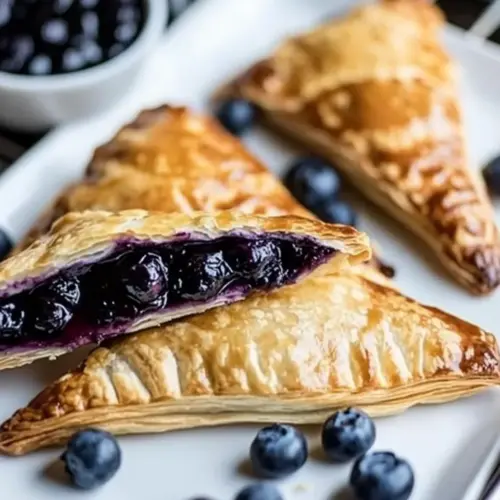
Easy Blueberry Turnovers
Easy Blueberry Turnovers offer a flaky, golden puff pastry exterior filled with a glossy, slightly tart blueberry sauce. This easy, crispy pastry combines jam like fruit with a buttery crust for an irresistible treat ideal for brunch or a quick dessert, delivering bakery quality with minimal effort. Try them for a simple weekend bake that always impresses.
Equipment
- Saucepan
- Baking Sheet
- Parchment Paper
- Rolling Pin
- Pastry Brush
Ingredients
- 2 cups fresh blueberries Provide plump, juicy fruit that forms the flavorful filling; toss gently with sugar and cornstarch to release juices while maintaining shape and texture during baking.
- 1/2 cup granulated sugar Add sweetness to balance the tartness of the berries; dissolve into the filling mixture so it caramelizes slightly and enhances overall flavor when baked.
- 1 tbsp cornstarch Thicken the blueberry juices to create a glossy, cohesive filling; blend into the sugar before heating so the turnover filling sets without being runny.
- 1 tbsp water Create a slurry to activate the cornstarch smoothly; whisk with cornstarch and incorporate into the fruit mixture to prevent lumps and ensure even thickening.
- 1 tsp lemon juice Brighten the filling with acidic brightness and balance sweetness; stir into the berries to accentuate flavor and help break down fruit slightly for a juicier interior.
- 1 tsp lemon juice Double the brightening effect to ensure consistent acidity throughout the filling; add with the first lemon juice to evenly distribute tartness and lift the fruit flavors.
- 1 sheet puff pastry dough defrosted Provide a flaky, golden outer shell that envelops the filling; roll and cut as directed, then fold over the fruit and bake until crisp and puffed.
- 1 egg yolk Enrich the glaze or wash to promote browning and a rich sheen; beat and brush over pastry edges to help seals and produce an attractive golden finish.
- 1 tsp water Thin the egg yolk to make an even egg wash that adheres smoothly; whisk with yolk and brush lightly for uniform color and a glossy surface after baking.
Instructions
- Set a medium size saucepan to medium-low heat and add in the blueberries and sugar.: The moment the blueberries and granulated sugar meet heat you will hear a soft sizzle and soon notice the sugar dissolving into syrup, releasing a bright fruity aroma. This low, steady heat coaxses juices out of the berries without scorching them, which preserves bright flavor. Stir gently to ensure the sugar dissolves fully and does not settle on the pan edges where it can burn. One common mistake is cranking the heat too high, which causes the fruit to blacken and the sugars to caramelize unevenly.
- Stir blueberries and sugar every minute for about 5 minutes until the berries have produced their own juices and become mushy.: As you stir, watch the berries soften and break down, turning the mixture into a glossy pool of purple juice and fruit. You will hear a faint bubbling as moisture is released, and the texture should shift from whole berries to a more tender, partially broken fruit. This frequent stirring encourages even heat distribution so individual berries do not overcook. Avoid walking away during this phase, because uneven heat can lead to some berries staying whole while others over reduce.
- Add in the remaining ingredients (corn starch, water, lemon juice and lemon zest if desired) and reduce the heat to low.: Introducing the cornstarch slurry and lemon juice at a lower temperature prevents the thickener from clumping and the citrus from evaporating. You should notice the mixture losing some shine as the starch integrates, and the aroma becomes a balanced sweet and tart harmony. Whisk or stir thoroughly so the cornstarch dissolves into the filling; raw lumps will leave gritty pockets. A typical error is adding starch to a roaring boil, which can create instant gelatinous clumps.
- Continue stirring constantly (every 30-60 seconds) for 10 minutes, until the blueberry mixture is thick and has the consistency of a blueberry sauce. Turn off the burner and remove the blueberry filling from heat (or it will continue to thicken and may harden).: The sauce should gradually thicken and cling to the back of a spoon, emitting a warm, fruity steam that smells slightly caramelized and citrusy. Low heat and periodic stirring allow the starch to fully activate and the excess water to reduce, giving you a glossy, cohesive filling. If the mixture seems too thin after the time, give it a few more minutes; if it becomes too stiff, a teaspoon of water can loosen it. A common pitfall is overcooking, which yields a filling that firms up too much as it cools.
- Set aside blueberry filling mixture to cool for 10-15 minutes while assembling the turnovers. You can store the filling in the refrigerator for 2-3 days if assembling the turnovers later.: Pulling the pan off the heat prevents the filling from continuing to thicken from residual pan heat, which can make it overly dense. At this point the surface will steam gently and the aroma will mellow into a jam like perfume. Let it sit briefly so the temperature evens out, but do not leave it sitting uncovered for too long or a skin can form. Many cooks forget to remove the pan promptly and end up with a filling that becomes too firm to spoon easily.
- Preheat oven to 375°F. Set out a baking sheet lined with parchment paper.: As the filling cools it will lose some of its initial fluidity and become easier to portion into the pastry. You will notice the texture moving from glossy to slightly set, which is ideal for filling without causing leakage. If you need to speed cooling, transfer it to a shallow dish, but avoid the temptation to chill it fully because a cold, stiff filling is harder to shape into neat mounds. A frequent mistake is filling pastry with piping hot filling, which leads to soggy bottoms and steam bursts during baking.
- Roll out puff pastry dough (defrost first) on a lightly flour dusted cutting board or work surface to increase its size. Cut it horizontally and vertically – into four equal size square pieces.: Heating the oven to a stable 375 degrees F ensures the puff pastry receives a strong burst of heat that initiates rapid steam formation, causing the layers to puff and separate. You should allow the oven to fully reach temperature before baking so the pastry does not cook unevenly. The air in the oven should feel consistently hot and dry, which promotes crispness. A common error is putting pastries into an oven that has not fully preheated, resulting in dense, underpuffed layers.
- In a small bowl, whisk together egg yolk and water to create an egg wash (which will give puff pastry turnovers a golden brown and very flaky dough crust when it bakes).: As you roll, you will feel the pastry loosen and lengthen under the rolling pin, with quiet, delicate flaking at the edges if it is well chilled. Light dusting of flour prevents sticking but keep it minimal to avoid drying the dough. Cut into four even squares so each turnover bakes uniformly. If the pastry feels warm and sticky, pop it back in the refrigerator briefly; handling it when too warm will reduce its rise during baking.
- Add one tablespoon of cold or room temperature blueberry filling in the center of each puff pastry square.: The mixture should become smooth and slightly glossy, and when brushed on the surface it lends a deep, golden sheen and helps the turnovers take on a beautiful color. The egg wash also acts as a glue along sealed edges. Use a light hand when brushing to avoid pooling, which can create dark spots. Overbrushing can saturate the pastry and inhibit puffing.
- Use a pastry brush to brush 1/2” along the edge of the puff pastry square with egg wash. Fold opposite puff pastry corners together to form a triangle shape. Use a fork to crimp the edges together by pressing down gently to smoosh both layers together and leave a slight fork shape around the edges of the turnover. Poke the top of the puff pastry with the edge of the fork prongs (which will allow steam to escape during the baking process). Repeat for all turnovers.: The filling will sit as a neat mound, glistening and slightly sticky, and placing a measured amount prevents overfilling and subsequent leaks. Cold or room temperature filling controls steam release during baking, preserving structure. Avoid adding too much filling, because excess will escape during baking and produce a sticky mess on the pan.
- Transfer turnovers to the parchment paper lined baking sheet and brush each turnover with egg wash.: Brushing the egg wash along the edge creates a tacky surface that helps the layers seal, and folding the pastry brings the edges together into a neat triangle that traps the filling. Use a fork to crimp the edges, which seals and decorates simultaneously. Press gently rather than forcefully to avoid tearing the dough; ripping is the most common mistake here.
- Bake blueberry turnovers for ~25 minutes at 375 degrees F, or until the pastry dough is golden brown.: Those small vents let hot air and steam escape in a controlled way, preventing explosive splits or soggy pockets. You will hear the pastry give a faint noise as you pierce it, and when baked the vents will darken slightly, signaling proper steam release. Too few vents can cause internal pressure and leaking, while too many can deflate the pastry.
- Allow turnovers to cool completely and test the heat before biting into them. Cooling will take at least 15 minutes and they will be very hot for a while. Serve with any extra blueberry filling in a small bowl on the side.: As you place them on the sheet, ensure spacing to allow each to expand. The egg wash applied before baking deepens the brown and gives the crust a glossy finish. Watch for pools of egg wash that can burn and remove any with a paper towel. Overcrowding the sheet is a frequent misstep that prevents even browning.
- Bake blueberry turnovers for ~25 minutes at 375 degrees F, or until the pastry dough is golden brown: During baking you will see the pastry inflate and take on a rich amber hue, while the filling will bubble gently through the vents. The aroma will become butter forward with a fruity backbone. Check for a deep golden color on both top and bottom for doneness; underbaked pastry will feel doughy. Avoid opening the oven repeatedly, which can reduce oven temperature and impede puffing.
- Allow turnovers to cool completely and test the heat before biting into them: Cooling for at least 15 minutes lets the filling thicken slightly and prevents mouth scalds, while the pastry remains crisp. The steam will subside and the filling will settle, making for cleaner bites. Rushing to eat them while piping hot often leads to burns and runny filling.
Notes
- Add a citrus twist: Stir a little extra lemon juice into the filling for brighter acidity and a fresher finish.
- Make extra filling: Prepare all the filling at once and refrigerate some for pancakes or toast the next morning.
- Brush lightly: Apply a thin layer of the egg yolk wash so the pastry browns without pooling.
- Chill between steps: If the pastry gets warm while shaping, pop the turnovers on the sheet into the fridge for 10 minutes before baking.
- Double the batch: If your puff pastry comes with two sheets, you can double the recipe to make more turnovers or save some filling for later use.