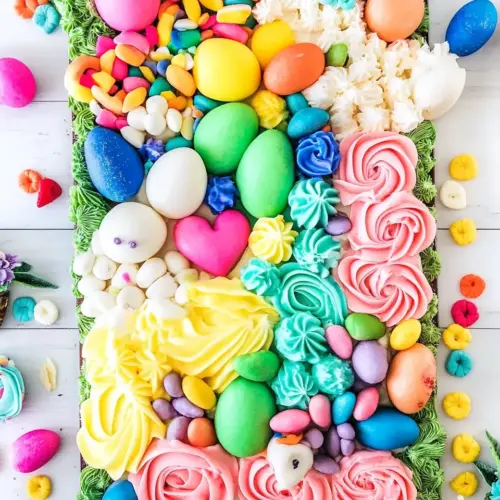
Easter Buttercream Board
Easter Buttercream Board is a colorful, easy to assemble dessert centerpiece that combines creamy vanilla frosting with crunchy and chewy dippers for an interactive treat. With bright pink sprinkles and playful jelly beans, this board makes a fun addition to spring gatherings and is perfect for easy entertaining and casual celebrations. Make it for a holiday party to delight guests and simplify dessert serving.
Equipment
- Parchment Paper
- Offset Spatula
- Serving plate
- Piping bag or decorator tube
Ingredients
- 1 recipe vanilla frosting or a can from the store Spread generously to create a smooth, creamy base for decorating; adds sweetness and structure to the board. Provide an easy canvas for piping, smoothing, and holding other candies in place, while offering familiar vanilla flavor that complements bright toppings.
- Black decorator icing Pipe finely to add detail and contrast for eyes, outlines, or small accents; provides strong color and precise application. Use sparingly for facial features or accents on candies to make designs pop against the lighter frosting surface.
- Pink sprinkles Sprinkle liberally to add color, texture, and playful crunch to the board; delivers visual interest and bite-sized bursts of sweetness. Scatter over the frosting or press into edges for festive coverage that helps tie together assorted decorations.
- Jelly Beans Scatter strategically to offer pops of color, varied shapes, and chewy texture across the board; contributes fun, nostalgic flavor. Arrange in groups or patterns to create focal points and to encourage guests to pick and enjoy different flavors.
- Assorted Dippers Arrange creatively to provide additional dipping options and varied textures, such as cookies, pretzels, or fruit; enhances the board’s variety. Offer contrasting flavors and shapes that pair well with frosting and candies, inviting guests to mix and match.
Instructions
- Cut parchment paper to fit your serving plate. Using a pencil, draw the outline of the bunny face: The moment you cut the parchment paper you can feel the project take shape, and the crisp edge helps you center the design visually. I listen for that faint paper sound as I trim, which tells me the paper will lay flat without buckling. Why this matters, the parchment acts as your temporary template so it must sit flush to avoid uneven transfer of frosting . A common hiccup is using a parchment piece that is too small, which forces you to squash the design; always err on the side of slightly larger so you can trim after placement.
- on the parchment. Lightly add some frosting to each corner and turn it (drawing side down): When you anchor the parchment with small dollops of frosting at each corner, the paper will adhere to the plate and not slide as you flip it. I press gently and listen for a faint suction as it settles, indicating good contact. This step ensures the filled areas align correctly when you remove the parchment. A typical mistake is using too much frosting for anchoring, which can smear the board underneath, so keep the anchor pieces small and tidy.
- onto the serving plate.: As you lower the parchment onto the plate, aim for a smooth lay down so there are no trapped air pockets. I watch the edge as it meets the plate, making sure the lines line up straight, and then lightly press the center to secure the template. The reason this matters is that a stable template ensures the transferred design keeps its intended shape. If the paper shifts during placement, lift and realign rather than trying to correct with extra frosting , which can create lumps.
- Frost the parchment paper design (either by hand or use a piping bag) to fill in the bunny face.: The texture of the frosting is most noticeable here; I spread it so the surface becomes satiny and smooth, which catches the light and frames the details. Use a small offset spatula for broad areas and a piping bag for tight corners; the spatula makes a sweeping motion across the parchment creating a leveled surface while the piping bag gives control for ears and inner features. You will smell the sweetness of the vanilla frosting as you work and see air pockets pop leaving a glossy finish. This technique matters because a smooth fill highlights the contrast with the black decorator icing and sprinkles . One error I see is overworking the frosting which can introduce visible streaks or air bubbles, so aim for confident, single strokes rather than repeated sanding motions.
- Give the bunny 2 black eyes and a pink nose (from decorator icing or jelly beans) and whiskers: When you add black decorator icing eyes and a pink sprinkles nose or a jelly bean nose, the features instantly animate the face. I apply the eyes as two small dots, then step back to ensure they are evenly spaced, which preserves a friendly expression. The nose can be a piped heart shape or a single jelly bean , and the contrast of color against the pale buttercream makes it readable from across the table. A detail to watch is symmetry; uneven eyes can make the face look lopsided, so adjust before the icing sets.
- and a mouth.: Crafting the mouth adds character, whether a tiny smile or a surprised O. I use a thin line of black decorator icing and keep the pressure light so the stroke is delicate and not blobbed. The subtle shadow the line creates against the frosting gives a three dimensional feel. Why this matters, a confident mouth completes the expression and signals the board is ready for guests. If the line looks too thick, gently remove it with a toothpick and try again; hardened corrections are harder to hide once the icing sets.
- Surround the frosting face with assorted dippers.: Placing the assorted dippers around the bunny creates texture and invites sharing, and arranging them in clusters helps guests navigate choices. I group crunchy items on one side, chewy on another, and small chocolates in a pile so each cluster reads as a mini station. The visual rhythm of shapes and colors encourages grazing. A trap is overstuffing the area right up to the frosting edge, which can make it awkward to scoop the face; leave a clear margin so the design remains the focal point and is easy to access.
Notes
- Serve within 2 hours. The frosting will start to firm up if it sits too long, which makes scooping less pleasant. Aim to assemble close to serving time so guests enjoy the soft, creamy texture.
- Use any dippers you like. Candy eggs, jelly beans, chocolate bunnies, Peeps, or Easter cookies all work well. I often mix textures for interest, and I suggest at least one crunchy and one chewy option.
- Loosen thick frosting. If your vanilla frosting is very thick, add milk a teaspoon at a time until it spreads smoothly. This keeps the surface glossy and easy to work with when filling the parchment design.
- Plan the color palette. Choose coordinating colors for sprinkles and jelly beans to create a cohesive look. Too many clashing colors can make the board look cluttered.
- Anchor the parchment. Small dabs of frosting at the corners prevent slipping when you flip the template, making the transfer cleaner and saving time on corrections.
- Keep extras on hand. Have an extra piping bag and a few spare candies for last minute touch ups or replacements if something shifts during serving.