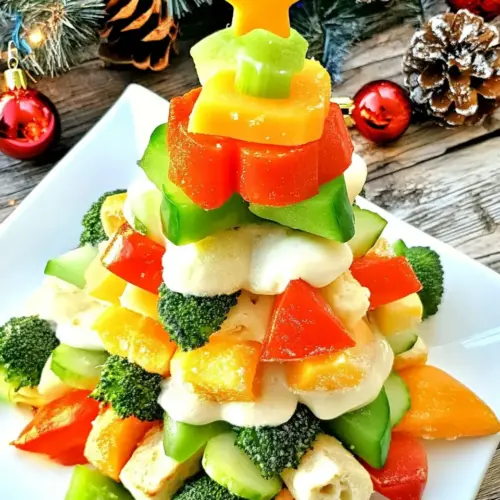
Crescent Veggie Christmas Tree
Crescent Veggie Christmas Tree is a crisp and creamy holiday appetizer that combines flaky crescent pastry with a tangy cream cheese and sour cream spread and crunchy assorted veggies. This easy, eye catching recipe makes a perfect easy weeknight dinner party starter or holiday appetizer, offering colorful texture and crowd pleasing flavor. Make it for your next gathering to impress without stress.
Equipment
- Oven
- Cookie Sheet
- Cooling rack
- Mixing Bowl
Ingredients
- 16 oz Pillsbury Crescent Rolls 2 cans Provide a buttery, flaky base for the tree structure and act as the baked vessel that holds the filling; unroll and shape as directed for even baking and golden color. Allow dough to rest slightly if needed to prevent tearing and ensure consistent layer separation during assembly.
- 8 oz cream cheese softened (I used light) Soften to a spreadable consistency and contribute a rich, tangy creaminess that binds the veggie mixture and adds moistness; beat until smooth to avoid lumps for easy spreading. Chill briefly if over-softened to maintain structure when assembling the tree.
- 1/2 cups sour cream light Add a cool, tangy creaminess that lightens the filling and improves spreadability while balancing richer flavors; fold together with the cream cheese for a smooth, scoopable mixture. Keep refrigerated until assembling to maintain a firm filling that won’t ooze during baking.
- 1 tsp dried dill weed Impart a subtle herby brightness and aromatic lift to the filling, complementing the creamy base and fresh vegetables; sprinkle evenly to distribute flavor without overwhelming. Rehydrate lightly when mixing into moist bases to release more aroma and meld flavors.
- 1/4 tsp garlic powder Provide a mellow, savory depth and gentle garlic aroma that enhances overall taste without dominating; measure carefully to avoid overpowering the delicate herb and veggie notes. Mix thoroughly into the cream base so the powdered garlic disperses evenly throughout.
- 3 cups finely chopped assorted veggies broccoli, bell peppers, carrots, green onion, cucumber Contribute crisp texture, fresh flavor, and colorful visual appeal as the primary filling; finely chop to ensure even distribution and easy biting in each tree segment. Pat vegetables dry if needed to prevent excess moisture from making the filling soggy during baking.
Instructions
- Preheat oven to 375 degrees. Removed the dough from the can without unrolling. Cut each can into sixteen slices (8 from each roll).: When the oven heats to 375 degrees you will notice the dry, warm air that signals consistent baking. That stable temperature helps the 16 oz Pillsbury Crescent Rolls 2 cans puff evenly and brown to a golden hue. Smell the faint toasty warmth as the oven comes up to temperature, it tells you the interior is ready. A common mistake is putting the dough into an oven that has not fully preheated, which can cause uneven rise and underbaked centers; avoid this by waiting the full preheat time. Make sure the rack is in the middle position so heat circulates well and gives the pastry even color.
- Place the slices on a lightly greased cookie sheet to form a tree. One slice at the top, two slices in the next row, three in the next, then four slices, and five slices for the last row. There will be one remaining slice that can be used for the trunk. After you have formed the tree, lightly roll out to flatten a little bit. I didn't do this and the crescent was a little too thick after it was baked.: The dough has a slightly tacky surface and a light yeasty aroma; as you remove it from the can you can feel its elasticity. Cutting the rolls into sixteen slices yields uniform pieces that will bake consistently. The thickness of each slice determines how flaky or dense the final pastry is, and too thick slices may stay doughy inside. A tip is to use a sharp bench knife and steady pressure to make clean cuts, avoiding tearing the layers.
- If you are making two trees, refrigerate the other tree while the first one bakes. Baked for 11-13 minutes or until golden brown. Let it cool for 1-2 minutes and then carefully loosen from the sheet and move to a cooling rack. Bake the second tree.: As you arrange the slices, you will hear a soft whispering as dough meets dough, and you will see the silhouette of a tree take shape. The layering creates the visual branches, and lightly rolling the assembled tree evens the thickness so it bakes uniformly. Roll gently, pressing just enough to connect the pieces without compressing all the layers, because retaining some layer separation is what produces flaky texture. A common error is overworking the dough and pressing until it becomes dense, which will reduce flakiness; stop when the pieces hold together but still show some layering. Visually aim for even thickness so the middle and edges finish at the same time.
- Move the cooled tree to your serving platter prior to decorating.: Chilling the second assembled tree keeps the butter layers firm and reduces spreading, which is especially helpful if you bake sequentially. While the first tree is in the oven, the kitchen will fill with a warm, buttery aroma as the pastry heats and the layers crisp. Watching for a golden brown color is more reliable than timing alone because ovens vary; a uniform golden top and slightly darker edges indicate readiness. After removing it, you will feel the surface go from hot to just warm in a minute or two, which is the best moment to transfer to a cooling rack; moving it too soon can cause it to deform. A common pitfall is leaving the tree on a hot sheet too long, which can steam the bottom and make it soggy; transfer promptly to maintain crispness.
- Combine the sour cream, cream cheese, dill, and garlic. Mix until smooth. Spread the mixture over both trees and decorate with veggies.: Once cooled to warm, the pastry will hold its shape and the surface will be receptive to the spread. The cooling process reduces steam so the topping does not slide off, and you will notice a subtle give when you press lightly on the surface. Choosing the right platter matters because it is the focal point; a wide, flat platter makes decorating easier. One mistake people make is decorating while the tree is still hot, which causes the spread to melt and run; wait until it is comfortably warm to the touch.
- Combine the sour cream cream cheese dill and garlic Mix until smooth Spread the mixture over both trees and decorate with veggies: As you blend the 8 oz cream cheese softened (I used light) with the 1/2 cups sour cream light , the mixture transforms from lumpy to velvety, releasing a mild tang and herb aroma from the 1 tsp dried dill weed and 1/4 tsp garlic powder . Mixing by hand or with a paddle gives you control over texture; aim for a spread that holds its shape but is easy to smooth. Spreading the mixture over the warm but not hot pastry creates an attractive contrast of warm pastry and cool, creamy topping. When decorating with the 3 cups finely chopped assorted veggies broccoli, bell peppers, carrots, green onion, cucumber , press lightly so the pieces adhere. A common issue is using a spread that is too thin, which will not hold the veggies; if needed, chill the spread briefly to firm it up before applying.
Notes
- Make ahead tip: Prepare the spread up to one day in advance and store it covered in the refrigerator so the flavors meld and assembly on the day is faster.
- Vary the veggies: Use a mix of textures and colors such as chopped 3 cups finely chopped assorted veggies broccoli, bell peppers, carrots, green onion, cucumber for visual appeal and balanced crunch in every bite.
- Even baking: If your oven runs hot, rotate the sheet halfway through baking to ensure the 16 oz Pillsbury Crescent Rolls 2 cans color evenly without burning the edges.
- Chill before decorating: Let the baked tree cool until warm, not hot, so the spread does not melt and the vegetables stay crisp when arranged.
- Texture control: If the spread seems too loose, refrigerate it briefly to firm up, which helps the 3 cups finely chopped assorted veggies broccoli, bell peppers, carrots, green onion, cucumber stick well.