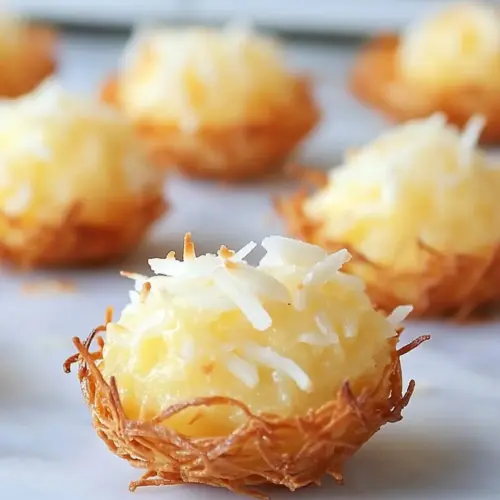
Coconut Macaroon Nests
Coconut Macaroon Nests are crispy edged, chewy centered treats with a toasty coconut aroma and sweet pops of chocolate. These easy festive bites come together with minimal ingredients and oven time, perfect for spring gatherings and holiday trays. Make a batch for an easy party dessert that looks special and disappears fast, ideal for an effortless crowd pleasing treat.
Equipment
- Heavy saucepan
- Mini Muffin Tin
- Measuring Spoon
- Oven
Ingredients
- 3/4 cup from 5 large egg whites Whisked to soft peaks, provides structure and lift to the macaroons while creating a light, airy texture; beaten egg whites also help bind the coconut and sugar together as they set during baking.
- 6 tbsp granulated sugar Added gradually to stabilize the meringue and sweeten the mixture, melts slightly during baking to create chewy centers and a glossy exterior that helps brown the tops.
- 10 oz sweetened coconut flakes, I used Baker's Folded into the whipped egg whites and sugar to supply the primary bulk and chewy texture; sweetened coconut flakes contribute flavor, chew, and the characteristic coconut aroma.
- 1/2 tsp almond extract Added for a concentrated nutty, floral note that complements the coconut and enhances overall flavor complexity; a small amount brightens the finished cookies without overpowering them.
- 1/4 tsp vanilla extract Included for warm, familiar sweetness and aromatic depth that rounds out the almond extract; a touch of vanilla enhances flavor harmony throughout the macaroons.
- pinch of salt Sprinkled into the mixture to balance sweetness and heighten flavor contrast; a pinch of salt also helps stabilize the meringue and sharpen the overall taste.
- cooking spray Used to lightly coat the baking tray or muffin tins so the nests release cleanly after baking, preventing sticking and preserving the shape and underside texture of each macaroon.
- 72 mini Cadbury chocolate eggs Placed into the cooled coconut nests to serve as a decorative and flavorful centerpiece; the mini chocolate eggs add visual appeal, contrast in texture, and a sweet chocolate finish.
Instructions
- In a heavy saucepan combine egg whites, sugar and coconut flakes and cook over medium-low heat, stirring frequently until all the ingredients combine together, about 12 minutes. The mixture should be sticky and moist, not dry.: Warmth transforms these raw components into a cohesive, sticky mass, and during this time you will notice a gentle toasty aroma as the coconut softens and the granulated sugar starts to dissolve into the egg whites . Listen for a soft simmer rather than a vigorous boil, you want small, consistent bubbles not a roar, which prevents curdling. The texture should be tacky and moist, clinging together when pressed between fingers; if it seems dry, reduce heat and add a splash of water to bring it back. A common mistake here is rushing the heat, which can make the mixture grainy or overcooked. Stir constantly to ensure even cooking and to avoid hot spots that could brown the coconut too quickly.
- Remove from heat and stir in the almond and vanilla extracts.: The pan will still feel warm, and adding the almond extract and vanilla extract releases a fragrant steam that melds with the coconut scent. This step layers aromatic complexity into the nests, and for the best result work quickly so the extracts disperse evenly before the mixture cools. If you wait too long, the extracts will not integrate as well and pockets of stronger flavor can form. One pitfall is adding too much extract, which can make the flavor sharp and artificial, so measure carefully.
- Set aside and let it cool 10 minutes, should be warm.: Cooling slightly firms the mix and makes it workable, and during this rest you will feel the sticky mass change from fluid to tacky. Warm but not hot is ideal, because it lets you press the mixture without burning your fingers, and allows the structure to hold in the muffin tin. If the mixture is too hot, the nests will slump and lose shape; if it cools too long and becomes stiff, it will not press smoothly. To troubleshoot, if it cools too much, return briefly to low heat for a few moments to regain pliability, stirring constantly.
- Preheat the oven to 300°F. Spray a nonstick mini muffin tin with oil.: Preheating ensures even, gentle baking so the nests crisp slowly instead of browning too fast. The 300°F temperature creates a steady environment where moisture escapes evenly, allowing the coconut to toast without burning. Lightly spray the tin so the nests release cleanly; too much oil can make the bottoms greasy, while too little causes sticking. A common error is skipping preheating, which leads to uneven bake and poor texture.
- Drop heaping tablespoons into the tin, lightly press mixture into the bottom and up the sides of the tin to make "nests" with the back of the measuring spoon.: As you press, you will feel the mixture give and hold shape. The visual cue is a smooth, even cup with a slightly compacted base and a textured rim from the coconut. Press firmly enough so the sides adhere, but not so firmly that the nests become overly dense; they should retain some air to crisp properly. Watch for inconsistent sizes, because uneven nests bake at different rates. If one side looks thin, gently reinforce it so the egg sits snugly later.
- Bake 22 to 25 minutes, or until golden.: During baking the scent will shift from warm coconut to a nutty amber note, and you will see the edges take on a light golden color while the centers stay slightly pale. The nests should feel set to the touch and hold their shape. Baking too long will dry them out and darken the coconut, while underbaking leaves them too soft to lift. A typical trap is opening the oven frequently which cools the chamber and prolongs bake time, so check only near the end of the suggested window.
- Let it cool 10 minutes, then carefully remove from the tin.: Cooling lets the nests stabilize so they release neatly. You may hear a faint crackle as steam leaves, and the bottoms will firm up. Use a small offset spatula or a gentle twist to ease them out; forcing them can break the delicate sides. If a nest sticks, warm the tin briefly in the oven for a minute to loosen the bond, then try again. The common mistake here is impatience, pulling them out too soon which causes crumbling.
- Arrange the nests and top each with two mini chocolate eggs.: The final step is visual and textural pleasure, placing two mini Cadbury chocolate eggs in the warm centers so they nestle in slightly. The contrast between toasted coconut and creamy chocolate is immediate, and the eggs add a glossy focal point. If the nests have cooled completely they will still accept the eggs, but if you want the eggs to sink a touch, place them on while the nests are still slightly warm. Avoid piling on extras that overpower the delicate coconut structure.
Notes
- Measure Carefully Use precise measuring for the sweetened coconut flakes and granulated sugar so the balance of moisture and sweetness is right.
- Low and Slow on the Stove Cook the mixture over medium low heat to allow the sugar to dissolve and the coconut to soften without burning.
- Warm but Workable Wait about ten minutes after cooking so the mix is warm rather than hot, which makes shaping safe and effective.
- Even Portions Use a small scoop or spoon to portion the mixture for uniform nests that bake evenly.
- Gentle Release If nests stick, warm the pan briefly and use a thin spatula to ease them out cleanly.