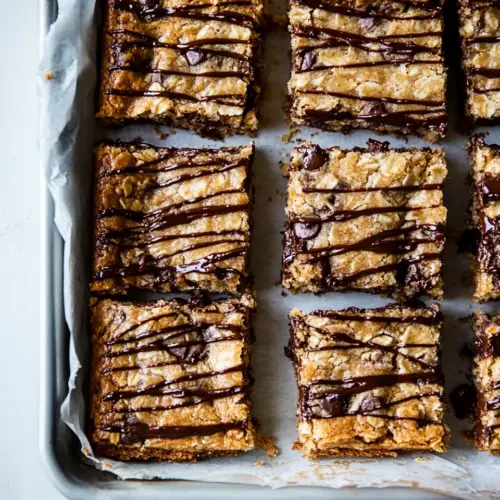
Chocolate Chip Oatmeal Toffee Cookie Bars
Chocolate Chip Oatmeal Toffee Cookie Bars are chewy, slightly crisp tray bars loaded with chocolate chips and crunchy toffee chip, balanced by hearty oatmeal and a tender crumb. This easy bake combines rich brown sugar flavor and a glossy cracked top for a comforting treat that is perfect for gatherings or quick snacks, making it a recipe you will want to make again and again.
Equipment
- Stand mixer
- Paddle attachment
- 13 by 9 inch baking pan
- Offset Spatula
- Wire Rack
Ingredients
- 1 1/4 cup unbleached all-purpose flour Whisked into the batter to provide structure and lightness, contributing gluten for chew and crumb development; balances moisture and supports rise when combined with leavening.
- 1 cup old fashion oatmeal Added for hearty texture and nutty flavor, giving chewy bite and rustic character while absorbing some moisture to prevent overly soft bars.
- 1 teaspoon baking powder Scattered through the dry mix to activate with eggs and leavening for lift; contributes gentle aeration and helps create a tender crumb in the finished bars.
- 3/4 teaspoon salt Dissolved into the dough to enhance flavor depth and balance sweetness; strengthens gluten control and promotes even texture across the pan.
- 1/2 cup unsalted butter, melted and cooled Poured in to add rich fat and mouthfeel, lending a toffee-like richness when melted and aiding in tenderizing the crumb while contributing flavor complexity.
- 1/4 cup olive oil Incorporated to introduce a lighter liquid fat that keeps bars moist and pliable; helps produce a softer bite and a slightly different flavor profile than butter alone.
- 1 cup light brown sugar Folded into the wet ingredients to impart deep caramel notes and moisture, enhancing chewiness and providing a complex sweetness that complements chocolate and toffee.
- 1/2 cup granulated sugar Sprinkled into the batter for bright sweetness and structure, aiding browning and balancing the deeper flavors while contributing to crisp edges.
- 2 eggs Beaten with sugars to bind ingredients and create lift, adding moisture and richness; eggs help set the bars and contribute to a cohesive texture.
- 1 tablespoon vanilla extract Stirred into the batter to infuse vanilla aroma and round out flavor, enhancing the perception of sweetness and harmonizing the chocolate and toffee notes.
- 4 oz . chocolate chips Scattered through the batter to provide pockets of melted semi-sweet richness, offering bursts of chocolate flavor and contrast in every bite.
- 4 oz . toffee chip Mixed into the dough to deliver crunchy, caramelized hits that add buttery toffee flavor and textural contrast against the soft oatmeal base.
Instructions
- Preparation: Heat oven to 350 degrees F. Lightly cover a 13-by-9-inch pan with baking spray.: Heat oven to 350 degrees F. Lightly cover a 13-by-9-inch pan with baking spray. : The moment the oven warms you will start to smell a gentle warmth, and preheating ensures even rise and consistent texture. I like to place the rack in the center so the bars bake evenly and the top does not brown too quickly. A common mistake is skipping the pan spray, which can make removal messy, so line or spray the pan thoroughly.
- In a large bowl whisk together flour, oatmeal, baking powder and salt; set aside.: You should see the dry mixture become uniform in color and texture, with the oats distributed throughout. Whisking aerates the dry ingredients slightly and ensures even leavening, which helps avoid dense pockets. Avoid overworking this mix, which can lead to a tough crumb if combined too aggressively later.
- In the bowl of a stand mixer, fitted with the paddle attachment, beat together, butter, olive oil, both sugars and vanilla. Beat in the eggs one at time, making sure each one is fully incorporated before adding the next. Add the flour in all once, beat on low until just combined.: Once you begin mixing the wet ingredients, you will notice the sugars dissolving into the fats and the mixture becoming glossy and slightly thickened. This creaming step distributes fat and sugar so the bars bake with an even crumb and caramelized top. If you mix too long at high speed you can incorporate excess air, creating large holes in the finished bars.
- Turn off mixer and fold in chocolate chips and toffee chips.: As each egg disappears into the batter the texture will lighten and the mixture will take on a silkier sheen. This staged addition ensures proper emulsification, which binds fat and water for a stable batter. A common error is adding both eggs at once, which can cause streaks or a split mixture.
- Scrape dough into prepared pan, smoothing top with an offset spatula. Bake for about 22 to 25 minutes, or until top is shiny and just starts to crack. Remove from the oven and transfer to a wire rack to cool to room temperature. Cut and serve.: When you add the dry mixture, the batter will thicken and become more dough like. Use low speed to prevent developing too much gluten, which would make the bars chewy in an unpleasant way. Stop mixing as soon as you see no dry streaks, because overmixing is the fastest route to toughness.
- Turn off mixer and fold in chocolate chips and toffee chips.: Folding by hand lets you feel the batter and see the distribution of chocolate chips and toffee chip . The mix will look studded and slightly denser. Folding gently prevents the chips from breaking and stops the batter from deflating. A mistake here is using the mixer to combine the chips, which can bruise them and melt the chocolate prematurely.
- Scrape dough into prepared pan, smoothing top with an offset spatula.: As you spread the batter, you should see it settle into the corners and level out, with the surface glossy and slightly tacky. Smoothing ensures even thickness so baking is consistent across the pan. Be careful not to press too hard, which can compact the dough and create a denser bar.
- Bake for about 22 to 25 minutes, or until top is shiny and just starts to crack.: While baking you will smell the sugars caramelizing and notice the edges pulling slightly away from the pan. The top should look glossy with tiny fissures rather than a dry matte finish. Underbaking leads to a loose center, while overbaking makes the bars dry; test by looking for that glossy crack and a springy center.
- Remove from the oven and transfer to a wire rack to cool to room temperature.: Cooling on a rack lets air circulate so steam escapes and the bars set properly, preserving chewiness. If you try to cut them while too warm they may crumble or smear, and if left in the pan they can oversteep and become soggy on the bottom.
- Cut and serve.: When the bars are fully cooled they will cleanly slice with a sharp knife, showing a tender interior studded with chocolate chips and toffee chip . Serve at room temperature to enjoy the contrast of chewy oats and crisp edges. A common oversight is using a dull knife, which tears rather than slices; wipe the blade between cuts for neat squares.
Notes
- Mixing order matters: Combine dry ingredients separately so leaveners distribute evenly, then add them to the wet at low speed to avoid overdevelopment of gluten.
- Butter temperature: Melt the unsalted butter and let it cool to warm before mixing; hot butter can cook the eggs and ruin the emulsion.
- Oat choice: Use old fashion oatmeal for chew and tooth; quick oats will change the texture and make the crumb softer.
- Even spreading: Use an offset spatula to smooth the batter in the pan for uniform thickness, which ensures even baking across the sheet.
- Slicing tip: Chill the pan slightly for cleaner cuts if you prefer neat squares, or serve warm for a gooier, rustic presentation.