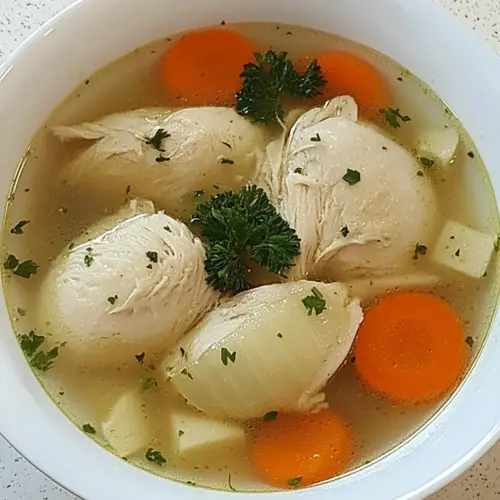
Chicken Soup for Knaidelach
Chicken Soup for Knaidelach is a golden, comforting broth made with whole chicken and aromatic vegetables, offering a rich, silky texture and bright herbal notes. This easy weeknight dinner or holiday staple yields tender shredded chicken and hearty vegetables, perfect when paired with Matzo Balls or gluten free potato knaidelach. Make it for nourishing family meals and lingering bowls that warm both body and memory.
Equipment
- Stockpot
- Mesh strainer
Ingredients
- 4 -5 pounds whole chicken or chicken pieces Provide rich, savory chicken flavor and body to the broth while supplying gelatin and fat that create a satisfying mouthfeel; simmer whole chicken or pieces gently for several hours to extract maximum collagen and taste.
- 6 celery stalks with leaves, chopped into thirds Add aromatic crunch and herbal brightness with both stalk and leaf included; chop into thirds to release flavor while lending a subtle savory note to the stock and completed soup.
- 6 whole carrots, peeled and chopped into thirds Contribute natural sweetness and depth when peeled and chopped, caramelizing slightly during simmering to enrich the broth; carrots also add color and complementary vegetal flavor to balance the soup.
- 1 large brown onion rinsed and halved, outer skin intact Impart a foundational aromatic backbone with a mild pungency; rinsing and halving the onion with outer skin intact helps deepen the stock’s color and adds subtle sweetness during long simmering.
- 5 sprigs of fresh curly-leafed parsley Introduce fresh herbal lift and a clean, slightly peppery green note that brightens the soup; add parsley sprigs during cooking and remove before serving to infuse delicate herb flavor.
- 1 tablespoon whole black peppercorns Deliver warm, rounded heat and peppery complexity that seasons the broth without overpowering; whole peppercorns lend a steady, background spice when simmered in the stock.
- 2 teaspoons whole cloves Provide warm, slightly sweet and aromatic spice notes that enhance savory flavors; whole cloves used sparingly contribute depth and a subtle festive aroma to the soup.
- 2 bay leaves Supply a subtle herbal, slightly bitter depth and bouquet when simmered; bay leaves enhance overall savory balance and should be removed before serving to avoid bitterness.
- 1/2 bunch of fresh dill, lower stems removed Offer a fresh, anise-like and grassy fragrance that complements poultry and herbs; adding dill stems removed ensures bright, clean herb flavor without tough lower-stem texture.
- Kosher or sea salt to taste Season and elevate all flavors to taste at the end of cooking; kosher or sea salt helps extract aroma from other ingredients and balances the finished soup.
Instructions
- Rinse the chicken and place it in a tall stockpot. Cover the chicken with water, reserving about 3 inches of space at the top of the pot. Bring to a slow boil over medium high heat. As the chicken cooks, a fatty foam will start to rise. Skim this foam from the surface. Add celery, carrots, onion, parsley, peppercorns, cloves, bay leaves, and a few sprigs of the dill to the pot. Add 1 tbsp of salt, then stir till all the vegetables are moistened and simmering in the broth. Cover pot, reduce heat to medium, and allow pot to simmer for two hours. Mince the remaining dill and set aside.: The first sensory cue is coolness as you rinse the chicken , and the slight metallic tap when it meets the pot. Using a tall stockpot keeps splatter contained and gives the broth room to circulate, which helps even extraction of flavor. Avoid crowding the pot too tightly, because that can trap heat unevenly and slow the simmering process. A common mistake is using a shallow pan, which causes faster evaporation and uneven cooking.
- After the soup has simmered, allow it to cool for about 30 minutes. Strain the broth with a mesh strainer. Reserve the carrots, celery, and chicken; discard parsley, cooked dill, cloves, peppercorns, and bay leaves. Pull meat from the chicken in bite-sized pieces and return to the broth. Add carrots and celery back to the broth. Add the remaining minced fresh dill to the stockpot, then return the soup to a slow boil. Taste the broth. Add more salt, if desired– be sure to add slowly, don’t over-salt!: As you pour water the pot will hiss lightly, and you should be able to see the chicken mostly submerged with room for gentle bubbling. Leaving space prevents boil overs and allows you to skim foam easily. Too little headspace invites messy spills if the heat rises, so always check the level before heating. If the pot is overfilled, strain off a little water rather than risking a spill.
- Ladle hot soup into bowls over Matzo Balls or Gluten Free Potato Knaidelach, if desired. Store unused knaidelach separately from the soup, otherwise they’ll turn mushy.: At this stage you will hear the water begin to sing as small bubbles form and the surface becomes active, but do not let it roar. The right sound is steady, gentle bubbling rather than aggressive rolling. Rapid boiling can shake the meat apart and make the broth cloudy, so moderate the flame until you see consistent small bubbles across the surface.
- As the chicken cooks, a fatty foam will start to rise: The foam looks like pale scum and often carries tiny suspended particles. Skimming it with a ladle or fine mesh spoon clarifies the broth and improves mouthfeel, and the broth will smell cleaner after you remove it. If you skip this step, the broth can taste dull and look cloudy, so take a few extra minutes to skim thoroughly rather than rushing ahead.
- Add celery, carrots, onion, parsley, peppercorns, cloves, bay leaves, and a few sprigs of the dill to the pot: When you add the vegetables you will hear a brief soft hiss and smell the first green, vegetal notes. These aromatics release their oils into the simmering water and begin building layers of flavor. Placing the stronger aromatics like whole cloves and peppercorns inside helps them steep slowly without dominating. A common error is chopping ingredients too small which causes them to disintegrate; keep them chunky for texture.
- Add 1 tbsp of salt, then stir till all the vegetables are moistened and simmering in the broth: The initial salt helps pull flavors from the vegetables and meat, releasing savory compounds into the liquid. Stirring until everything is glossy ensures even exposure to the hot water, and you will notice the aroma deepen almost immediately. Resist the urge to over salt at this stage because the broth will concentrate as it reduces, and too much salt becomes impossible to remove.
- Cover pot, reduce heat to medium, and allow pot to simmer for two hours: Over the next minutes to hours the kitchen will fill with an evolving scent, from vegetal freshness to that rich, layered roast note that comes from slow cooking bones. A gentle simmer preserves tenderness and extracts collagen, resulting in a mouth coating but clear broth. If the simmer becomes a full boil, the liquid will agitate and emulsify fat into the stock, making it cloudy and less refined, so lower the heat if necessary.
- Mince the remaining dill and set aside: The sound here is the soft chop and the green fragrance that brightens the work surface. Minced dill added later keeps its freshness intact, so reserve it until the end. A mistake is adding all the dill during the long simmer which flattens its brightness; saving some for finishing makes the soup sing.
- After the soup has simmered, allow it to cool for about 30 minutes: As the pot cools you will notice the room settle and the broth slightly thicken as it stops moving, which makes the next steps easier and safer. Cooling reduces the risk of scalding when you strain and handle the contents. Rushing this step can lead to burns or splashes, so give it time to come down to a manageable temperature.
- Strain the broth with a mesh strainer: Straining produces a clear, golden liquid and the sound of broth pouring is quietly satisfying. Use a fine mesh to catch cloves, peppercorns, and herb fragments, and discard the bouquet garni elements. If you skip straining, you may end up with gritty or fibrous bits in the final bowl, detracting from mouthfeel.
- Reserve the carrots, celery, and chicken; discard parsley, cooked dill, cloves, peppercorns, and bay leaves: The reserved vegetables and meat will be returned to the soup, offering both texture and substance. Removing the spent aromatics ensures the broth is clean without bitter or overpowering notes. Many cooks forget to remove the whole spices and end up with an unpleasantly intense bite in a spoonful, so take care at this stage.
- Pull meat from the chicken in bite sized pieces and return to the broth: The meat should separate easily and have a tender, yielding feel; it may still be warm and fragrant. Returning the shredded chicken to the broth reintroduces protein and body to each bowl. A common pitfall is leaving large clumps of meat which cool unevenly, so shred into consistent sizes for an even eating experience.
- Add carrots and celery back to the broth: Reintroducing the vegetables gives the soup both color and bite, and you will see the pot look more complete instantly. The chunks should be warm and soft, offering a textural contrast to the shredded meat. If the vegetables seem overly broken, they may have cooked too long earlier, so in future simmer a bit less.
- Add the remaining minced fresh dill to the stockpot, then return the soup to a slow boil: As the dill hits the hot broth it releases a bright, quick aroma that livens the entire pot. Bringing the soup back to a slow boil blends the flavors together and ensures everything is hot for serving. Avoid boiling hard, which can degrade the delicate herb notes and toughen meat if left too long.
- Taste the broth and add more salt, if desired: The final seasoning step is all about balance, and your palate will guide you. Add salt slowly and in small increments, tasting between additions, because the concentrated soup responds strongly to small changes. Oversalting is the most common finishing mistake, and it is much harder to correct than a bland pot.
- Ladle hot soup into bowls over Matzo Balls or Gluten Free Potato Knaidelach, if desired: The final sensory reward is steam rising from the bowl and the comforting combination of broth, chicken , and dumplings or knaidelach. Serving the dumplings separately until plating preserves their texture, preventing them from becoming soggy. Dropping knaidelach into the pot too early will cause them to absorb too much liquid and disintegrate.
- Store unused knaidelach separately from the soup: Leftovers keep best when components are separated, because the knaidelach will otherwise turn mushy as they soak up broth. Cool items quickly and refrigerate in airtight containers to preserve texture and freshness. Forgetting to separate after serving often leads to disappointing leftovers that lack the original bite.
Notes
- Use a whole chicken for depth This yields both flavorful meat and a gelatin rich stock that gives the soup body. The bones and skin release collagen that turns into a silky mouthfeel when simmered slowly.
- Keep vegetables chunky Large pieces hold their shape during long simmering, so they still provide texture when returned to the soup. Small dice tends to break down and cloud the broth.
- Reserve fresh herbs for finishing Adding dill toward the end preserves its brightness and prevents a muted, cooked down flavor. Save a little for garnish to enhance presentation.
- Skim the foam properly Regular skimming produces a clearer, cleaner tasting broth. Use a fine mesh skimmer and remove foam every 10 to 15 minutes during the first part of cooking.
- Salt cautiously Add a baseline of salt early, then finish seasoning after reduction. It is easier to correct under seasoned soup than an over salted one.
- Store components separately Keep leftover knaidelach and soup apart to maintain texture. Reheat them together just before serving to preserve the dumplings' integrity.