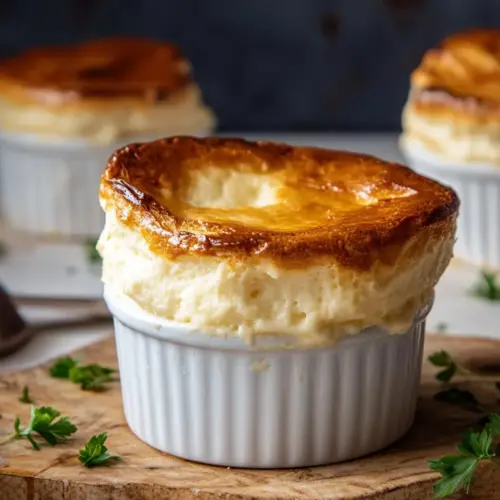
Cheese Soufflé
Cheese Soufflé is a creamy, airy classic that lifts high with a golden top and a cloud like interior. This easy yet impressive dish offers a rich, savory bite from Gruyère and a light, delicate crumb, perfect for an easy weeknight dinner or an elegant served starter. Make it when you want simple ingredients to deliver maximum theatre and flavor.
Equipment
- Saucepan
- Whisk
- Mixer or hand mixer
- Ramekins
- Rubber spatula
- Baking Tray
Ingredients
- 2 cups full fat milk, but works with lite milk too Provide rich, whole-milk fat and body to the béchamel base, contributing creaminess and helping create a tender soufflé structure; heat gently to scald before thickening for best texture. Offer flexibility with lite milk substitution, though reduced fat will yield a slightly less rich final lift and mouthfeel.
- 75 g (5 tbsp) unsalted butter Melt to form the roux with flour, supplying buttery flavor and richness while coating starch granules to thicken the sauce; use unsalted butter so salt levels can be controlled precisely. Add at the start of cooking to ensure even dispersion and prevent the sauce from tasting greasy.
- 1/2 cup plain flour (all-purpose) Absorb milk and swell when cooked with butter to create a smooth, stable roux that thickens the base; sift or whisk to avoid lumps and cook briefly to remove raw flour taste. Measure carefully to maintain the correct sauce viscosity so the soufflé can rise properly.
- 1/2 tsp cooking salt / kosher salt (halve for table salt, + 50% for flakes) Season the base with a balanced saline element to enhance all flavors and help proteins tighten slightly during cooking; adjust quantity for different salt types as noted. Use half the amount for table salt and increase for flaky salts to maintain consistent seasoning.
- 2 pinches ground white pepper (substitute black pepper) Season with a subtle, warm heat and aromatic lift that complements cheese without overpowering; choose ground white pepper for visual subtlety or substitute black pepper if preferred. Add sparingly to preserve the delicate flavor profile of the soufflé.
- 150 g (1 1/2 cups) Gruyère cheese, shredded using a standard box grater (tightly packed if using cups) (Note 2 for other cheeses) Contribute nutty, savory intensity and melting fat that enriches the béchamel and flavors the interior; shred finely for even melting and measure packed if using cup volumes. Substitute with other sharp melting cheeses as needed, while noting changes to saltiness and melt behavior.
- 3 egg yolks from large eggs (55 g / 2 oz each in shell), at room temperature (Note 1) Provide richness and emulsifying fat to stabilize and enrich the sauce, helping create a smooth, glossy base that supports the folded egg whites; bring to room temperature for easier incorporation. Separate carefully from whites to avoid contamination and ensure proper whipping.
- 4 egg whites from large eggs, at room temperature (total egg whites ~ 120 g / 4.2 oz, Note 1) Leaven the soufflé by whipping to soft peaks and folding into the base for volume and lift; use room-temperature whites for maximal aeration and reliable structure. Measure total weight to ensure consistent whipping times and avoid any yolk traces that prevent foaming.
- 1/2 tsp cream of tartar, sifted if lumpy (Note 3) Stabilize whipped egg whites and increase their volume and resilience, helping the beaten whites hold air during folding and baking; sift if lumpy to ensure even distribution. Use the specified small amount to avoid altering flavor while improving stability.
- 15 g (1 tbsp) unsalted butter, melted (to grease the ramekins) Grease the ramekins to prevent sticking and allow the soufflé to climb and release cleanly from the sides, using melted unsalted butter for an even coating and neutral flavor. Apply a thin, uniform layer before dusting or flouring as desired.
Instructions
- Melt butter, cook flour 2 minutes, whisk in warm milk in 3 batches. Add salt and pepper, turn off heat, whisk in yolks one at a time, then melt through gruyere over low heat. Beat egg whites and cream of tartar to firm peaks, starting on medium for 2 minutes, then increasing to high. Whisk 1/4 of the whites into Mornay Sauce, then fold through remainder in 3 batches. Fill butter brushed ramekins to 1 cm / 0.4” from rim, clean inside of rim. Bake at 200°C / 400°F (180°C fan) for 20 minutes. No peeking! Serve immediately.: The moment the butter melts it releases a warm, nutty aroma that signals the start of the roux; the texture should be pasty like wet sand before cooking, then it will turn smoother and glossy as you whisk, which feels satisfying under the whisk and looks like a gentle sheen on the surface. When you add the hot milk in three batches, the sauce transforms, going from thick to silkier with each addition; you will hear a soft bubbling as it returns to heat and notice the viscosity change when the spatula draws a slow path that briefly holds. This technique prevents lumps and encourages even thickening. Avoid browning the roux, which gives a toasty flavor that will throw off the delicate soufflé; if you see any browning, lower the heat and whisk rapidly to rescue it.
- Preheat oven to 200°C / 400°F (180°C fan-forced). A properly hot oven is crucial, it's what gives the soufflé its famous lift. A cold oven = a sad soufflé.: When the salt and white pepper join the sauce you’ll catch a subtle seasoning scent that brightens the milk base; turning off the heat before adding the egg yolks prevents them from scrambling. As you whisk each yolk in, the sauce will become silkier and take on a deeper sheen, and the motion of whisking feels smooth and reassuring. This step enriches the béchamel and controls temperature so the yolks integrate without cooking. The main mistake is adding yolks to a sauce that is too hot, which yields tiny cooked bits; if this happens, remove from heat and whisk vigorously to cool slightly.
- Prepare the ramekins (Note 4) – Brush the insides of 4 (325 ml / 1 1/3 cups) ramekins generously with melted butter (use all the butter). No need to brush upwards (see post for why). Set on a baking tray.: Adding the shredded Gruyère back on gentle heat releases a warm, nutty fragrance and the sauce will become thicker and glossy as cheese melts into it; you will see long silky strings as the cheese incorporates and a slightly elastic texture that signals readiness. Maintaining low heat prevents the oils from separating and keeps the sauce cohesive, which is vital to a smooth Mornay. Overheating can cause grainy separation, so keep the pan at low heat and stir patiently until fully combined.
- Heat the milk – Place the milk in a small saucepan over medium heat. Warm it until it’s steaming but not boiling. Set aside.: As you beat the egg whites and cream of tartar , the bowl will first look frothy, then glossy, and finally form firm peaks that hold their shape; you’ll hear a change from sputtering to a steady, higher pitched whir as stability increases, and the mixture should look like billowy clouds. Starting at medium speed helps proteins align gradually, which yields a finer foam; ramping up briefly finishes the structure. A common error is over beating, which dries the whites and makes them granular; stop when peaks are firm but still shiny.
- Make the roux – While the milk is heating, let’s start our roux. In a large saucepan, melt the butter over medium heat. Once melted, add the flour. Whisk it gently, it will be thick and pasty at first like a wet sand. Cook, whisking constantly, for about 2 minutes. It will thin up and become smooth and glossy. Make sure to use the whisk to get into the corners of the pot and don’t let it brown. Reduce heat if you think it’s too high.: Incorporating a small portion of the whipped egg whites into the warm Mornay loosens it and eases the transition of textures; you will notice the sauce lighten in color and become more aerated, with tiny suspended bubbles giving a gentle, airy sheen. This is not the time for vigorous stirring, a few brisk motions are all you need to marry the elements while protecting the foam structure. The why is simple, it prevents a heavy collapse when folding the remainder in. Avoid dumping all the whites in at once, which will deflate the foam and yield a denser soufflé.
- Make Béchamel – Add a third of the hot milk to the roux while whisking vigorously, it will thicken very quickly. Add half of the leftover milk, whisk until smooth and then pour the rest of it along with the salt and pepper. Keep whisking for 30 seconds to a minute until thickened and smooth, lumps will go away. It will be thick enough so you can draw a path with a spatula in the middle, it should hold its shape for a moment before slowly sinking back.: Folding the remaining egg whites in batches requires slow, sweeping strokes from the bottom to the top so you keep as much air as possible; the mixture should look marbled at first, then gradually uniform, and you will feel a lightness return to the batter as it becomes homogenous. Use a gentle turn and lift motion with a rubber spatula; the sound is soft and the motion deliberate, not frantic. This technique preserves the bubbles that create lift in the oven. Common mistakes include over mixing, which removes air, or under mixing, which leaves streaks and uneven texture in the bake.
- Turn it into a Mornay sauce – Turn off the heat and whisk in the egg yolks, one at a time, until fully combined (don't worry the egg yolks won't cook). Then, turn the heat back on to medium and whisk in the grated Gruyère until melted through. Scrape down the sides and cover with a lid. Set aside.: As you ladle the batter into the buttered ramekins, the surface should shine and settle slightly, and leaving a small gap to the rim ensures room for the soufflé to rise without spilling over; running your thumb around the inner rim creates a clean edge that helps the soufflé climb uniformly and produces a neat, even collar. You will notice the batter’s surface tension smoothing under the spoon, and the visual clarity of a clean rim makes for a dramatic rise. Don’t skip cleaning the rim, as residue will impede a proper ascent and create an uneven edge.
- Beat the egg whites, gently at first – Add egg whites and the cream of tartar in a large bowl. Using a hand mixer or a stand mixer fitted with a whisk attachment, beat the egg whites on medium speed for 2 minutes then high speed for 30 seconds until you get firm peaks. Starting slowly helps the protein structure to develop properly. Rush it and you risk unstable, foamy whites that collapse when folded in.: The oven’s roar as you slide the tray in is part of the ritual; a properly hot oven delivers rapid steam and expansion, which is what gives the soufflé its lift. You’ll see them swell and develop a golden, slightly crackled top, and the sound is a quiet, steady rise rather than a loud boil. Resist peeking because that sudden temperature drop causes a collapse; the correct finish is a gentle jiggle in the center when nudged. If the centers wobble excessively or the tops brown too fast, your oven may be uneven or too hot; rotate carefully next time and adjust the rack position.
- Fold gently – Give the Mornay a quick whisk to make it smooth again then add in a quarter of the egg whites and whisk it in to loosen it. Then gently fold a third of the remaining egg whites in using a rubber spatula until mostly incorporated. Use slow, sweeping motions from the bottom of the pot, you want to keep as much air in as possible. (See video at 2.15 minutes) Rough folding = flat soufflé. Few lumps are ok. Repeat twice more with the rest of the egg whites.: Once out of the oven, the aroma of warm cheese fills the room and the tops stand tall, glossy, and golden; there is a brief window where the soufflé is at its visual peak and the interior is pillowy. Serving immediately captures that moment, and spooning into it reveals an air filled, custardy crumb. Waiting will invite a gentle deflation, and while it will still taste wonderful, it loses the dramatic rise. Plate quickly and invite diners to dive in while the texture is at its best.
- Fill the ramekins – Pour the mixture evenly into the ramekins using a ladle or a large serving spoon, filling to about 1 cm / 0.4" below the rim. Smooth the tops with the back of a teaspoon dipped in water, no need to be 100% meticulous here, just get rid of big bumps. Run your thumb around the inside rim of each ramekin to clean it, this gives the soufflé a clean edge to rise against.: A fully preheated oven is non negotiable because swift, even heat is how the soufflé gains lift. You will feel the heat when you open the door and see the oven walls glowing; placing the tray in a properly hot environment creates the rapid steam that expands the air bubbles. If the oven is underheated the rise will be weak and the result flat. Always allow extra time for the oven to stabilize at temperature before baking.
- Bake – Place the ramekins on a baking tray and bake for 20 minutes until tall and golden. Do not open the oven door while it's baking, the sudden drop in heat will make them sink. When it's cooked, the soufflés should jiggle a bit when you shake the ramekin.: Brushing the ramekins gives the batter something to cling to as it climbs; the glossy butter forms a nonstick layer and a slick surface that encourages an even ascent. When you set them on a tray, they should look uniformly coated and slightly gleaming. If a ramekin is not well greased, the soufflé may not rise evenly along that side. Be sure to use all the melted butter and don’t brush upwards to avoid uneven run off.
- Serve immediately – As soon as they’re out, serve straight away. Soufflés don't wait. So make sure all your family/guest are seated so they can enjoy the show!: Warming the milk until it is steaming but not boiling is a tactile cue, you will see thin wisps of steam and feel the bowl become warm to the touch; this temperature lets the milk integrate smoothly with the roux without cooling it excessively. If the milk boils it can introduce tiny curdled bits and change the sauce texture, so watch closely. Heating gently keeps the system balanced for a glossy béchamel.
- Make the roux – In a large saucepan, melt the butter over medium heat, add the flour and whisk constantly for about 2 minutes: Cooking the roux for the right amount of time removes raw flour flavor and yields a pasty stage that transforms into a smooth, glossy mixture; you’ll notice it becoming less gritty and more cohesive under the whisk, and the scent turns subtly nutty. Constant whisking prevents scorching in the corners, and the feel of the whisk gliding is a good indicator you’re on track. If you let it brown you will introduce an unintended toasty note, so stay attentive.
- Make Béchamel – Add milk in thirds, whisk until thickened and smooth: Adding the hot milk in stages keeps the sauce lump free and allows you to control the final thickness; the béchamel should coat the back of a spoon and leave a slow trail when you draw a spatula through it. The visual cue is a smooth surface that holds a brief path before settling. This ensures a stable base for the yolks and cheese. If you see lumps, whisk vigorously and strain if necessary to rescue the texture.
- Turn it into a Mornay sauce – Whisk in yolks then cheese, cover and set aside: Turning the béchamel into a Mornay by adding egg yolks and Gruyère makes the sauce indulgent and slightly elastic; you will notice a richer color and a silky sheen as the cheese melts. Covering briefly lets residual heat finish the melding without overcooking. Overheating at this stage can cause graininess, so off heat is safer unless you need to melt the cheese gently back in.
- Beat the egg whites, gently at first: The progression from foamy to glossy peaks is a sensory delight; the bowl will warm slightly and the whites will change tone, becoming denser and reflective. Gentle starting speed helps proteins align, then finishing at higher speed firms the structure. Rushing leads to unstable foam that collapses, so patience at this step pays dividends.
- Fold gently – Loosen the Mornay with a quarter of the whites then fold in remaining in thirds: Folding is a slow, mindful motion that preserves air; as you fold you will see marbling give way to uniform batter that still feels light and buoyant. The sound is almost silent, and the movement should be deliberate, not aggressive. Rough handling crushes bubbles and produces a flat soufflé, so always fold with care.
- Fill the ramekins – Smooth tops, run thumb around rim: Smoothing the tops with a wet teaspoon gives a neat finish and running your thumb around the rim cleans the edge so the soufflé can rise evenly; doing this yields a crisp, rising collar that looks professional. The batter should glisten and sit slightly below the rim to permit an impressive lift. Skipping the rim clean will cause uneven rise patterns.
- Bake – Place ramekins on a tray and bake for 20 minutes until tall and golden: The oven will coax the batter into a tall, golden dome; you will see the tops blister and color, an aroma of warm cheese will waft out, and the center should still have a gentle jiggle indicating a creamy interior. Avoid opening the oven, as the shock of cool air causes collapse. If your soufflés brown too fast, lower the rack or reduce temperature slightly next time.
- Serve immediately – Soufflés don’t wait: The final sensory joy is the immediate serving, when steam rises and the first spoon reveals a cloud like interior. The contrast of the golden exterior and tender center is at its peak right away, and sharing that instant with others makes the effort worthwhile. Delay and the soufflé will descend, losing some of its magic.
Notes
- Choose a milder or sharper cheese like swapping Gruyère for Cheddar or Monterey Jack to shift flavor intensity while maintaining meltability.
- Adjust milk richness by using lite milk for a leaner texture or full fat for a creamier mouthfeel, noting that higher fat yields a richer béchamel.
- Try different ramekin sizes by using smaller ramekins for individual appetizers or larger ones for main course portions; adjust baking time accordingly and watch for jiggle to test doneness.
- Incorporate herbs sparingly such as finely chopped parsley or chives folded in with the final whites for a fresh note that does not weigh the batter down.
- Stabilize whites naturally if you don’t have cream of tartar by ensuring bowls and beaters are grease free and that egg whites are at room temperature for maximum volume.
- Make ahead strategy by preparing the Mornay sauce and chilling it, then whipping whites and folding just before baking; this shortens active time on the day you serve.