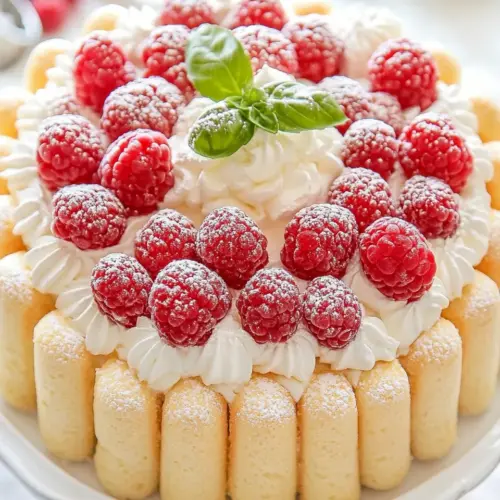
Charlotte Cake
Charlotte Cake is a creamy, fruity showstopper with a light mousse center and tender sponge layers, finished with crisp Lady Fingers and fresh raspberries. This easy to impressive dessert brings bright raspberry and lemon flavors, perfect for a summer gathering or special occasion. Try it for an elegant, make ahead treat that slices beautifully and pleases a crowd.
Equipment
- 9" springform pan
- Mixer with whisk attachment
- sauce pan
- Sieve
- Wire Rack
- piping bag with star tip
Ingredients
- 10 oz 2 1/2 cups frozen raspberries Frozen and sweet-tart raspberries provide a concentrated fruit base for the filling, offering natural bright color and intense raspberry flavor when pureed and strained for smooth texture.
- 1/2 cup granulated sugar Granulated sugar adds necessary sweetness and helps balance the raspberries' acidity; it also aids in maceration when combined with fruit to draw out juices and flavor.
- Juice from 1 medium lemon, 2 Tbsp for mousse + 1 Tbsp for simple syrup below Squeezed lemon juice contributes vibrant acidity to the mousse, balancing sweetness and enhancing the fruit’s brightness while helping to set flavors for a fresher finish.
- 1 tbsp Knox unflavored Gelatin, from 1 1/4 packets Knox unflavored gelatin functions as a stabilizer for the mousse, dissolving into warm liquid to create a firm but tender set that holds the charlotte’s shape when chilled.
- 3 cups heavy whipping cream Heavy whipping cream supplies rich fat and body to create a voluminous, airy mousse when whipped, giving the dessert a light, creamy mouthfeel and structure.
- 6 tbsp confectioners, powdered sugar Confectioners (powdered) sugar sweetens and helps stabilize whipped cream by dissolving quickly, while adding a silkier texture than granulated sugar would in the mousse.
- 4 large eggs, room temperature Large room-temperature eggs provide structure and lift in the sponge component; when whipped with sugar they incorporate air that yields a light, tender cake layer.
- 2/3 cup granulated sugar Granulated sugar for the cake component sweetens and assists with aeration when creamed or beaten with eggs, contributing to crumb tenderness and caramelized flavor.
- 2/3 cup cake flour, make your own with 2 ingredients! Cake flour blend (created from two ingredients) yields a lower-protein, tender crumb ideal for delicate sponge or ladyfinger-adjacent cake layers that should be fine and soft.
- 1/4 tsp baking powder Baking powder acts as a chemical leavening agent in the cake mixture, producing carbon dioxide during baking to lighten the batter and improve rise and texture.
- 7 oz pkg Lady Fingers Package of ladyfingers provides the classic exterior and interior structure of a charlotte, offering crispness that soaks up flavorful syrup while keeping overall shape.
- 3 -4 tbsp raspberry preserves or jam Raspberry preserves or jam adds an extra layer of concentrated fruit flavor and sweet stickiness between cake layers or under the mousse to intensify raspberry notes.
- 1 cup warm water Warm water is used to dissolve gelatin or to prepare a simple soaking syrup, helping disperse other ingredients evenly and ensure proper setting or moisture.
- 1 tbsp fresh lemon juice Fresh lemon juice for the simple syrup brightens and balances sweetness, infusing the soaking liquid with citrus notes that complement the raspberries and lift flavors.
- 1 tbsp sugar Sugar for the simple syrup sweetens the soaking liquid to permeate ladyfingers or cake layers, controlling sweetness and ensuring even moistness throughout the dessert.
- 1 cup fresh raspberries and mint leaves for garnish Fresh raspberries and mint leaves provide a final decorative garnish, contributing fresh fruit aroma, a pop of color, and a hint of herbal brightness to finish the presentation.
Instructions
- In medium sauce pan, combine: 10 oz frozen raspberries and 1/2 cup sugar. Cook stirring occasionally until jam consistency. Remove from heat and strain through a sieve, pressing on the fruit with a spoon to extract as much raspberry juice as possible (you should get 2/3 cup syrup).: 10 oz frozen raspberries and 1/2 cup sugar. Cook stirring occasionally until jam consistency. Remove from heat and strain through a sieve, pressing on the fruit with a spoon to extract as much raspberry juice as possible (you should get 2/3 cup syrup) : As the berries soften in the sauce pan , the kitchen fills with a warm, sweet fragrance, and you will notice the mixture thicken to a jam like sheen. The sound is a gentle simmer, not a vigorous boil, and this slower heat helps the fruit release flavor without burning. Pressing through a sieve yields a smooth, seed free syrup with intense color and aroma, which is crucial for a silky mousse. A common mistake is overheating, which can make the syrup taste cooked rather than fresh, so keep the heat moderate and stir occasionally to prevent sticking.
- Into the raspberry syrup, stir in 2 Tbsp lemon juice and 1 Tbsp gelatin. Pour syrup back into sauce pan and place back over medium heat, whisk until gelatin is dissolved. Do not boil. Remove from heat and cool to room temp.: The scent brightens when you add fresh lemon juice , and whisking helps the gelatin blend seamlessly so no grains remain. Warmth should be comforting to the touch, not bubbling, because boiling can reduce the volume and compromise the gelatin's setting power. Cooling to room temperature ensures the syrup is ready to incorporate into whipped cream without melting it. The usual error here is adding gelatin to cold syrup where it clumps, so dissolve it gently over low heat and remove promptly to cool.
- Line a 9" springform pan with parchment paper. Preheat oven to 350˚F. In the bowl of your mixer with the whisk attachment on high speed, beat 4 eggs for 1 minute. Gradually add 2/3 cup sugar and continue beating on high 7 min until thick and 3 to 4 times in volume.: The room will smell faintly of cooked egg as the mixture inflates, and you will see the batter turn pale and ribbon when the whisk lifts. This aeration is the lifeblood of a light sponge, creating fine bubbles that expand in the oven to form a tender crumb. Avoid stopping too soon, because underwhipped eggs produce a dense cake. Also, do not overheat the bowl or use cold eggs, as that will limit volume.
- Stir together cake flour and baking powder then sift flour into whipped eggs in 2 additions, folding to incorporate between each addition. Scrape from the bottom to catch any hidden pockets of flour and fold just until incorporated - don't overmix. Bake at 350˚F for 23-25 minutes or until top is golden and springs back when poked lightly.: Folding should be a gentle, feathery motion so you preserve the airy batter; you will feel slight resistance but see no streaks of flour when done. The top will develop a light golden sheen and a gentle bounce when pressed, and a thin knife inserted will come out clean. Overmixing collapses the air and creates a dense crumb, so stop folding as soon as the batter is uniform and smooth.
- Once it's out of the oven, remove cake from pan by sliding a thin edged spatula around the edges. Transfer to wire rack, peel back parchment and cool to room temp. Then slice cake layers in half horizontally.: The aroma of baked cake will be warm and slightly sweet, and moving it to a wire rack prevents steam from condensing and making the bottom soggy. Slicing the cooled cake into layers gives you even strata to build the Charlotte, and a thin edged spatula helps release the cake without tearing. Cutting while too warm risks a ragged edge, so ensure the layers are at room temperature before slicing.
- Cover springform walls with plastic wrap. Trim off 1/2" all around the edges of both cake layers (I used kitchen scissors) and place the first layer into the bottom of your springform pan. Trim about 1/2" off one end of all lady fingers. Place lady fingers in a tight ring, cut-side-down, around the cake base then brush cake with 1/3 of the simple syrup. Brush backs of lady fingers with 1/3 of syrup as well. Spread 1 1/2 Tbsp raspberry preserves over cake. Set aside.: The visual of a snug Lady Fingers ring is gratifying, and brushing syrup gives the sponge a glossy sheen while adding moisture. The sound is silent here, but your hands will sense the snug fit as you press fingers into place. The preserves add a concentrated fruity patch that shows through thin layers, and arranging these components neatly prevents movement when slicing. A common slip is over saturating the cake with syrup, which makes the base soggy, so apply sparingly.
- With the whisk attachment, beat 3 cups heavy cream with 6 Tbsp powdered sugar on high speed until thick and spreadable. Remove 1 1/2 cups of whipped cream to a piping bag fitted with a star attachment and refrigerate to use as topping later.: As the heavy whipping cream whips, it will shift from glossy liquid to soft peaks and finally to thick, spreadable texture; watch closely because the transition can be quick. The room smells faintly of sweet cream, and the volume increases as air folds in. Reserving part of the whipped cream for piping ensures a pretty finish. Stopping too late leads to butter formation, so pull the bowl off the mixer when peaks hold but still look smooth.
- Once raspberry syrup is completely at room temp (don't wait way too long or it will thicken and become difficult to blend), fold it into remaining big batch of whipped cream adding 1/4 syrup at a time and folding between each addition. This is your mousse.: The mousse should glisten with a soft pink hue and smell of bright raspberries . Folding in small amounts protects the airy texture of the whipped cream and prevents deflation. If the syrup is too cool and thick, it will clump and resist incorporation, so aim for a pourable room temperature. A misstep is rushing and adding the syrup all at once, which can collapse the air and yield a runny filling.
- Spread 1/2 of the mousse over cake layer inside the springform. Top with second cake layer, brush with remaining simple syrup and spread with 1 1/2 Tbsp raspberry preserves. Add remaining mousse. Pipe whipped cream and top with fresh raspberries and mint leaves if using. Cover with plastic wrap and refrigerate until set (3 hours or overnight). To serve, remove springform walls and plastic wrap.: When you spread the mousse, its texture should be billowy and smooth, with a faint fruity aroma, and layering will create an inviting profile when sliced. Piping the reserved whipped cream gives a decorative edge and a light contrast to the mousse. Chilling allows the gelatin to firm the mousse so slices hold their shape and the flavors meld. The frequent pitfall is insufficient chilling, which leads to messy slices, so allow at least a few hours or overnight for best results.
Notes
- Chill equipment: Refrigerate your mixing bowl and whisk before whipping the heavy whipping cream so it reaches stable peaks faster and yields a silkier mousse.
- Control syrup temperature: Make sure the raspberry syrup is room temperature and pourable when folding into the whipped cream, to avoid clumps and prevent deflating the mousse.
- Whip eggs correctly: Whip the 4 large eggs and sugar until the mixture is pale and ribbons when the whisk is lifted, this ensures a sponge that is airy enough to slice thinly yet strong enough to support the mousse.
- Fold gently: Use a gentle folding motion when combining sifted flour with the whipped eggs to maintain the sponge's delicate structure and avoid toughness.
- Trim with care: Trim just enough off the cake edges so the layers fit snugly in the springform pan, preventing gaps between the sponge and the Lady Fingers.
- Reserve topping: Save 1 1/2 cups of whipped cream in a piping bag for decoration, it creates a polished finish and provides contrast to the mousse texture.