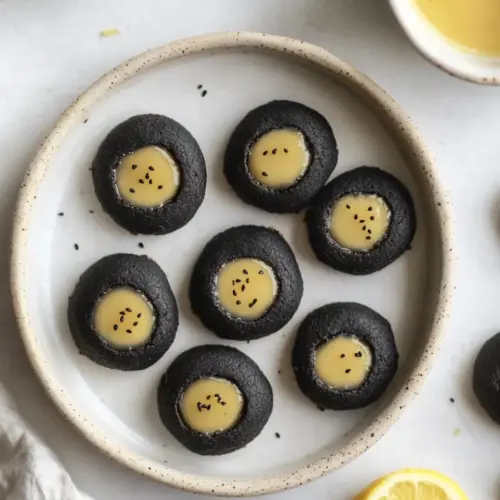
Black Sesame Thumbprint Cookies with Meyer Lemon Curd
Black Sesame Thumbprint Cookies with Meyer Lemon Curd marry earthy, toasty sesame with bright, creamy Meyer lemon curd for a unique, crispy yet tender cookie. These easy to make thumbprints are great for gifting or entertaining and offer an elegant flavor contrast that feels both modern and nostalgic, a perfect reason to bake a batch this week.
Equipment
- Baking Sheet
- Stand up Mixer
Ingredients
- 3/4 cup freshly squeezed meyer lemon juice or regular lemon juice, from about 5 blood oranges, strained and pulp discarded Provide bright, acidic juice that balances sweetness and adds citrusy brightness to curd; strain removed pulp ensures a smooth, silky lemon curd texture and consistent flavor intensity suitable for filling cookies.
- 4 tablespoons unsalted butter, room temperature Contribute creamy richness and mouthfeel to the lemon curd; room temperature butter easily emulsifies with the citrus and egg yolks to create a glossy, stable curd with a tender bite.
- 1/2 cup white granulated sugar Add bulk sweetness and help stabilize the curd’s structure; granulated sugar dissolves into the citrus mixture, controlling tartness while also aiding in the curd’s glossy finish and shelf stability.
- 2 large egg yolks Enrich and thicken the curd while providing a custardy texture; large egg yolks lend fat and emulsifying lecithin that create a smooth, rich curd that sets without becoming rubbery.
- 2 large eggs Bind and leaven in the cookie dough while contributing moisture and structure; whole eggs add protein and water that help create a cohesive dough and tender crumb for thumbprint cookies.
- 1/4 teaspoon kosher salt Enhance overall flavor and balance sweetness in both curd and dough; kosher salt sharpens citrus notes and strengthens gluten network control in dough for improved texture and flavor depth.
- 1 1/4 cup all-purpose flour Supply the primary dry structure and body for the cookie dough; all-purpose flour forms the framework that determines cookie tenderness, spread, and how well it holds the curd filling.
- 1/2 teaspoon baking powder Act as a mild leavening agent to lighten the cookie crumb; baking powder releases gas during baking to create a slightly airy texture while maintaining a tender bite.
- 1/2 teaspoon baking soda Provide additional leavening power and spread control in the dough; baking soda reacts with acidic components to promote browning and help achieve a balanced rise and texture.
- 1/3 cup smooth black sesame paste, *see below for tip Introduce deep, nutty sesame flavor and moist fat content to the dough; smooth black sesame paste enriches taste and provides a distinctive color and mouthfeel for sesame thumbprint cookies.
- 1/2 cup unsalted butter, at room temperature Contribute richness and tenderness to the cookie dough; room temperature unsalted butter creamed with sugars creates aeration and a soft, buttery bite while controlling salt levels.
- 1/3 cup light or dark brown sugar Add caramel-like sweetness and moisture to the cookies; light or dark brown sugar supplies molasses notes that deepen flavor while helping cookies retain chewiness.
- 1 large egg Provide binding, moisture, and structure to the cookie dough; a large egg helps emulsify fats and sugars, lending shine and cohesion to the dough for even baking.
- 1 teaspoon vanilla extract Impart aromatic flavor and enhance overall sweetness perception in the dough; vanilla extract rounds out flavors and elevates both sesame and lemon notes for a more complex cookie.
Instructions
- To a small saucepan, placed over medium heat, simmer the lemon juice until it reduces by half (to about 1/3 cup), about 3-5 minutes. Set aside to cool slightly.: You will notice the liquid change from a loose, watery stream to a slightly syrupy pour, with tiny bubbles forming around the edges. This reduction concentrates the citrus oils and aroma, which makes the curd pop with flavor. A common misstep is boiling too rapidly, which can create bitter notes and evaporate too much. Keep the heat steady and watch for the visual cue of reduced volume. The reduced juice will smell intensely lemony, brighter than straight juice, and that brightness is essential for a well balanced curd.
- In the stainless steel bowl of your stand-up mixer, add the softened butter and sugar and beat until light and fluffy, about 2 minutes.: The mixture should turn paler and increase in volume, with a whisper of air trapped inside the batter, giving a cushiony texture. This aeration helps create a tender cookie. If your butter is too cold, it will not cream properly and the sugar will not dissolve, leading to a grainy texture. Scrape the bowl once or twice to ensure even mixing. The creamed butter will smell rich and sweet, foreshadowing the cookie's tender crumb.
- Add the egg yolks, beat the mixture together, and then add the eggs, beating again until they’re well incorporated. Stir in the salt, and then in a few batches, add lemon juice. The mixture will look curdled and you might scratch your head and wonder if it’s right, it will be!: At this stage the batter becomes glossy and smoother as the eggs bind fats and dry ingredients. You might notice a slight thinning as the liquid incorporates. Overbeating can cause too much looseness, so stop when fully uniform. A frequent error is adding cold eggs that then firm up the butter ; let eggs reach room temperature first for seamless blending. The aroma shifts to a richer, bakery like scent.
- Rinse out the small saucepan you used earlier, and fill it with a few inches of water. Bring the water to a simmer and place your stainless steel bowl of curd mixture on top. Stir constantly, and heat the curd slowly enough that the sugar has time to dissolve and the whole mess becomes cohesive; this step usually takes about 5 to 10 minutes. Pull the curd from the heat when it is just thick enough to coat your spoon and until a thermometer reads 166 F. The curd will thicken as it cools.: When you add the reduced lemon juice , the curd mixture may appear curdled or separated; this is normal. The acid reacting with the fats produces this look temporarily. Patience is key here, because continued gentle heating will marry the ingredients back into a silky texture. A mistake is rushing with high heat, which can scramble the eggs . The mixture will smell intensely citrusy and feel thicker as you incorporate the juice.
- I ran the curd through a sieve into a chilled bowl a few times just to ensure it was silky smooth. I highly recommend this step! Transfer the curd to a container and keep in the fridge, in an airtight container, for up to a week.: Setting up a gentle double boiler keeps the heat even and prevents the curd from overheating. As the water simmers, the bowl above warms indirectly, allowing the sugar to dissolve slowly and the mixture to thicken without scrambling. Stir constantly and use a thermometer to confirm 166 F. Do not skip constant stirring, or the curd may seize or stick. The curd will transform from runny to a custard like consistency and smell like sweet, tangy citrus goodness.
- In a medium mixing bowl, combine the all-purpose flour, baking powder, baking soda and salt. Set aside.: The visual cue of coating the spoon is important because the curd will continue to set as it cools. Overcooking risks a grainy texture, undercooking leaves it loose. Cooling also concentrates aroma, so expect the scent to mellow slightly while remaining bright. A common mistake is assuming it is done the moment it thickens; checking temperature ensures safety and proper consistency.
- In the bowl of a stand-up mixer (with the paddle attachment) or in a large bowl (using a hand-mixer), beat together the black sesame paste and softened butter until very smooth, about 30 seconds. Add the brown sugar and beat once more until smooth, about 30 seconds. Next, beat in the egg and vanilla extract. In two batches, add the dry ingredients until no speckles of flour are visible. The dough should be soft and supple. Transfer to the fridge to chill for about 10 minutes.: Passing the curd through a fine mesh removes any tiny cooked egg bits and any pulp, leaving a glass smooth finish. Chilling the bowl helps the curd come to temperature quickly, which stops cooking and stabilizes texture. Skipping the sieve can result in a slightly grainy mouthfeel. The strained curd will be glossy and luxurious, ready to refrigerate.
- Meanwhile, preheat the oven to 350 degrees. Line a baking sheet with parchment and set aside.: Dry whisking distributes the leavening evenly so each cookie rises uniformly. The mixture should look consistent, with no clumps. If you omit this step, you risk uneven pockets of baking soda or powder that create odd shapes or flavors. The combined dry mix smells faintly toasty and is ready to be folded into the wet batter for a reliable structure.
- Using a 2-ounce cookie dough scooper (or a tablespoon), scoop out a ball of dough. Roll the dough into a circle using the palm of your hands. Transfer to the cookie sheet. Using the opposite end of a spatula, make an indentation in the center of the cookie. Repeat the scooping, rolling and “thumbprinting” process until you’ve worked through about half the dough (you’ll need to bake these cookies in two batches), being sure to space the cookies about 3-inches apart (they’ll spread a bit).: The black sesame paste will loosen and emulsify with the butter , releasing its nutty, toasted aroma. Once smooth, add brown sugar and beat again, then the egg and vanilla extract . The batter will become shiny and fragrant. If the paste is separated or oily, blitz it briefly to restore uniformity, otherwise the texture may be inconsistent. The result should be a supple, slightly glossy dough.
- Transfer to the oven and bake for 15 minutes, until the cookies have spread slightly. Carefully remove the baking sheet from the oven and using the opposite end of a spatula, re-make the indentation in the center of the cookie. Allow to cool for 5 minutes on the baking sheet (they’ll be very fragile right when they come out of the oven) and then transfer them to a cooling rack until they’re room temperature. When cooled, add a teaspoon of the meyer lemon curd to the center of the cookies. These cookies will keep in an airtight container for up to 5 days.: Folding the dry mix in gently prevents overdeveloping gluten, which keeps the cookies tender rather than tough. The dough should be soft and pliable, not stiff. Overmixing will create a chewier cookie, so stop as soon as the flour is incorporated. The dough will feel smooth to the touch and hold together when rolled.
- Transfer to the fridge to chill for about 10 minutes: Brief chilling firms the dough slightly, making it easier to scoop and helping the cookies maintain their shape during baking. The cold dough also slows spread for a thicker cookie. If you skip chilling, cookies may spread too thin. The chilled dough will handle like dense clay and smell deeply of sesame and brown sugar.
- Meanwhile preheat the oven to 350 degrees: Proper preheating ensures even rise and browning the moment the cookies hit the oven. Set a rack in the middle for best circulation. An oven that is not fully heated will yield uneven texture and color. You want a consistent, warm environment so edges set while centers remain tender.
- Using a 2 ounce cookie dough scooper scoop out a ball of dough: As you scoop and roll, the dough should form smooth spheres. Place them on a parchment lined baking sheet spaced about 3 inches apart. Using the back of a spatula to create the indentation is gentler than using a thumb and prevents cracking. If cookies are too warm when indented, they may collapse; indent each cookie just before baking for the best hold. The raw dough will be pleasantly scented and slightly tacky.
- Transfer to the oven and bake for 15 minutes until the cookies have spread slightly: You will notice edges become set and the top looks matte rather than shiny. Remove and remake the indentation while still warm, then cool on the sheet for 5 minutes before moving to a rack. A common error is overbaking; cookies should be slightly soft in the centers when removed. The baked cookies smell nutty and warm, and the centers will be ready to accept the curd once cooled to room temperature.
- When cooled add a teaspoon of the meyer lemon curd to the center of the cookies: The curd should be chilled or at least room temperature so it holds its shape in the indentation. Spoon carefully, letting the glossy curd nestle into the thumbprint. If the curd is too warm it will run, and too cold it may be stiff to spoon. Once filled, the cookies are ready to serve or store in an airtight container for up to 5 days, with the curd keeping them bright and fresh.
Notes
- Swap for tahini: If you cannot find black sesame paste, use tahini for a similar nutty flavor though the color will be lighter. Pulse the tahini briefly if it is oily to ensure a smooth, cohesive dough.
- Make the curd ahead: Prepare the Meyer lemon curd up to a week in advance and refrigerate in an airtight container to save time on baking day and deepen the flavors as they meld.
- Adjust sweetness: If you prefer a tarter finish, reduce the curd sugar slightly; taste the reduced juice first and calibrate gradually so the curd still sets properly.
- Plate for gifting: Arrange cookies in a shallow box with parchment, separating layers with wax paper; the contrast between dark centers and pale cookies looks elegant and homemade.
- Texture play: For added crunch, roll cookie edges in finely chopped toasted sesame seeds before baking for a subtle nutty crackle.