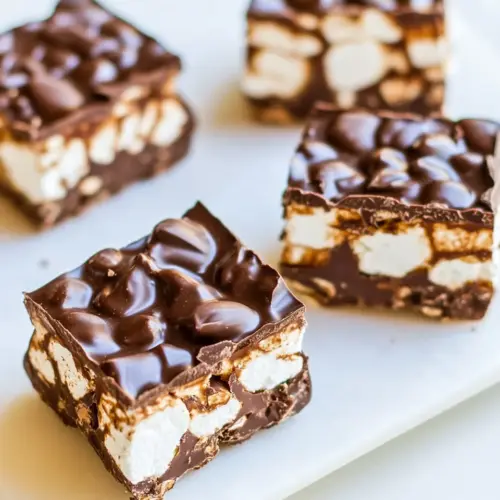
Biscoff Marshmallow Chocolate Bars
Biscoff Marshmallow Chocolate Bars are a creamy, chewy, and crispy no bake treat layered with melted semi sweet chocolate, cookie butter, and pillowy marshmallows. These easy bars come together quickly for an easy weeknight dessert or an impressive party snack, and they travel well for gifting or potlucks. Make them for a fuss free sweet that always disappears fast.
Equipment
- 8-by-8-inch pan
- Aluminum Foil
- Microwave-safe Bowl
- Spatula
- Refrigerator or freezer
Ingredients
- 1 1/2 cups semi-sweet chocolate chips, for melting Provide a smooth, rich melting base to bind and coat the bars, delivering deep chocolate flavor and sheen when melted; helps set the outer layer as it cools and adds sweetness and structure to the finished bars.
- 1/3 cup Creamy Biscoff Spread or Cookie Butter Spread - peanut butter may be substituted although the flavor will not be the same Add a spiced, caramelized cookie butter flavor and creamy fat content that enriches texture and helps glue marshmallows and crumbs together; offers distinctive Biscoff notes and prevents the bars from becoming dry.
- 3 1/4 cups mini-marshmallows Contribute light, pillowy sweetness and airy volume that creates chewy pockets and contrast against the dense chocolate and cookie layers; melt slightly into the warm mixture to provide gooey texture throughout the bars.
- 1 cup Biscoff Cookies about 10 to 12 cookies or Bistro Biscuits or substitute with 2 full-size sheets chopped cinnamon graham crackers Supply crunchy, cinnamon-spiced cookie texture and fragrant flavor when chopped or crushed, creating a buttery crumb component that adds bite and complements the Biscoff spread and chocolate.
- 1/4 cups semi-sweet chocolate chips, for sprinkling (white chocolate, butterscotch, peanut butter, or cinnamon chips may be substituted) Provide a finishing touch of chocolatey texture and visual appeal when sprinkled on top, melting slightly into the warm bars to enhance flavor; choice of chip variety allows subtle flavor adjustments to the topping.
Instructions
- Line an 8-by-inch pan with aluminum foil, spray with cooking spray; set aside. In a large microwave-safe bowl, add 1 1/2 cups chocolate chips and heat on high power for 1 minute to soften and begin to melt. Add Biscoff spread and heat on high power for 30 seconds to melt, stirring to combine. Heat in 15-second bursts until the mixture can be stirred smooth, taking care not to overheat it.: The foil lining makes removal and slicing much easier, and the light spray prevents sticking. As you press the mixture into the pan later, you will notice the foil allows you to lift the whole slab out cleanly. A common error is using too small a pan which makes the bars overly thick and harder to set evenly.
- Add the marshmallows, Biscoff cookies, and toss to coat evenly. Pour mixture into prepared pan, smoothing it lightly with a spatula. Sprinkle 1/4 cup chocolate chips evenly over the top. Place pan in the refrigerator for at least 2 hours to set-up, or until chilled and bars can be sliced. Bars will keep in an airtight container at room temperature for 1 week, in the refrigerator for up to 2 weeks, or in the freezer for up to 3 months. I prefer to keep them in the freezer (mine don't freeze solid) and serve them chilled.: At this point you should see the edges softening and a glossy sheen developing, but many chips will still hold shape. The brief initial burst primes the chips for gentle stirring. Overheating here leads to grainy texture, so stop once you see partial melting and stir to distribute heat.
- Optional Variations: Add slivered almonds, macadamia nuts, or a handful of shredded coconut to the batter. Omit the Biscoff cookies or graham crackers and instead use Nilla wafers or chopped Oreos. Sprinkle white chocolate chips, cinnamon chips, peanut butter or butterscotch chips, toffee bits, diced peanut butter cups, or Rolos on top. Mix and match as desired.: When the spread is added the aroma will bloom a bit, bringing that spiced cookie scent forward. Stirring at this stage helps emulsify the spread into the chocolate, creating a smooth, ribbon like texture. If the mixture resists combining, short 10 second bursts are better than a long interval.
- Heat in 15-second bursts until the mixture can be stirred smooth, taking care not to overheat it: The final smoothing is where you aim for a silky, homogenous mixture. You should see a glossy surface and feel the warmth when you stir. If it becomes too hot and thick, let it rest briefly to cool; overheated chocolate can seize and become grainy, which is hard to rescue.
- Add the marshmallows, Biscoff cookies, and toss to coat evenly: When you fold in the mini marshmallows and chopped Biscoff Cookies , you will feel the mixture become chunky and textured. Coat everything thoroughly so each morsel is surrounded by chocolate, which helps the bars set evenly. A common slip is adding too many mix ins which prevents the chocolate from binding the pieces together.
- Pour mixture into prepared pan, smoothing it lightly with a spatula: Pouring is sensory; listen for the low, thick sound as the mixture settles, and smooth with a lightly oiled spatula to create an even surface. You want a consistent thickness for uniform slicing later. If you press too hard you can compress air pockets that change the texture, so smooth gently.
- Sprinkle 1/4 cup chocolate chips evenly over the top: The topping adds the finishing look and concentrated chocolate bites. Scatter the chips so they are evenly distributed, and press them lightly so they adhere. If the chips sink unexpectedly, it usually means the base is too warm and soft; chill briefly before topping in that case.
- Place pan in the refrigerator for at least 2 hours to set up, or until chilled and bars can be sliced: While chilling, the chocolate firms and the bars achieve sliceable texture. You will notice the surface go from glossy and soft to matte and firm. Patience is key here, rushing to slice too soon yields messy edges and clumping.
- Bars will keep in an airtight container at room temperature for 1 week, in the refrigerator for up to 2 weeks, or in the freezer for up to 3 months: Proper storage preserves texture and flavor. I prefer the freezer because the bars stay firm but not rock hard, making them quick to slice and serve chilled. A common storage mistake is leaving them uncovered which leads to stale or sticky surfaces.
- I prefer to keep them in the freezer (mine dont freeze solid) and serve them chilled: Serving chilled highlights the contrast between the firm chocolate and the tender marshmallow. When you bite in, you should notice a satisfying snap followed by chewy marshmallow and cookie crunch. If your freezer makes them too hard, allow a few minutes at room temperature before serving to restore that ideal chew.
- Optional Variations: Add slivered almonds, macadamia nuts, or a handful of shredded coconut to the batter : These add layers of flavor and texture when mixed in. Nuts add crunch and coconut adds chew and a subtle tropical note, changing the mouthfeel meaningfully. Be mindful of added ingredients altering the binding ratio; too many inclusions can keep the bars from setting firmly.
- Optional Variations: Omit the Biscoff cookies or graham crackers and instead use Nilla wafers or chopped Oreos : Swapping cookies changes the spice and sweetness profile, which can be fun to experiment with. The key is similar piece size so the texture balance remains. If your substitute is very oily, it may affect setting, so adjust mix ins accordingly.
- Optional Variations: Sprinkle white chocolate chips, cinnamon chips, peanut butter or butterscotch chips, toffee bits, diced peanut butter cups, or Rolos on top : These toppings let you tailor the final flavor and visual appeal. A variety of chips can provide color contrast and flavor pops, but be cautious combining too many different melts that might behave differently when chilling.
- Optional Variations: Mix and match as desired : Experimentation is encouraged, and you will learn which combinations give you the best texture and balance. Keep notes on what you try so you can repeat your favorites. A mistake here is changing multiple elements at once, which makes it hard to know what created the improvement or problem.
Notes
- Swap the topping chips White chocolate, butterscotch, or cinnamon chips give a different flavor profile, and they also change the visual contrast on the finished bars.
- Add a nut crunch A handful of slivered almonds or chopped macadamia nuts folded in gives a satisfying contrast to the soft marshmallows and smooth chocolate.
- Try different cookies Substituting chopped Oreos or graham crackers alters the spice and sweetness, so pick ones that complement the Biscoff notes.
- Adjust chill time For firmer bars use the freezer, for slightly softer, keep them in the refrigerator and serve chilled not frozen.
- Mix in toasted coconut Toasting coconut before adding will boost its flavor and add a toasty note that pairs well with the cookie butter.
- Portion control Use a sharp knife warmed under hot water and dried between cuts to keep edges clean when slicing.