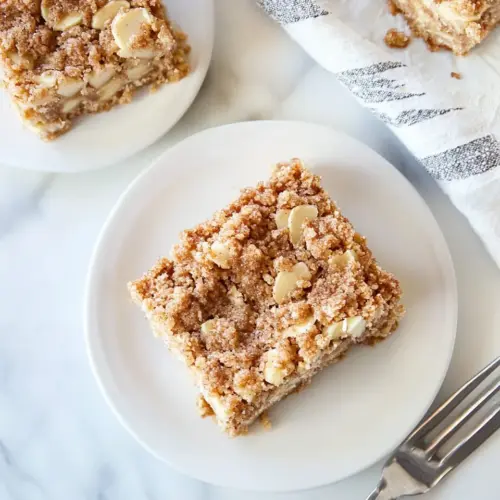
Apple Blondies with Cinnamon Almond Streusel
Apple Blondies with Cinnamon Almond Streusel are buttery, chewy bars with pockets of tender apple, warm cinnamon, and crunchy almonds. These easy to slice blondies deliver comforting fall flavors and a crisp streusel top perfect for gatherings, weekend brunches, or simple afternoon treats. Make them to impress with minimal fuss and maximum cozy payoff.
Equipment
- Stand mixer
- Food Processor
- 8 x 8-inch baking pan
- Parchment Paper
Ingredients
- 1 3/4 cup all-purpose flour Provide structure and tender crumb to the blondies while absorbing moisture from the batter; contributes to the overall texture and helps bind other dry ingredients evenly. Use measured, sifted flour if desired to prevent dense spots and ensure consistent results.
- 3/4 teaspoon baking powder Leaven lightly to give the blondies a subtle lift and prevent them from being too dense; helps the batter rise during baking for a soft yet slightly airy bite. Measure precisely to avoid over-rising that could alter texture.
- 1 teaspoon ground cinnamon Add warm, aromatic flavor throughout the blondies and streusel while complementing the apples; enhances depth and pairs well with brown sugar and almonds. Use a moderate amount so the cinnamon remains pleasant without overpowering.
- 1/2 teaspoon cream of tartar Stabilize acidity and contribute to a tender texture by reacting with baking ingredients; can help maintain a fine crumb in combination with the leavening agent. Use as specified to balance pH and preserve the blondies' softness.
- 1/4 teaspoons salt Season the batter to enhance and balance sweetness, bringing out other flavors like cinnamon and brown sugar; prevents the finished blondies from tasting flat. Dissolve evenly into dry ingredients for uniform seasoning.
- 1 1/2 cups packed light brown sugar Sweeten richly while adding a hint of molasses that deepens the caramel-like flavor profile typical of blondies; helps retain moisture for a chewy texture. Pack brown sugar firmly when measuring to achieve the correct sweetness and moisture level.
- 3/4 cups salted butter at room temperature Provide butterfat that enriches flavor, contributes to a tender crumb, and helps create a moist, rich base for the blondies; at room temperature it creams well with sugar for proper aeration. Soften evenly but avoid melting to preserve structure during mixing.
- 2 large eggs Bind ingredients together and add richness and moisture while contributing to structure through coagulation during baking; eggs also assist with leavening and browning. Use large eggs at room temperature for best incorporation and even texture.
- 2 teaspoon vanilla Impart sweet aromatic notes that enhance vanilla flavor and meld with brown sugar and apples; deepens overall flavor complexity. Measure precisely to avoid overwhelming other delicate flavors.
- 1 cup diced apples peeled Provide fresh fruity moisture and pleasant texture contrast while contributing light tartness to balance sweetness; peeled and diced apples integrate throughout the batter for pockets of fruit. Choose a crisp, slightly tart apple and dice consistently for even distribution.
- 1/4 cup chopped almonds Add crunch and a toasty, nutty flavor to the streusel or batter while contributing textural contrast; chopped almonds also deepen the nutty aroma when baked. Chop uniformly to ensure small, even bites and prevent large pieces from sinking.
- 6 tablespoons salted butter chilled and cut into small dice Create a cold, flaky streusel texture by incorporating chilled butter that remains in small pieces in the topping; chilled butter yields crisp, layered crumbs after baking. Keep butter chilled and cut into small dice for optimal streusel consistency.
- 1/2 cup all-purpose flour Provide body and mild structure to the streusel topping while helping the butter and sugar form crumbly clusters; flour also helps absorb excess butter so the topping isn't greasy. Use measured flour and mix gently to avoid overworking the topping.
- 1/2 cup sugar Sweeten the streusel and contribute to caramelization and crispness on top of the blondies; granulated sugar helps create crunchy bits when baked. Distribute evenly and rub with butter and flour to form coarse crumbs.
- 1/4 cup chopped almonds Contribute additional nutty crunch in the streusel while enhancing the almond flavor that complements apples and cinnamon; extra almonds bolster texture contrast. Chop to a similar size as other almonds to keep the topping uniform.
- 1 teaspoon ground cinnamon Provide a warm, aromatic lift to the streusel that ties flavors together with the blondie batter and apples while reinforcing the cinnamon in the base. Sprinkle evenly through the topping for consistent flavor in every bite.
Instructions
- Preheat the oven to 350 degrees F.: You will notice a gentle warmth spread in the oven as it reaches 350 degrees F , and this even heat is essential for the blondies to bake through without burning the top. The smell of warm metal and residual oven aromas is subtle but reassuring. Preheating ensures the batter begins setting immediately, which improves rise and texture. A common mistake is putting the pan into a cool oven, which leads to uneven baking and a denser center, so wait until the oven indicates it is fully preheated.
- Spray an 8 X 8 inch pan (or 9 X 9 inch) with non-stick spray then layer with parchment paper so it hangs over at least two edges of the pan and fits tightly into the corners.: When you press the parchment into the pan you will feel it conform to the corners, creating neat edges that make lifting the bars simple after cooling. The non-stick spray ensures the parchment stays in place and helps with an easy release. Tactile cues like the parchment snug against the pan and the spray sheen matter, because without them the paper can slip and the bars may stick. If you skip the parchment you risk tearing the bars when removing them, so take the extra minute to line the pan correctly.
- Whisk the flour, baking powder, cinnamon, cream of tartar and salt in a medium size bowl and set aside.: As you whisk, you will see the flour lighten and the dry cinnamon distribute into the mix, giving a faint speckled appearance. This pre-mixing ensures even distribution so you do not get pockets of baking powder or spice. The sound is a soft shuffling of dry ingredients, and the visual cue is uniform color. A mistake to watch for is adding wet ingredients to unblended dry mix which can cause uneven leavening and scattered spice intensity.
- Beat the brown sugar and butter in the bowl of a stand mixer. Add the eggs and vanilla and mix until well combined. Add the dry ingredients and mix until incorporated. Add the apple and nuts and mix on low for 2-3 turns. Spread the batter in the prepared pan.: When you cream the brown sugar with the softened butter , the mixture becomes glossy and thick, and you will smell the caramel notes blooming. Adding the eggs and vanilla creates an emulsion that looks silky; this is when the batter holds together. Folding the dry mix in brings the color to a uniform tan, and the small visible bits of diced apple and chopped almonds are dispersed like tiny islands. The batter should be dense but spreadable; if it feels overly wet the apples may be too juicy. A common mistake is overmixing after adding the dry ingredients which develops gluten and leads to a tougher bar, so mix just until incorporated, and when you add the fruit and nuts, run the mixer on the lowest speed or fold gently by hand before spreading evenly into the pan.
- Add all of the ingredients for the streusel to the bowl of a food processor and pulse to mix. Sprinkle evenly over the top of the batter.: As you pulse, you will hear a rhythmic chopping and feel the motor work in short bursts. The streusel should break into coarse crumbs with visible chunks of chilled butter and almonds , not a paste. The scent will shift to toasted nut and warm cinnamon once the butter incorporates slightly. The why here is textural contrast; cold butter yields clumps that create crunch. A frequent error is overprocessing, which turns the mixture into a dough rather than crumbly pieces, so pulse briefly until you see clusters forming.
- Bake for 40-45 minutes or until the top is lightly golden and a toothpick inserted into the center of the pan comes out clean. Allow to cool completely then pull out of the pan by holding onto the parchment overlap. For extra clean cuts, use a large knife or pizza cutter.: As you scatter the streusel, you will notice irregular clusters landing on the surface, creating a mosaic of texture. These pieces will brown and crisp in the oven, offering a satisfying crunch against the soft blondie. The visual cue is an even but not uniform coverage; leave some bare batter showing. Avoid pressing the streusel into the batter, because that compresses it and reduces the contrast you want. If pieces fall into the batter, they may sink and lose their crispness.
- If you are baking at less than 3,500 ft., use 1 1/2 cups flour, 1 teaspoon baking powder and 1/2 cup sugar.: During baking you will see the edges pull away slightly from the pan and the streusel gain a golden brown color, releasing a toasty aroma. The sound is quiet, maybe a faint crackle as the topping sets. The toothpick test is your objective cue; clean means set through the center. If the top browns too quickly but the center is still soft, tent with foil to prevent overbrowning. A common mistake is underbaking to keep chewiness, which can leave a gooey center that will not slice cleanly.
- Allow to cool completely then pull out of the pan by holding onto the parchment overlap.: Cooling lets the structure set, and as the bars come to room temperature the crumb firms and the streusel bonds to the surface. Pulling by the parchment yields neat edges without collapsing the bars. You will feel a slight resistance as the bars release, then a smooth glide. Cutting while hot leads to ragged edges, so resist the urge to slice immediately. For extra clean cuts, use a large knife or pizza cutter, wiping the blade between slices to keep edges tidy.
- If you are baking at less than 3,500 ft., use 1 1/2 cups flour, 1 teaspoon baking powder and 1/2 cup sugar.: This adjustment compensates for differences in air pressure that affect rise and moisture. At lower altitudes the batter benefits from slightly different ratios to maintain the intended texture, yielding a balanced crumb and proper set. The numbers change the batter density and sweetness, and they are important to follow for predictable results. If you ignore altitude adjustments you may end up with a denser or overly sweet bar, so adapt accordingly.
Notes
- Toast the almonds first to deepen the nutty flavor, but watch them closely as they can go from golden to burnt in moments.
- Dice apples uniformly so they distribute evenly in the batter, preventing soggy pockets and ensuring consistent bites.
- Chill the pan briefly after baking if you want cleaner slices, the short rest firms the structure and makes cutting easier.
- Adjust streusel chunk size by pulsing less for larger clusters or more for finer crumbs, depending on whether you want loud crunch or subtle texture.
- Use light brown sugar for a milder caramel note, or darker brown sugar if you want deeper molasses flavor in the blondie.
- Wipe your knife between cuts to maintain tidy edges and prevent the streusel from smearing across slices.