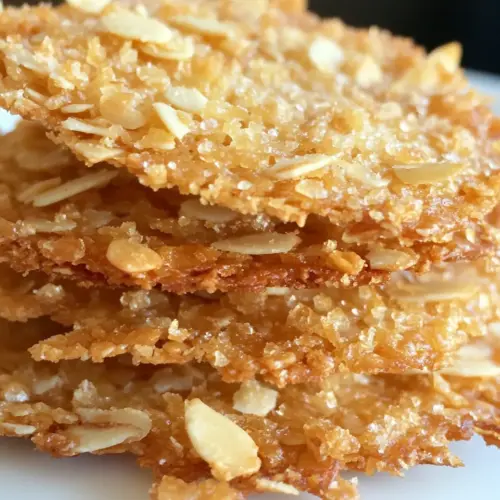
Almond Lace Cookies
Almond Lace Cookies are thin, crisp cookies with a toasted almond crunch and browned butter depth. Lightly sweet and lacy, they deliver a delicate snap and caramel notes, perfect for tea time or gifting. An easy, crowd friendly treat that looks impressive yet comes together quickly, worth making whenever you want an elegant homemade cookie.
Equipment
- Medium Saucepan
- Baking Sheet
- Parchment Paper
- Wire Rack
- Spatula
Ingredients
- 2/3 cup (151.33 g) unsalted butter Creamed to provide richness and a tender, buttery base that helps bind and spread the lace cookies during baking; contributes a golden flavor and crisp edges when melted in the hot oven.
- 1 cup (220 g) light brown sugar Sweetened and moistened to caramelize and create the signature lacy texture; contributes deep, molasses-like notes that enhance color and chewiness when combined with butter.
- 1/4 cup (85.25 ml) light corn syrup Sweetened syruped to increase chewiness and help dissolve sugar for a glossy, thin batter; stabilizes the cookie structure and promotes the delicate, spread-out lace pattern.
- 1 tablespoon whole milk Added to loosen the batter and provide a touch of dairy richness; helps achieve the right consistency so the mixture spreads thinly and bakes evenly into crisp cookies.
- 1/4 teaspoon (0.25 teaspoon) salt Balanced to enhance overall flavor and control sweetness while strengthening the gluten network slightly; prevents the cookies from tasting flat and rounds out sweetness.
- 1 1/2 cups (121.5 g) old-fashioned rolled oats Textured to give body and hearty chewiness while forming the lacy holes as oats toast and crisp; contributes whole-grain flavor and structural integrity to the thin cookies.
- 2 tablespoons all-purpose flour Thickening to absorb some moisture and provide structure so the lace cookies hold their shape; helps moderate spread for a slightly firmer, more stable cookie.
- 2 teaspoons vanilla extract Aromatic to infuse warm, sweet vanilla notes that complement the caramelized sugars and nuts; enhances overall flavor complexity without altering texture.
- 1/2 cup (118.29 g) toasted, finely chopped almonds Crunchy and nutty to add toasted almond flavor and crisp texture; dispersed finely to create even nutty bites and deepen the cookie’s flavor profile.
Instructions
- Preheat oven to 375 degrees F; adjust oven rack to the upper third of the oven. Line baking sheet with parchment paper; set aside.: You will notice a warm, anticipatory smell in the kitchen as the oven comes to temperature, and placing the rack in the upper third helps the edges brown quickly while the centers remain lacy. Using parchment paper prevents sticking and encourages even spreading, and a light tap of the baking sheet will tell you it is ready. A common mistake is preheating on the wrong rack which can result in underbaked centers or burnt edges, so double check your oven rack position before starting.
- Bring the butter to a boil in a medium saucepan over medium heat. Reduce the heat so the butter slows to a gentle boil, stirring occasionally, for 3 to 4 minutes, or until the solids on the bottom of the pan turn light brown. Remove from heat.: As the butter comes to a boil you will hear a soft bubbling and begin to smell nutty, caramel notes; that is your cue. Stir occasionally to keep the milk solids moving, and watch the bottom of the pan for pale brown bits which indicate the butter is properly browned. If you let it go too long it will turn dark and bitter, which is the most frequent error here, so remove it as soon as the color is right and transfer it off the heat to stop the cooking process.
- Add the brown sugar, corn syrup, milk and salt to the butter and stir to blend well. Stir in the oats, flour and vanilla, then fold in the almonds.: Right after removing the pan from heat, add the light brown sugar , light corn syrup , whole milk , and salt , and stir until the mixture becomes glossy and uniform. You will feel the warm syrupy texture and smell deep caramel. This step dissolves the sugar into the butter base, which is essential for smooth cookies. If the sugar does not fully dissolve, your cookies can be gritty, so take a moment to stir until smooth.
- Drop teaspoons of the batter onto the baking sheets, spaced about 3 inches apart. Bake for 6 to 8 minutes, or until the cookies are golden brown all over and slightly darker at the edges. Transfer the baking sheets to a cooling rack and let sit until the cookies firm up, about 5 minutes. Using a spatula, gently transfer the cookies to wire racks until cool. Store the cookies in an airtight container at room temperature for 2 weeks, or freeze for up to 2 months.: When you add the old-fashioned rolled oats , all-purpose flour , and vanilla extract , the batter will thicken and become more matte, with flecks of oats visible. Folding in the toasted almonds last preserves their crunch and even distribution. The texture should be cohesive but slightly loose; if it seems too stiff, a tiny splash more milk can help. Be careful not to overmix, which can break down the oats and change the texture.
- Drop teaspoons of the batter onto the baking sheets, spaced about 3 inches apart.: As you spoon the batter, you will hear a soft plop and see small glossy domes form that will spread thin as they bake. The spacing is important because the cookies spread dramatically into lacy rounds. A typical trap is crowding the pan, which causes cookies to merge; keep ample distance to protect that delicate lacework. If the batter stiffens while you are scooping, let it sit for a moment to loosen up from residual heat.
- Bake for 6 to 8 minutes, or until the cookies are golden brown all over and slightly darker at the edges.: In the oven the cookies will hiss faintly, and within minutes you will see them flatten and the edges become deeply golden. The scent will shift from buttery to toasted and sweet. Pull them when they are uniformly golden, with slightly darker rims, because underbaking leaves them soft and overbaking makes them too brittle. Ovens vary, so watch closely in the last minute to hit the perfect shade.
- Transfer the baking sheets to a cooling rack and let sit until the cookies firm up, about 5 minutes.: When removed from the oven the cookies will continue to set on the hot sheet, and you will feel the gentle steam as they cool. Letting them rest on the sheet helps them hold their lacy shape while they finish crisping. A common mistake is trying to move them too soon, which can tear the delicate edges, so be patient for about 5 minutes until they are stable to touch.
- Using a spatula, gently transfer the cookies to wire racks until cool.: Slide a thin spatula under each cookie for a confident lift, and lay them out on a wire rack to cool fully so air circulates and prevents sogginess. The final texture will be crisp and the aroma fully developed as they reach room temperature. If you stack them while warm you risk condensation and loss of crispness, so only stack once completely cool.
- Store the cookies in an airtight container at room temperature for 2 weeks, or freeze for up to 2 months.: When stored correctly the cookies keep their crispness and flavor; I like to separate layers with parchment to protect the lacy edges. At room temperature they remain enjoyable for about two weeks, and in the freezer they retain quality for up to two months. A frequent storage error is using a container that is not airtight, which lets humidity in and makes the cookies soft, so seal tightly.
Notes
- Smaller or larger cookies: If you prefer bite size, use a half teaspoon to make petite cookies; for a dramatic plated cookie use a tablespoon but be aware larger cookies will spread more and may need a touch more flour to hold shape.
- Adjusting sweetness: Use slightly less light brown sugar if you want a less sweet cookie; remember that brown sugar also affects moisture and spread, so reduce by no more than 10 percent and test one sheet first.
- Nut swap considerations: If you replace the almonds with another toasted nut, chop them finely to match texture so the lace pattern remains intact and the distribution feels balanced.
- Make ahead tips: You can toast and chop the almonds and premeasure dry ingredients a day ahead, keeping them sealed; mix and bake on demand for freshest texture.
- Presentation ideas: For a special occasion, sandwich two cooled cookies with a thin spread of soft filling; choose a light filling because these cookies are delicate and too heavy a filling will cause collapse.