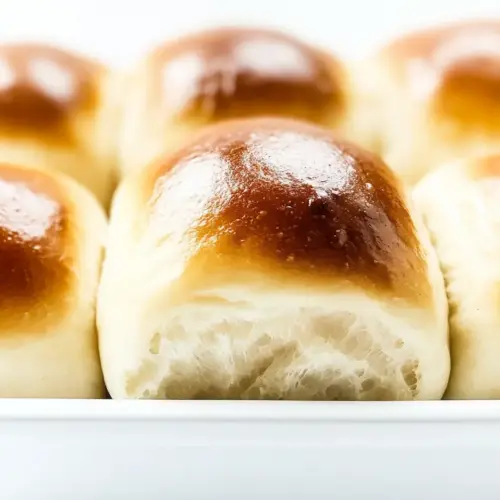
1 Hour Rolls
1 Hour Rolls are soft, buttery, and surprisingly quick, offering a tender crumb and golden top with minimal fuss. This easy bread uses rapid rise yeast and warm milk to speed proofing, making it an ideal easy weeknight dinner or last minute gathering bake. Make them for a crowd and enjoy the comforting aroma and melt in your mouth texture.
Equipment
- Mixer with dough hook
- 9×13 baking pan
- Mixing Bowls
- Kitchen Scale
- Measuring Cups and Spoons
Ingredients
- 3 1/2 cups all-purpose flour Provides structure and body to the dough, forming the gluten network when hydrated and kneaded; helps create the tender crumb and chew expected in soft rolls. Measures accurately for consistent dough hydration and rise times.
- 3 tablespoons granulated sugar Adds sweetness and feeds the yeast for fermentation, promoting browning and a slightly sweet flavor in the crust; helps tenderize the crumb by interacting with gluten and starch. Dissolves into the liquid for even distribution throughout the dough.
- 1 tablespoon rapid rise yeast Leavens the dough quickly by producing carbon dioxide when activated in warm liquid, enabling the rolls to rise within an hour; choose rapid rise yeast for a fast, reliable fermentation. Mixes evenly with the dry ingredients or rehydrated in milk for best activation.
- 1 1/2 teaspoons salt Enhances flavor and controls fermentation rate, strengthening gluten and balancing the overall taste; helps regulate yeast activity so the dough doesn't overproof. Sprinkle or mix into dry ingredients to ensure even seasoning throughout the dough.
- 1 1/4 cup milk, warmed Hydrates flour to form the dough and activates yeast while contributing milk solids for a richer flavor and softer crumb; warmed milk helps speed yeast activation for a quicker rise. Use at the right temperature to avoid killing yeast while promoting fermentation.
- 6 tablespoons unsalted butter, melted and divided Adds richness, flavor, and tenderness to the rolls; melted butter improves dough softness and contributes to browning. Reserve some melted butter for brushing the tops after baking to impart shine and extra flavor.
Instructions
- Set the oven to warm or alternately as low as you can set it if you don’t have a warm option, about 170 degrees Fahrenheit. Lightly spray a 9×13 pan with pan spray and set it aside.: You will sense a gentle warmth when the oven is right, not hot or stifling. This low heat gives the dough a friendly environment to begin proofing, so the yeast wakes up steadily instead of rushing and collapsing. If your oven does not have a warm setting, the lowest temperature works fine, and you can test with your hand near the glass to confirm a steady gentle heat. A common mistake is making the oven too hot, which can start baking the outside of the dough and prevent proper rising. The pan should feel neutral to the touch after spraying, and arranging the rack in the center ensures even warmth. Use a 9×13 pan so the rolls have enough surface contact to support rising, and avoid thicker pans that trap too much heat close to the metal.
- In the bowl of your mixer whisk together the flour, sugar, yeast, and salt.: As you whisk, notice the dry mixture take on a uniform pale hue and a fine texture. Combining these dry ingredients evenly ensures the rapid rise yeast is distributed so every roll rises consistently. If you detect clumps, break them up with the whisk so the dough will hydrate uniformly. A frequent error is adding ingredients in a haphazard way, which can leave pockets of yeast or salt and lead to uneven proofing. Take a moment to sift or whisk thoroughly, and you will see a smooth, homogenous mix that smells faintly of flour and sugar.
- In another bowl combine the warm milk and 4 tablespoons of melted butter. Using the dough hook on low, slowly add the liquid to the dry ingredients. Knead the dough for about 4 minutes or so, until it is smooth and elastic. If the dough is still very sticky, add more flour 1-2 tablespoons at a time.: When you pour the warm milk and melted butter into the dry mix, the scent of butter becomes noticeable and the dough starts to cohere. Using the dough hook on low prevents overworking the gluten while encouraging development; you should hear a steady light whir as the dough cleans the bowl sides. After about four minutes the dough should feel springy and slightly tacky, and visually it will smooth out with small air pockets forming. If it remains sticky after kneading, add a tablespoon or two of all purpose flour sparingly; too much flour will dry the dough. Avoid kneading at high speed, because that can heat the dough and tighten gluten excessively, creating a firmer crumb. A common trap is to stop kneading too soon, leaving dough shaggy and unable to hold shape. Keep kneading until you can press the surface lightly and see a slight bounce back.
- Once you have achieved a smooth dough, cover the bowl and let rest for about 5-10 minutes.: During this brief rest the dough relaxes and develops subtle air pockets, and the surface will lose some tackiness. You will notice a calmer texture when you come back to it, and it becomes easier to divide and shape. Covering traps gentle humidity so the dough does not form a dry skin. A usual error is letting it rest too long at warm temperature, which can overproof the dough and make shaping difficult. Set a timer for about five to ten minutes and check for a slightly puffed look, not a fully doubled size, before proceeding.
- Once the dough has rested, turn it out onto a lightly floured surface and divide the dough as evenly as you can into 15 pieces. I like to use a kitchen scale so I can get them equal in size. Weigh the whole ball of dough in grams and then divide it by 15. That’s the weight each roll should be. Shape each piece into a ball and pinch the dough together on the bottom.: The dough will feel soft and slightly tacky as you portion it. If you use a scale you will get perfectly uniform rolls that bake evenly, otherwise aim for similar sizes by eye. Shaping into tight balls creates surface tension which helps the rolls rise upward instead of spreading outward. You should hear a faint whisper of dough moving as you cup and roll each piece; the bottom seam needs to be sealed by pinching to preserve shape. Beginners sometimes handle the dough too roughly, deflating the air pockets you worked to create. Be gentle, and if a piece seems under tension, re-roll lightly to create the smooth dome that bakes into a golden top.
- Place the dough balls into the baking pan and use your fingers to rub a little bit of water over the tops of the balls so they don’t dry out while baking. Transfer to the warm oven and let rise for 20 minutes, or up to 30 minutes if they have not doubled in size after 20. I find it can be helpful to use a spray bottle to spray the bottom of the oven to create steam to help the rolls rise faster.: Arranging the balls in the pan, you will feel them nudge each other, promising tender sides. Lightly wetting the tops prevents crusting during the rise and keeps the surface supple. As they proof in the warm oven you will see them swell and press against each other, softening and becoming pillowy. If you do not observe a noticeable increase after 20 minutes, give them a few more minutes; sometimes colder ingredients slow the rise. A common mistake is overproofing so the rolls collapse in the oven; watch for a gentle doubling rather than a runaway puff. If your oven is dry, a quick spray at the bottom adds humid heat that fosters a lively rise and a fine crumb structure.
- Remove the risen rolls from the oven and bump the heat up to 375 degrees Fahrenheit. As soon as the oven has preheated, bake the rolls for 16-18 minutes, until the tops are golden brown. Brush with melted butter as soon as they come out of the oven.: The transition from warm proof to active baking is audible as the oven temperature climbs, and the smell changes from yeasty to sweet and toasty. During baking you will see the tops turn from pale to glossy to a rich golden hue; that color and a light hollow sound when tapped indicate doneness. Brushing with the reserved melted unsalted butter right after baking gives a soft sheen and an extra layer of flavor. A common pitfall is removing them too early, which leaves a dense center, or leaving them just a touch too long so the outer crust becomes firm. Aim for a uniform golden brown and rotate the pan if your oven has hot spots to achieve even color.
Notes
- Weigh for uniformity Use a kitchen scale to divide the dough into 15 equal portions, this ensures even baking and consistent texture across the tray.
- Milk temperature matters Aim for warm milk that feels like a warm bath, not hot, to safely activate the rapid rise yeast and preserve its strength.
- Butter strategy Reserve two tablespoons of the melted unsalted butter for brushing after baking, it gives the rolls a glossy finish and an inviting aroma.
- Watch proofing times Keep an eye on volume rather than strict minutes, because ambient temperature affects how quickly the rolls rise.
- Fix sticky dough gently Add flour a tablespoon at a time if needed, and knead briefly between additions to avoid over-drying the dough.
- Reheat carefully To refresh leftovers, wrap in foil and warm at low oven temperature for a few minutes to restore softness without drying the crumb.